First 50k Ultra Training Plan: 16 Weeks on Trail
A 16-week plan for your first 50k trail ultra: five runs a week, peak 7.5 hours, long runs to 3.5 hours with power hiking and back-to-backs. Free.

A first 50k trail plan runs 16 weeks at five runs a week, peaks at about 7.5 hours of running, and builds the long run to 3.5 hours with a back-to-back run the next day. It is written in time and effort, not pace. It fits runners who have finished a marathon or regularly run two hours on trail, and train 3 to 5 hours a week now.
The 16 weeks
Sample plan · 50k trail ultra, first ultra
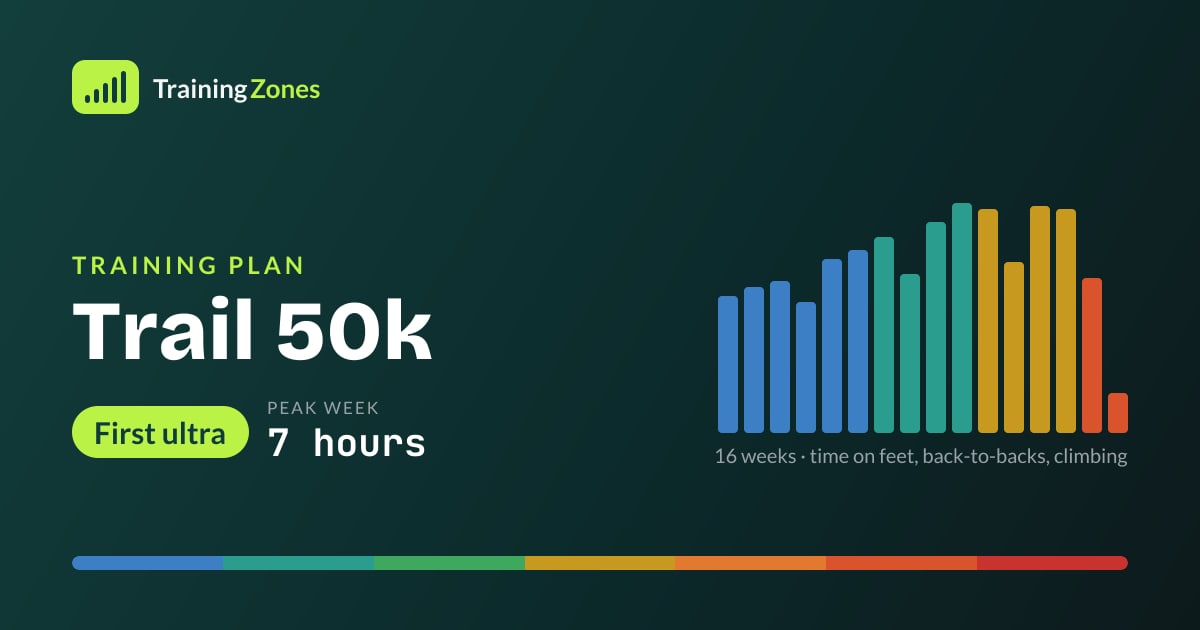
16 weeks, 5 runs a week, peak week 7h 21m, longest run 3h 30m, up to 1200 m of climbing a week for a race with 1500 m. 88 % of the running is easy.
| Week | Time | Key sessions | Long run |
|---|---|---|---|
| 1 Base | 4h 25m · 300 m | Easy running only | 1h 40m long run |
| 2 Base | 4h 44m · 350 m | Easy running only | 1h 50m long run with power hiking |
| 3 Base | 4h 52m · 750 m | Hill repeats: 4 × 3 min I (3 min jog) | 1h 55m long run |
| 4 Base, recovery | 4h 09m · 400 m | Long hill intervals: 3 × 6 min T (4 min jog) | 1h 30m long run with power hiking |
| 5 Base | 5h 33m · 800 m | Hill repeats: 4 × 3 min I (3 min jog) | 2h 05m long run |
| 6 Base | 5h 51m · 850 m | Hill fartlek: 7 × 90 s I (90 s jog) | 2h 20m long run with power hiking |
| 7 Build | 6h 19m · 1000 m | Hill repeats: 4 × 3 min I (3 min jog) | 3h long run with power hiking |
| 8 Build, recovery | 5h 03m · 400 m | Long hill intervals: 3 × 6 min T (4 min jog) | 2h 25m long run, steady finish |
| 9 Build | 6h 48m · 1150 m | Hill repeats: 5 × 3 min I (3 min jog) | 3h 20m long run with power hiking |
| 10 Build | 7h 21m · 1200 m | Hill fartlek: 8 × 90 s I (90 s jog) | 3h 30m long run, steady finish |
| 11 Peak | 7h 09m · 1200 m | Hill repeats: 5 × 3 min I (3 min jog) | 3h 30m race rehearsal |
| 12 Peak, recovery | 5h 27m · 500 m | Long hill intervals: 3 × 6 min T (4 min jog) | 2h 40m long run, steady finish |
| 13 Peak | 7h 15m · 1200 m | Hill repeats: 5 × 3 min I (3 min jog) | 3h 30m race rehearsal |
| 14 Peak | 7h 11m · 1200 m | Hill fartlek: 10 × 90 s I (90 s jog) | 3h 30m longest run: race rehearsal |
| 15 Taper | 5h 02m · 750 m | Hill repeats: 4 × 3 min I (3 min jog) | 2h 25m long run |
| 16 Taper | 1h 17m + race | Race day | None, race week |
The sample runner has five days a week and a race with 1,500 m of climbing:
- Base, weeks 1 to 6. 4.4 to 5.9 hours a week. The long run grows from 1 h 40 to 2 h 20, every second one with power hiking. A hill session starts in week 3: 4 × 3 minutes uphill, 3 × 6 minutes at threshold effort, hill fartlek.
- Build, weeks 7 to 10. 6.3 to 7.4 hours. Long runs of 3 to 3.5 hours, some with a steady finish, and a back-to-back of 75 to 85 minutes the next day.
- Peak, weeks 11 to 14. Three race rehearsals of 3.5 hours in race kit with race food, around a lighter week 12. Weekly climbing reaches 1,200 m.
- Taper, weeks 15 and 16. Five hours, then race week with two short runs.
Who this plan is for
Ultra levels come from experience, not a finish time, because trail finish times depend on the course. First ultra means a marathon or long trail runs behind you and 3 to 5 hours of running a week today. The plan starts at about 4.4 hours.
No race time is needed. Every session is minutes at an effort you can feel: easy, steady, threshold or hard. Add your max heart rate and each effort gets a heart-rate range.
The weekend does the work
A first ultra is mostly a question of going further than before. The plan answers it with time on feet, stacked on the weekend.
The long run and the back-to-back the day after carry about two thirds of the peak week. The long run teaches your body to keep going for hours. The back-to-back teaches it to start again on tired legs, which is what the second half of a 50k feels like. Back-to-backs are common coaching practice rather than something trials have tested, so the plan keeps them modest: 75 to 85 minutes, easy.
Three skills get rehearsed on those weekends:
- Hiking the steep parts. Walking costs less energy than running on climbs steeper than about 16 degrees (Giovanelli 2016). Every second long run includes power hiking.
- Eating on the move. Every run of two hours or more carries the ISSN target: 30 to 50 g carbohydrate and 450 to 750 mL fluid per hour.
- Race kit. The peak long runs are rehearsals: race shoes, race vest, race food.
The weekdays stay short. One hill session, two easy runs with strides or hill sprints. 88 % of the running is easy.
Your own plan
The 50k ultra training plan generator builds your plan from your race date or number of weeks, your running days, your long-run day, your experience and the race's total climb. Every session shows its time, effort, climbing and purpose. Free, no email, PDF included.
FAQ
Can I run a 50k on four days a week? Yes. On four days the plan keeps the long run, the back-to-back, the hill session and one easy run, and the easy days carry less.
How long should my longest run be before a first 50k? 3.5 hours in this plan, three times in the peak phase, each followed by a back-to-back. That is less than the race, on purpose: the race day adds the rest on fresh legs.
Do I need poles? Only if the race allows them and you train with them. Practise on the long runs with power hiking first.
What if my race has more climbing? Enter its total climb. Weekly climbing builds toward 80 % of it for a first ultra.
Plan your race fuelling:
Target carbs
60g/h
Per hour of exercise
Total carbs
120g
Across your 2-hour session
Recommended carbohydrate by session length
| Under 1 hourWater is usually enough | 0 g/h |
| 1 to 2.5 hoursRecommendedSingle transportable carb (glucose) | 60 g/h |
| 2.5 hours or longerGlucose plus fructose, near a 2:1 mix | 90 g/h |
- Pair carbohydrate with fluid and sodium. Concentrated fuel without enough water sits in the gut and causes discomfort.
- Tolerating high carbohydrate rates is a trainable skill. Practice your race fueling in long sessions and build up gradually, never try a new high intake on race day.
- Above 60 g per hour, use a glucose-to-fructose mix near 2:1. Glucose alone saturates the gut transporter at about 60 g per hour.
- Hard efforts burn carbohydrate faster, so sit toward the top of each range.
A PDF of your personalized results, with a QR code to reopen them anytime.
More in this series: the experienced and competitive 50k plans, the first 100k / 50 mile plan, and the beginner marathon plan.
Sources
- Tiller et al. 2019, ISSN position stand on ultra-marathon nutrition
- Giovanelli et al. 2016, energetics of steep uphill running and walking
Cover image: TrainingZones.