Beginner Half Marathon Training Plan: 12 Weeks, Built for Sub-2
A 12-week beginner half marathon plan for 2:00 to 2:30 finishers: four runs a week, peak 39 km, a 13 km long run and race-pace practice. Free.

A beginner half marathon plan runs 12 weeks at four runs a week, peaks at about 39 km, and builds the long run to 13 km. It fits runners whose fitness predicts a 2:00 to 2:30 half marathon: roughly a 26 to 33 minute 5k, or a 10k between about 54 and 68 minutes. The band ends at two hours, so this is the plan for breaking 2:00, at 5:41 per km.
The 12 weeks
Sample plan · Beginner half marathon
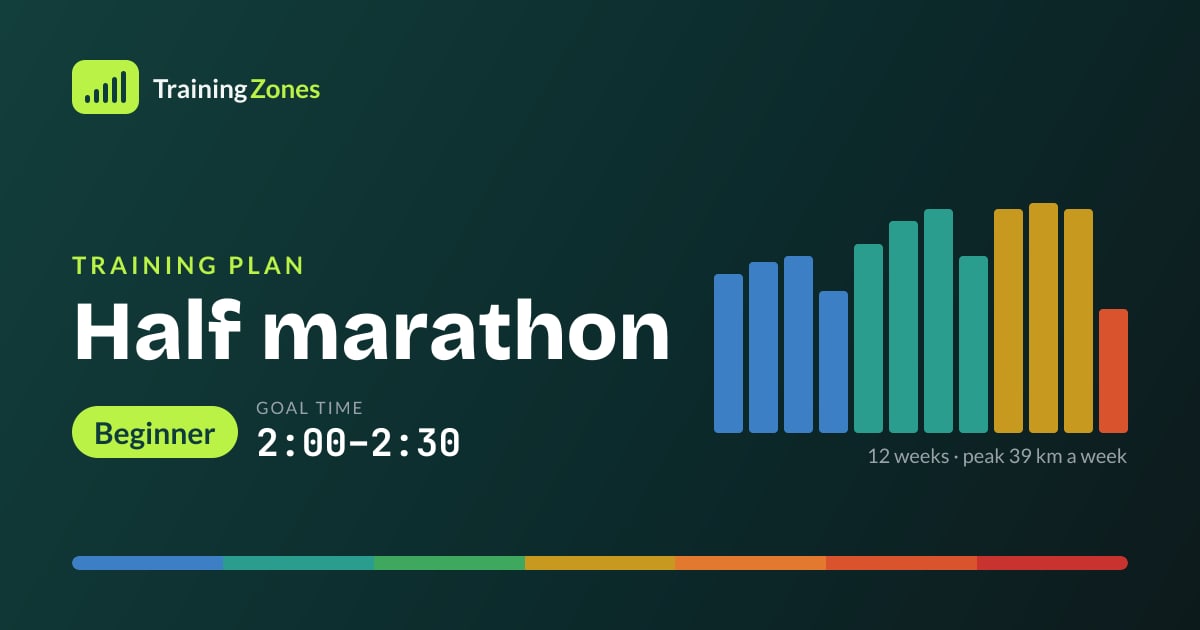
12 weeks, 4 runs a week, peak 39 km, longest run 13 km. Built for a recent 5k of 27:00 (VDOT 35.0). 79 % of the running is easy.
| Week | Km | Key sessions | Long run |
|---|---|---|---|
| 1 Base | 27 | Easy running only | 9 km long run |
| 2 Base | 29 | Easy running only | 10 km long run + strides |
| 3 Base | 30 | Tempo run: 15 min T | 10 km long run |
| 4 Base, recovery | 24 | Progression run: 8 min M · 8 min T | 8 km long run |
| 5 Build | 32 | Cruise intervals: 3 × 1.6 km T (1 min jog); Long intervals: 3 × 3 min I (3 min jog) | 11 km long run |
| 6 Build | 36 | Tempo run: 15 min T; 30/15 sets: 2 × (13 × 30 s I / 15 s jog), 3 min between sets | 12 km progressive long run |
| 7 Build | 38 | Broken tempo: 2 × 9 min T (2 min jog); 5k time trial | 13 km long run |
| 8 Build, recovery | 30 | Progression run: 14 min M · 14 min T; 1000 m repeats: 3 × 1000 m I (400 m jog) | 11 km long run |
| 9 Peak | 38 | Half-marathon pace reps: 2 × 3 km race pace (2 min jog); Long intervals: 3 × 3 min I (3 min jog) | 13 km long run with marathon-pace finish |
| 10 Peak | 39 | Race-pace run: 5 km race pace; 30/15 sets: 2 × (13 × 30 s I / 15 s jog), 3 min between sets | 13 km progressive long run |
| 11 Peak | 38 | Half-marathon pace reps: 2 × 3 km race pace (2 min jog); Hill repeats: 7 × 75 s I (2 min jog) | 13 km long run with marathon-pace finish |
| 12 Taper | 21 + race | Sharpener: 4 × 2 min race pace (2 min jog); race day | None, race week |
- Base, weeks 1 to 4. From 27 to 30 km a week, long runs of 9 and 10 km. One quality session from week 3: a 15-minute tempo, then an 8-minute marathon-pace plus 8-minute threshold progression.
- Build, weeks 5 to 8. Up to 38 km. Two quality days: threshold (cruise intervals, broken tempo) and a small VO2max dose such as 3 × 3 minutes or 30/15 sets. A 5k time trial in week 7 checks your progress. Long runs reach 13 km.
- Peak, weeks 9 to 11. Half-marathon pace arrives: 2 × 3 km, then a continuous 5 km, then 2 × 3 km again. Long runs stay at 13 km and finish with 4 to 7 km at marathon pace.
- Taper, week 12. About half the volume, in line with the 41 to 60 % cut Bosquet's meta-analysis found works best. Four 2-minute race-pace pickups keep you sharp.
Who counts as a beginner
Beginner means your current fitness, measured with Jack Daniels' VDOT: one number from a recent race that sets every training pace and predicts your half. The beginner band is a predicted half slower than 2:00. Breaking two hours takes VDOT 36.5. Once you are there, the intermediate plan takes over. The sample runner has a 27:00 5k, VDOT 35, which predicts 2:04.
| Half marathon finish | Race pace | Easy | Marathon | Threshold | Interval |
|---|---|---|---|---|---|
| 2:00 | 5:41 | 6:18–7:31 | 5:52 | 5:29 | 5:02 |
| 2:15 | 6:24 | 7:01–8:21 | 6:34 | 6:08 | 5:38 |
| 2:30 | 7:07 | 7:45–9:12 | 7:16 | 6:47 | 6:14 |
Half-marathon pace sits between threshold and marathon pace. That is why the plan trains both.
No recent race? Choose the beginner level in the generator and run the 5k time trial in week 1. Your paces appear once you enter the result.
Why race-pace practice matters for beginners
A pace you have never practised feels easy for the first kilometres. It creeps up, and the second half pays for it. The fix is not more fitness, it is a pace your body already knows.
The peak phase gives you three sessions at half-marathon pace, 17 km of it in total. Run them on the watch the first time and by feel the third time. On race day the same effort should feel familiar.
The rest of the plan protects the consistency that gets you there:
- 79 % easy. Seiler found well-trained endurance athletes settle on about 80 % of sessions at low intensity. Easy days are where the aerobic engine grows.
- Small, steady increases. Weekly km never rise more than 10 % between loading weeks. Nielsen (2014) found runners who added more than 30 % over two weeks got injured more often.
- Recovery in weeks 4 and 8, at about 75 % volume.
Build your own plan
The sample is one runner with four free days. The half marathon training plan generator uses your recent race, your weeks until race day, your running days and your long-run day, and gives every session your own pace. Add a goal like 1:59 to see it next to what your race predicts. It is free, needs no account, and exports a PDF.
FAQ
Can a beginner train for a half marathon in 12 weeks? Yes, if you run about 20 km a week now. The plan never starts below half its peak, so build to 20 km first if you are lower. With more time, pick a longer plan: the generator allows 10 to 24 weeks.
How long should my longest run be before a half marathon? 13 km in this sample, about 90 minutes. The half-marathon long run is capped at 35 % of the week. Longer runs add fatigue without adding much for a race this length.
What pace do I need for a sub-2 half marathon? 5:41 per km. A 5k of 26:04 or a 10k of 54:07 predicts it.
Do I need to run more than four days a week? No. On three days the peak target stays at 40 km, with longer runs. Four days makes each run shorter and easier to recover from.
Only need your training paces? Enter a recent race:
VDOT
49.8
Daniels running fitness score
| Zone | Range | What it trains |
|---|---|---|
| E | Easy / Long 4:54–5:53 /km | Aerobic base, capillaries, fat metabolism; most weekly volume. RPE 3–4, conversational. |
| M | Marathon 4:26–4:51 /km | Marathon-specific endurance and economy. RPE 5–6, steady. |
| T | Threshold 4:16–4:28 /km | Lactate threshold; comfortably-hard tempo and cruise intervals. RPE 7, ~1h race effort. |
| I | Interval 3:51–4:01 /km | VO₂max; 3–5 min hard reps. RPE 9, hard. |
| R | Repetition 3:19–3:42 /km | Speed, economy and running power; short fast reps with full recovery. RPE 9–10, fast and controlled. |
E · Easy / Long. Aerobic base, capillaries, fat metabolism; most weekly volume. RPE 3–4, conversational.
M · Marathon. Marathon-specific endurance and economy. RPE 5–6, steady.
T · Threshold. Lactate threshold; comfortably-hard tempo and cruise intervals. RPE 7, ~1h race effort.
I · Interval. VO₂max; 3–5 min hard reps. RPE 9, hard.
R · Repetition. Speed, economy and running power; short fast reps with full recovery. RPE 9–10, fast and controlled.
- Your VDOT of 49.8 is a single number that captures current running fitness (a 'VO₂max' adjusted for running economy). Every training pace is derived from it.
- VDOT comes from one recent, hard race or time trial. Use a result you raced all-out, ideally 5 km or longer; a half-marathon or 10 km gives the most stable estimate.
- Switch the units toggle to read paces per mile. As you get fitter, re-race; your VDOT and all paces will update.
- These are Daniels’ discrete training paces (E, M, T, I, R), not continuous zones: you run at each one for a specific purpose. The gaps between the harder paces (T, I and R) are intentional, not a glitch.
A PDF of your personalized results, with a QR code to reopen them anytime.
More in this series: the intermediate, advanced and sub-elite half marathon plans, the beginner 10k plan and the beginner marathon plan.
Sources
- Seiler 2010, training intensity distribution
- Nielsen et al. 2014, weekly distance progression and injury
- Bosquet et al. 2007, tapering meta-analysis
Cover image: TrainingZones.