Sub-Elite Half Marathon Training Plan: 12 Weeks for 1:10 to 1:20
A 12-week sub-elite half marathon plan for 1:10 to 1:20 runners: six runs a week, peak 95 km, 9 km race-pace runs at almost exactly threshold pace.

A sub-elite half marathon plan runs 12 weeks at six runs a week, peaks at about 95 km, and puts 9 km of race-pace running into every peak week. It fits runners whose fitness predicts a 1:10 to 1:20 half: roughly a 15:15 to 17:30 5k, or a 10k between about 32 and 36 minutes.
The 12 weeks
Sample plan · Sub-elite half marathon
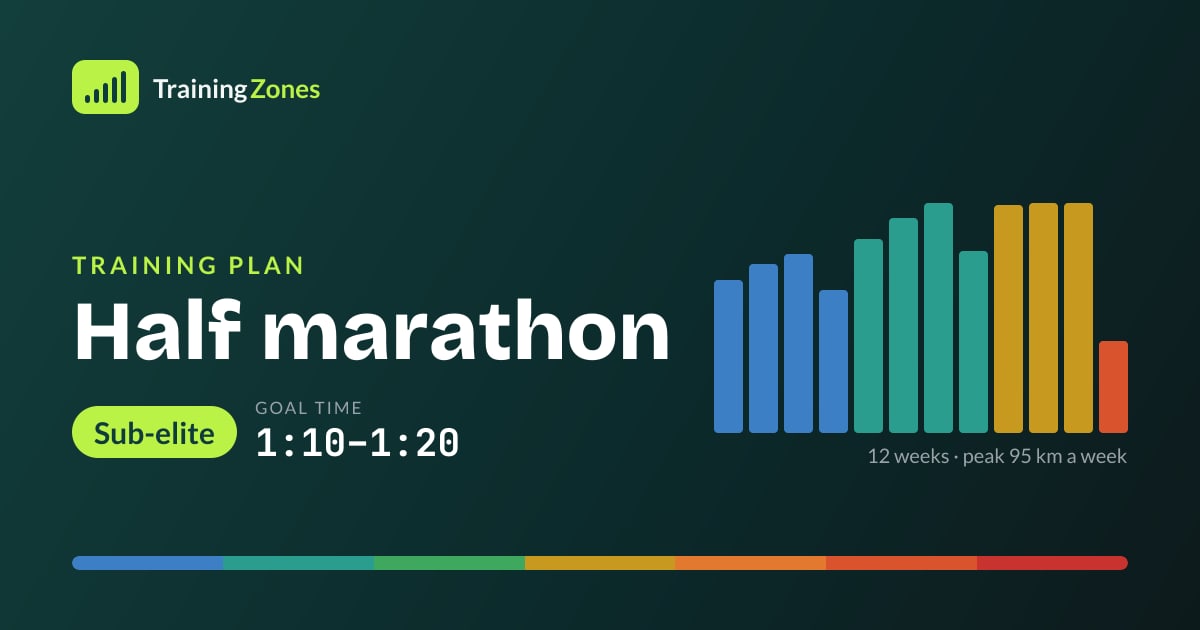
12 weeks, 6 runs a week, peak 95 km, longest run 23 km. Built for a recent 5k of 16:00 (VDOT 64.6). 84 % of the running is easy.
| Week | Km | Key sessions | Long run |
|---|---|---|---|
| 1 Base | 63 | Easy running only | 22 km long run |
| 2 Base | 70 | Easy running only | 23 km long run + strides |
| 3 Base | 74 | Tempo run: 20 min T | 22 km long run |
| 4 Base, recovery | 59 | Progression run: 16 min M · 16 min T | 21 km long run |
| 5 Build | 80 | Cruise intervals: 5 × 1.6 km T (1 min jog); Long intervals: 5 × 4 min I (4 min jog) | 22 km long run |
| 6 Build | 89 | Tempo run: 30 min T; 30/15 sets: 3 × (13 × 30 s I / 15 s jog), 3 min between sets | 22 km progressive long run |
| 7 Build | 95 | Broken tempo: 3 × 11 min T (2 min jog); 5k time trial | 22 km long run |
| 8 Build, recovery | 75 | Progression run: 26 min M · 26 min T; 1000 m repeats: 5 × 1000 m I (400 m jog) | 22 km long run |
| 9 Peak | 94 | Half-marathon pace reps: 3 × 3 km race pace (2 min jog); Long intervals: 4 × 3 min I (3 min jog) | 22 km long run with marathon-pace finish |
| 10 Peak | 95 | Race-pace run: 9 km race pace; 30/15 sets: 2 × (13 × 30 s I / 15 s jog), 3 min between sets | 22 km progressive long run |
| 11 Peak | 95 | Half-marathon pace reps: 3 × 3 km race pace (2 min jog); Hill repeats: 12 × 75 s I (2 min jog) | 22 km long run with marathon-pace finish |
| 12 Taper | 38 + race | Sharpener: 4 × 2 min race pace (2 min jog); race day | None, race week |
- Base, weeks 1 to 4. From 63 to 74 km, long runs of 21 to 23 km from the first week. Threshold from week 3: a 20-minute tempo, then a 16-minute marathon-pace plus 16-minute threshold progression.
- Build, weeks 5 to 8. Up to 95 km. Threshold grows to 5 × 1.6 km cruise intervals, a 30-minute tempo and 3 × 11 minutes broken tempo. VO2max work runs alongside: 5 × 4 minutes, three sets of 30/15, 5 × 1000 m. A 5k time trial in week 7.
- Peak, weeks 9 to 11. Half-marathon pace: 3 × 3 km, a continuous 9 km, 3 × 3 km. Long runs of 22 km close with 4, 7, then 10 km at marathon pace.
- Taper, week 12. 38 km of training plus the race, with four 2-minute pickups at race pace.
Who counts as sub-elite
Sub-elite is the level just below professional: fast club and championship runners. Here it means a predicted half faster than 1:20, roughly VDOT 58 and up in Jack Daniels' system. A 1:15 half is VDOT 62.9 and a 1:10 half VDOT 68.1. The sample runner has a 16:00 5k, VDOT 64.6, which predicts 1:13:19.
| Half marathon finish | Race pace | Easy | Marathon | Threshold | Interval |
|---|---|---|---|---|---|
| 1:10 | 3:19 | 3:49–4:35 | 3:28 | 3:19 | 3:02 |
| 1:15 | 3:33 | 4:04–4:53 | 3:43 | 3:32 | 3:14 |
| 1:20 | 3:48 | 4:19–5:11 | 3:58 | 3:45 | 3:26 |
Compare race pace and threshold in the table. They are within 2 seconds per km of each other.
At this level, race pace is threshold
Daniels sets threshold pace at what you could race for about an hour. A sub-elite half lasts 70 to 80 minutes, so race pace and threshold pace nearly meet. At VDOT 65 threshold is 3:26 per km and half-marathon pace is 3:27.
That changes how the plan reads. Every cruise interval and tempo run in the build phase is already race-pace practice. The peak phase then extends it: 9 km per week at race pace, in one continuous run or in 3 km reps. Haugen (2022) found the same pattern in world-class runners, where race-pace volume rises as the main race approaches.
What holds it up is the easy volume underneath:
- 84 % easy. Casado (2021) found world-class distance performance is best predicted by the volume of easy running plus deliberate practice of tempo and short intervals.
- Recovery in weeks 4 and 8, at about 75 % of the loading week.
- A one-week taper, cutting volume while keeping the race-pace pickups.
Where this plan stops
The generator plans up to six runs a week and caps the half-marathon long run at 22 km. It has no doubles. At 95 km that means runs of 12 to 18 km on most days. Haugen reports world-class track runners at 130 to 190 km a week. If you already train at that volume, use the plan's quality sessions and long runs as the skeleton and add easy mileage around them.
Your plan from your race
The half marathon training plan generator builds all 12 weeks from your recent race, your weeks, your days and your long-run day. Add a goal like 1:09:59 and it shows the gap to your prediction. The week-7 time trial updates every pace. Free, no account, PDF included.
FAQ
What 10k time predicts a sub-1:10 half marathon? About 31:44, VDOT 68.1. A 5k of 15:17 predicts the same.
How many kilometres a week for a sub-1:15 half marathon? This plan peaks at 100 km on six days. A 1:15 half is VDOT 62.9, inside the sub-elite band.
Should my race-pace runs be continuous or broken into reps? Both. The plan alternates 3 × 3 km with a continuous 9 km, so you practise holding pace alone and recovering between efforts.
Can I use this plan for a half on the way to a marathon? Yes. Choose 10 to 12 weeks and race it as a tune-up, then start the marathon plan from the new result.
Only need your training paces? Enter a recent race:
VDOT
49.8
Daniels running fitness score
| Zone | Range | What it trains |
|---|---|---|
| E | Easy / Long 4:54–5:53 /km | Aerobic base, capillaries, fat metabolism; most weekly volume. RPE 3–4, conversational. |
| M | Marathon 4:26–4:51 /km | Marathon-specific endurance and economy. RPE 5–6, steady. |
| T | Threshold 4:16–4:28 /km | Lactate threshold; comfortably-hard tempo and cruise intervals. RPE 7, ~1h race effort. |
| I | Interval 3:51–4:01 /km | VO₂max; 3–5 min hard reps. RPE 9, hard. |
| R | Repetition 3:19–3:42 /km | Speed, economy and running power; short fast reps with full recovery. RPE 9–10, fast and controlled. |
E · Easy / Long. Aerobic base, capillaries, fat metabolism; most weekly volume. RPE 3–4, conversational.
M · Marathon. Marathon-specific endurance and economy. RPE 5–6, steady.
T · Threshold. Lactate threshold; comfortably-hard tempo and cruise intervals. RPE 7, ~1h race effort.
I · Interval. VO₂max; 3–5 min hard reps. RPE 9, hard.
R · Repetition. Speed, economy and running power; short fast reps with full recovery. RPE 9–10, fast and controlled.
- Your VDOT of 49.8 is a single number that captures current running fitness (a 'VO₂max' adjusted for running economy). Every training pace is derived from it.
- VDOT comes from one recent, hard race or time trial. Use a result you raced all-out, ideally 5 km or longer; a half-marathon or 10 km gives the most stable estimate.
- Switch the units toggle to read paces per mile. As you get fitter, re-race; your VDOT and all paces will update.
- These are Daniels’ discrete training paces (E, M, T, I, R), not continuous zones: you run at each one for a specific purpose. The gaps between the harder paces (T, I and R) are intentional, not a glitch.
A PDF of your personalized results, with a QR code to reopen them anytime.
More in this series: the beginner, intermediate and advanced half marathon plans, the sub-elite 10k plan and the sub-elite marathon plan.
Sources
- Haugen et al. 2022, training of world-class distance runners
- Casado et al. 2021, predictors of world-class long-distance performance
Cover image: TrainingZones.