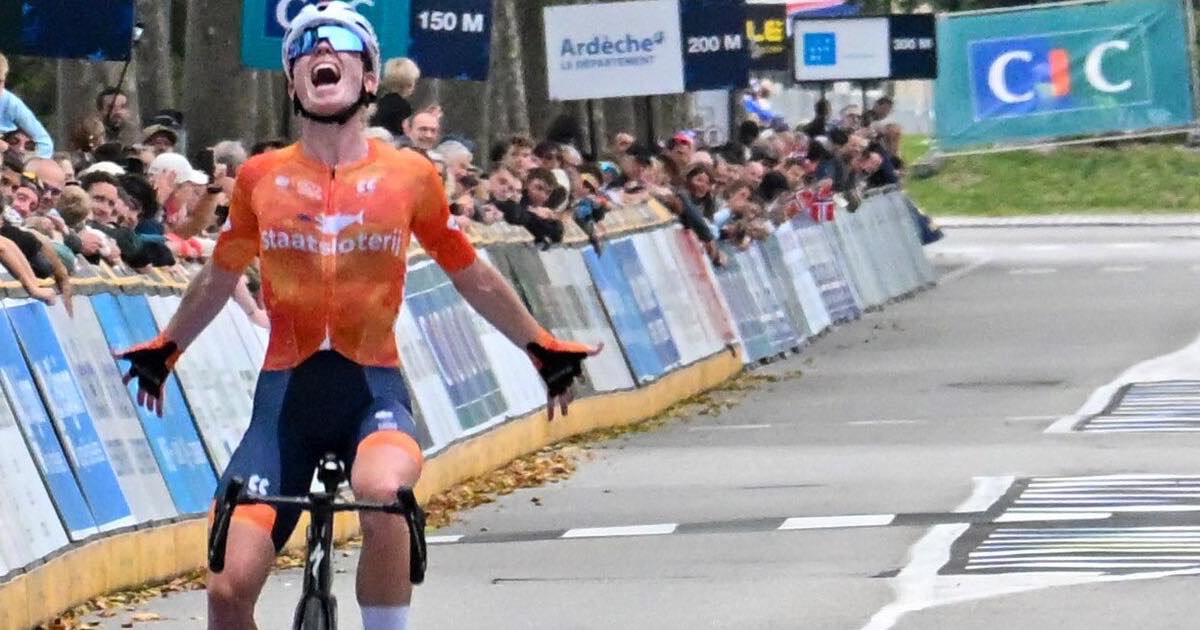
How Demi Vollering Trains (and How She Won a Second Tour de France Femmes)
Vollering cut her racing from 29 days to 18, bet on training blocks over race days, and won the 2026 Tour de France Femmes. The method, and what to steal.

Going into 2026, Demi Vollering cut her race programme from 29 days to 18, added an altitude camp, and made structured training blocks the backbone of the year. Then she won Omloop Het Nieuwsblad, the Tour of Flanders, La Flèche Wallonne, Liège-Bastogne-Liège, the Giro d'Italia Women, and in August the Tour de France Femmes, her second, sealed with a solo win on the Col d'Èze above Nice. The lesson is not a session. It's an allocation.
Fewer races, more training
In her own words:
The big difference is that my summer is calmer, without a Spanish block and with one more altitude camp before the Giro. I've got more structured training blocks around the races.
A race day is an enormous, uncontrolled stimulus that takes several days back in recovery. A training block is a specific stimulus at a dose you picked. Both draw on the same recovery budget, and most riders spend too much of it on the uncontrolled one.
Jonas Vingegaard runs the same logic: a thin race calendar so the blocks survive intact. If your season is a rolling series of hard group rides and events, you're racing, not training.
Long climbs don't lie
I love the long climbs because they don't lie. If you win there, you are the strongest.
A long climb tests sustainable power over 20 to 40 minutes. To train it you need an anchor number. Critical power comes from two efforts rather than one dreaded 20-minute test:
Critical Power
229W
W′ (anaerobic work)
12.9kJ
12857 J
| Zone | Range | What it trains |
|---|---|---|
| Z2 | Endurance ≤ 183 W | Aerobic base below CP. Easy, RPE 3–4. |
| Z3 | Tempo 183–206 W | Sub-threshold steady work. Comfortably hard, RPE 5–6. |
| Z4 | Threshold (CP) 206–229 W | Right at critical power, maximal metabolic steady state. Hard, RPE 7–8. |
| Z5 | VO₂ / W′ tapping 229–274 W | Above CP, every second draws down your W′ battery. Very hard, RPE 9. |
| Z6 | Anaerobic ≥ 274 W | Heavy W′ depletion; short maximal efforts. Maximal, RPE 10. |
Z2 · Endurance. Aerobic base below CP. Easy, RPE 3–4.
Z3 · Tempo. Sub-threshold steady work. Comfortably hard, RPE 5–6.
Z4 · Threshold (CP). Right at critical power, maximal metabolic steady state. Hard, RPE 7–8.
Z5 · VO₂ / W′ tapping. Above CP, every second draws down your W′ battery. Very hard, RPE 9.
Z6 · Anaerobic. Heavy W′ depletion; short maximal efforts. Maximal, RPE 10.
- Critical Power is the asymptote of the power–duration curve: the highest power you can sustain (in theory) indefinitely. W′ is the fixed amount of work available above CP, your anaerobic 'battery'.
- Two-parameter CP needs two maximal efforts of clearly different durations (e.g. 3 min and 12 min). Efforts too close in length give an unstable estimate.
- CP usually lands within a few percent of FTP, but it adds W′, which models how long you can stay above threshold.
A PDF of your personalized results, with a QR code to reopen them anytime.
A short maximal effort and a longer one give you the intensity you can hold in a metabolic steady state plus your anaerobic reserve above it. Everything in threshold training hangs off that number. The FTP calculator is the other route to it.
Raise the power, don't shrink the rider
After being pressed on her weight at the 2025 Tour de France Femmes, Vollering said:
I make, and will continue to make, every decision in my career by putting my health first.
She has rejected the idea that becoming the lightest rider in the peloton is her route to winning, and framed nutrition around the basics: eat properly before, during and after training, and focus on recovery.
Climbing is decided by watts per kilogram. Raising the numerator is slow, reliable and makes you a better rider. Shrinking the denominator by under-eating is fast, feels productive, and tends to take your power, recovery, hormones and bone density with it.
Training with a cycle, not against it
Vollering is one of the few riders at the top of the sport who talks openly about how her menstrual cycle interacts with training:
Just before my period comes I always feel a bit less motivated, a bit more insecure, my sleep is less good, my heart rate is a bit higher, my breathing is a bit more hard.
Those are measurable: sleep quality, resting heart rate, perceived effort at a given intensity. If they shift predictably across your cycle, a flat four-week template will misread normal fluctuation as bad form.
Log where you are in your cycle next to your usual numbers for a few months and look for the pattern. The research base is thin, so nobody can hand you a validated protocol, but your own data is enough to stop you panicking about a Tuesday that was always going to feel heavy.
What it won
She rides for FDJ United-Suez and has extended into 2028. She went into the Tour de France Femmes as the stated favourite, after finishing second in each of the previous two editions. She overturned Kasia Niewiadoma's Mont Ventoux lead in the final days and attacked alone on the Col d'Èze on the last stage to win into Nice by 1:18 overall, the first rider to win the modern Tour de France Femmes twice.
Afterwards she talked about the build-up, not the climb:
You train very hard every day, you focus on your recovery, and that's how you get better. Not taking shortcuts for short-term gain.
She called it "the whole journey leading to this moment" and tied it to health: "I don't want to force myself into corners where I don't belong. First of all, I believe you need to be a healthy version of yourself." The 2026 Vollering was not a smaller rider. She was a better prepared one.
What you can steal from it
- Spend your recovery budget on purpose. Every event is stimulus you didn't design. Fewer events and better blocks between them is usually the higher-return trade.
- Anchor training to a measured number. Critical power or FTP, tested on a schedule so you see the trend.
- Train the demand. For long climbs, the currency is sustainable 20 to 40 minute power, not sprints.
- Fix the fuelling before the physique. Under-fuelling blunts the adaptation you did the session for.
- Raise the numerator. Better W/kg by building power, not by shrinking yourself.
- Log your own patterns. For female athletes especially, a few months of personal data beats a generic template.
More in this series: Kasia Niewiadoma, who beat her on Mont Ventoux, plus Jonas Vingegaard, Tadej Pogačar, Kilian Jornet, Jakob Ingebrigtsen and Eliud Kipchoge.
Sources
Cover photo by Kakoula10, CC BY-SA 4.0, via Wikimedia Commons.
