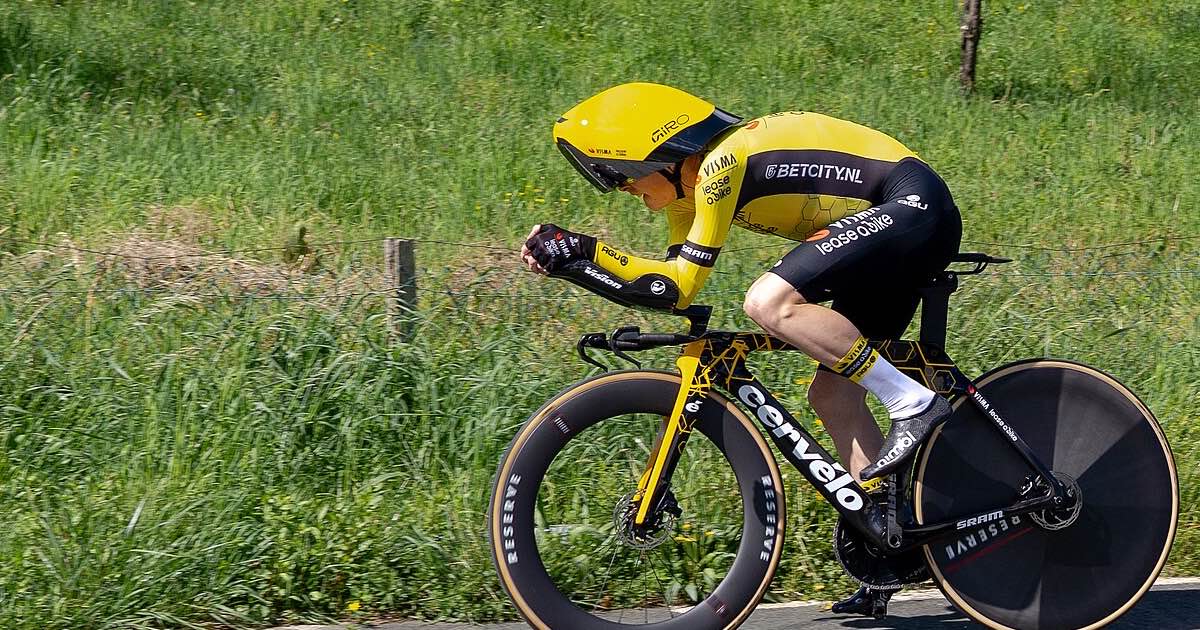
How Jonas Vingegaard Trains (and Why He Rode the Giro First in 2026)
Vingegaard's training rests on measured thresholds, few race days and years of patience. The method, the 2026 Giro-Tour change, and what to copy.
Tadej Pogačar wins races with sudden violence. Jonas Vingegaard wins them by holding a brutally high steady output for forty minutes until everyone else cracks. Vingegaard's training is narrower than Pogačar's: find the exact intensity that matters on the climbs he wants to win, measure it, and defend the conditions that let him train it week after week. In 2026 he changed the recipe, and it worked right up until it didn't.
Train the strength, not the weakness
Mathieu Heijboer, Visma's head of performance, explained that they built on what Vingegaard was already good at rather than patching what he wasn't: "If you train a lot for explosivity you lose length in your duration, and the other way around."
The adaptations behind a huge one-minute effort are not the ones that let you sit at threshold for forty minutes. So the team pointed his training at long, high, steady efforts, the demand of a 30 to 45 minute mountain pass.
Ask the same question of your goal event. A hilly gran fondo, a flat 40k time trial and a criterium reward different engines. Pick the demand and train it.
The number that runs the whole plan
Vingegaard's training is organised around threshold, the highest effort you can hold in a metabolic steady state. Visma is a testing-led team, so thresholds are measured, and every zone above and below is anchored to that number.
Your FTP is the amateur's version of that anchor:
FTP
250W
Sweet Spot
220–235W
88–94% FTP
| Zone | Range | What it trains |
|---|---|---|
| Z1 | Active Recovery ≤ 138 W | Recovery; spins the legs without adding load. RPE 1–2, very easy. |
| Z2 | Endurance 139–188 W | Aerobic base, fat oxidation, all-day pace. RPE 3–4, conversational. |
| Z3 | Tempo 189–225 W | Aerobic endurance and muscular efficiency. RPE 5–6, comfortably hard. |
| Z4 | Threshold 226–263 W | Lactate threshold, FTP work, the sustainable ceiling. RPE 7–8, 10–30 min reps. |
| Z5 | VO₂max 264–300 W | Maximal aerobic power; 3–8 min intervals. RPE 9, very hard. |
| Z6 | Anaerobic Capacity 301–375 W | Anaerobic capacity; 30s–3min efforts. RPE 9–10, near maximal. |
| Z7 | Neuromuscular Power ≥ 376 W | Sprint and neuromuscular power. RPE 10, all-out sprints. |
Z1 · Active Recovery. Recovery; spins the legs without adding load. RPE 1–2, very easy.
Z2 · Endurance. Aerobic base, fat oxidation, all-day pace. RPE 3–4, conversational.
Z3 · Tempo. Aerobic endurance and muscular efficiency. RPE 5–6, comfortably hard.
Z4 · Threshold. Lactate threshold, FTP work, the sustainable ceiling. RPE 7–8, 10–30 min reps.
Z5 · VO₂max. Maximal aerobic power; 3–8 min intervals. RPE 9, very hard.
Z6 · Anaerobic Capacity. Anaerobic capacity; 30s–3min efforts. RPE 9–10, near maximal.
Z7 · Neuromuscular Power. Sprint and neuromuscular power. RPE 10, all-out sprints.
- Andrew Coggan's seven-zone model expresses every zone as a percentage of Functional Threshold Power. Sweet Spot (220–235 W, 88–94% FTP) sits between Tempo and Threshold and gives a high training stimulus for moderate fatigue.
- FTP is the power you could theoretically hold for about an hour. Re-test every 4–6 weeks; a stale FTP makes every zone wrong.
A PDF of your personalized results, with a QR code to reopen them anytime.
To derive it from two hard efforts instead of one 20-minute test, use critical power. On the running or heart-rate side the anchor is your lactate threshold heart rate. What matters is that the number comes from a test you repeat, so you can see it move. A well-run field test is close enough.
With a real anchor, threshold work stops being guesswork. Long intervals at the correct intensity are the most Vingegaard-shaped session in cycling.
Availability is the training plan
Heijboer's other priority: "We wanted to make sure he was always healthy and fit." Vingegaard races little compared to his rivals, so the training blocks happen intact.
You have less recovery capacity than a professional, not more. Watching your training load is the most reliable upgrade available to an amateur.
Altitude, heat, and the things you can't copy
Vingegaard spends long blocks at altitude, in Sierra Nevada and Tignes, to push red-cell production. Visma also uses structured heat training, which produces a similar plasma-volume adaptation without a mountain. Before the 2026 Tour, he spent two weeks in Tignes and then tapered, without racing between the Giro and the Grand Départ.
You cannot replicate two weeks at 2,000m. You can copy the logic: a hard block, a taper, the event. Not a permanent simmer.
The 2026 change: burnout, and the Giro
For four of the previous five seasons, Vingegaard's spring was identical: altitude camp, Dauphiné, altitude camp, Tour. In 2026 he broke it. He has said how close he came to walking away from the sport and that he "really needed the change," and the team built his season around a first Giro d'Italia.
A three-week Grand Tour in May is an enormous cost to carry into July. In May it did not look like one. He won the Giro by 5:22 over Felix Gall with five stage wins, becoming the eighth man to win all three Grand Tours. Then Tignes, then Barcelona.
He crashed out of the 2026 Tour on stage 15 with a fractured collarbone, which no training plan controls. That does not make the plan wrong. If your training has become something you endure, changing the shape of the year is a legitimate intervention.
Eight years with one coach
Vingegaard worked with Dutch coach Tim Heemskerk from the start of his WorldTour career, roughly eight years, and has called him one of the best coaches out there. Heemskerk's framing: the magic starts after three years.
That relationship ended in 2026, with Heemskerk leaving Visma and later joining Red Bull-Bora-hansgrohe, where he now works with Remco Evenepoel. Much of a top athlete's performance sits in continuity rather than any single session.
Almost nobody reading this is under-trained because they picked the wrong interval. They are under-trained because they have never run the same sensible plan for three uninterrupted years.
What you can steal from it
- Anchor everything to a measured number. Set your bands from FTP, critical power or threshold heart rate, then re-test on a schedule.
- Train the demand of your event. Long steady climbs and short attacks need different work. Threshold training is the highest-return choice for most endurance events.
- Protect the block. Race and hard-group-ride less than you want to if that keeps the training intact.
- Periodise, don't simmer. Build, taper, target, recover.
- Stay in it for years. A boring plan you repeat outperforms a perfect plan you abandon in November.
More riders in this series: Tadej Pogačar, Remco Evenepoel, Mathieu van der Poel, Primož Roglič and Demi Vollering.
Sources
Cover photo by Hugo LUC, CC BY-SA 4.0, via Wikimedia Commons.
