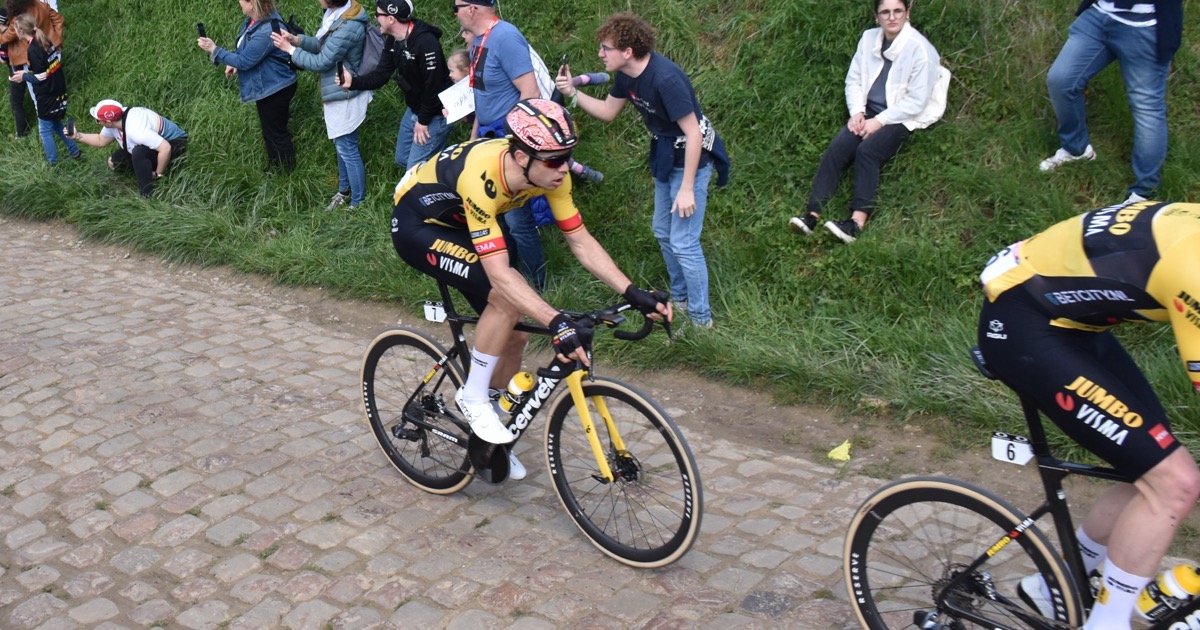
How Wout van Aert Trains (the VLamax Fix Behind His Roubaix Win)
Van Aert won the fastest Paris-Roubaix ever, then two Vuelta stages. The training idea behind it is one number his team spent years lowering: VLamax.
On 12 April, Wout van Aert won the fastest Paris-Roubaix ever ridden: 258.3km in 5:16:52, an average of 48.91km/h, and he still outsprinted Tadej Pogačar on the velodrome with 200m to go. This afternoon in Córdoba, in about 40 degrees, he won his second Vuelta a España stage in three days and all but sewed up the green jersey. In between, surgery on an infected elbow to stop it becoming sepsis cost him the Tour de France for the first time since 2018.
The training idea behind Roubaix is one number his team decided was too high.
The wrong engine for the job
Van Aert is 1.90m and 78kg, a three-time cyclocross world champion (2016, 2017, 2018) before he was a road rider. Cyclocross is roughly an hour in the red, repeated accelerations out of corners, no fuel strategy because the race ends before fuelling matters.
That builds the wrong metabolic profile for 260km. Van Aert has been assessed with INSCYD testing since 2017, and his Jumbo-Visma coaches kept finding a VLamax that was too high.
VLamax is the maximum rate at which your body produces energy through glycolysis, meaning how fast you can burn carbohydrate. A high VLamax gives you a vicious 20-second acceleration. It also burns your limited sugar stores faster at any sub-maximal pace and drags your sustainable threshold down.
Van Aert's own words: "In November, my VLamax was too high."
Lowering the number
To lower VLamax you do months of long, low-intensity riding where fat oxidation peaks, which his team calls FatMax work and everyone else calls the deep end of zone 2. And you stop doing what raises VLamax: short, sharp, maximal glycolytic work.
Per the model his team used, fat oxidation goes up so you spare carbohydrate at any intensity, and threshold power rises as a secondary effect.
Van Aert: "Lowering VLamax keeps my sugars for the final, so I don't waste them already in the beginning."
That is the Roubaix race plan as a metabolic goal. Five hours and seventeen minutes at nearly 49km/h across 54.8km of cobbles in 30 sectors, and the decisive question at the end was who still had fuel. He did. Pogačar did not have quite enough.
Mathieu van der Poel came out of cyclocross with the same problem and had to solve it before the road results arrived.
What this means if you are not Wout van Aert
Almost every amateur has cyclocross-era Van Aert's imbalance: too much riding in the moderately-hard middle, too little easy for long enough to shift fat oxidation.
First, ride easy. The full argument is in how to train zone 2, inside a polarized distribution. If your easy rides are not easy, you never build the fat-burning side.
Second, know your burn rate and feed it. Lowering VLamax slows carbohydrate spend. It does not make you self-sufficient. Anything over about 90 minutes still needs fuel.
Target carbs
60g/h
Per hour of exercise
Total carbs
120g
Across your 2-hour session
Recommended carbohydrate by session length
| Under 1 hourWater is usually enough | 0 g/h |
| 1 to 2.5 hoursRecommendedSingle transportable carb (glucose) | 60 g/h |
| 2.5 hours or longerGlucose plus fructose, near a 2:1 mix | 90 g/h |
- Pair carbohydrate with fluid and sodium. Concentrated fuel without enough water sits in the gut and causes discomfort.
- Tolerating high carbohydrate rates is a trainable skill. Practice your race fueling in long sessions and build up gradually, never try a new high intake on race day.
- Above 60 g per hour, use a glucose-to-fructose mix near 2:1. Glucose alone saturates the gut transporter at about 60 g per hour.
- Hard efforts burn carbohydrate faster, so sit toward the top of each range.
A PDF of your personalized results, with a QR code to reopen them anytime.
Enter duration and intensity for a grams-per-hour target, the number most amateurs are furthest below. In 40-degree heat, pair it with a sweat rate estimate.
The anchor underneath is threshold power, from FTP or critical power. VLamax needs a lab. The fix, hours of easy riding under a measured threshold, does not.
The year that should have ruined him
He crashed in training before the Tour Auvergne-Rhône-Alpes. The elbow wound became infected during the race, he abandoned, and it took surgery and a night in hospital, with a team statement that the operation was to stop him developing sepsis. He missed the Tour de France, where he has won ten stages and the 2022 green jersey.
The pattern: a career-threatening crash in the 2019 Tour time trial. A broken collarbone and ribs at Dwars door Vlaanderen in 2024. A knee injury that ended his 2024 Vuelta. A fractured ankle in cyclocross.
Then in September he wins two Grand Tour stages in three days, the second by going clear through the intermediate sprint and bridging with 32km to go.
A deep aerobic base is durable. Sharpness disappears in a fortnight off the bike. Fat-oxidation machinery built over years of long easy hours does not. It is why Van Aert and Enric Mas, who won this same Vuelta after a year lost to a blood clot, can lose months and still arrive.
What you can steal from it
- Your best 20 seconds may be costing you your best five hours. A high glycolytic rate burns sugar fast at every intensity. If you fade late in long events, suspect this before a lack of top-end power.
- Long, easy riding is the lever. It raises fat oxidation and, in his team's model, threshold with it.
- Train the fuel system, then feed it. Carb intake for grams per hour, sweat rate for fluid.
- Anchor the easy pace to a measured number. FTP or critical power. Easy is a zone, not a feeling.
- Base outlasts interruption. Van Aert lost the Tour to an infected elbow and won two Vuelta stages nine weeks later.
Van Aert spent years making his body better at not spending. In April it gave him 200 metres more than the world champion had, a decision made about four years before it paid.
Since then he has spent the final week of the same Vuelta leading out Matthew Brennan, who has won five stages on his Grand Tour debut at 21.
More in this series: Matthew Brennan, Mathieu van der Poel, Tadej Pogačar, Jonas Vingegaard, Primož Roglič and Enric Mas.
Sources
- Wikipedia
- 2026 Paris-Roubaix
- Olympics.com on Roubaix
- INSCYD on his VLamax
- Cyclingnews on the elbow infection
- Visma-Lease a Bike on his Tour withdrawal
- Rouleur on Vuelta stage 15
- CyclingUpToDate stage 15 report
Cover photo by René Hourdry, CC BY-SA 4.0, via Wikimedia Commons.
