How to Set Your Training Zones (and Actually Use Them)
How to find your heart-rate, power and pace zones: pick the right anchor, test it with a field test, then train by it with a polarized week.

Training zones turn "kind of hard" into a number you can repeat and improve. Setting them takes three steps: pick the right anchor, test it, then train by it.
Step 1: Pick your anchor
Every zone system is a set of percentages hung off one reference number. Which anchor you use depends on your sport and your data.
- Heart rate: works for every sport. It lags effort by 30–90 seconds and drifts with heat, sleep and caffeine.
- Power: the standard for cycling and increasingly running. Instant and immune to drift, but you need a power meter.
- Pace: the natural anchor for runners and swimmers on stable terrain.
A perfect zone chart built on a guessed max heart rate is a precise wrong answer.
Heart-rate zones
You need your maximum heart rate and, ideally, your lactate threshold heart rate (LTHR). The "220 − age" formula overestimates for most adults. Tanaka's 208 − 0.7 × age is more accurate. Start with the max heart rate calculator, then verify the number in the field.
LTHR is the better everyday anchor, because the zones around threshold are where most training happens. The LTHR zones calculator takes a 30-minute time-trial average and splits it into Friel's seven heart-rate zones.
Power zones (cyclists)
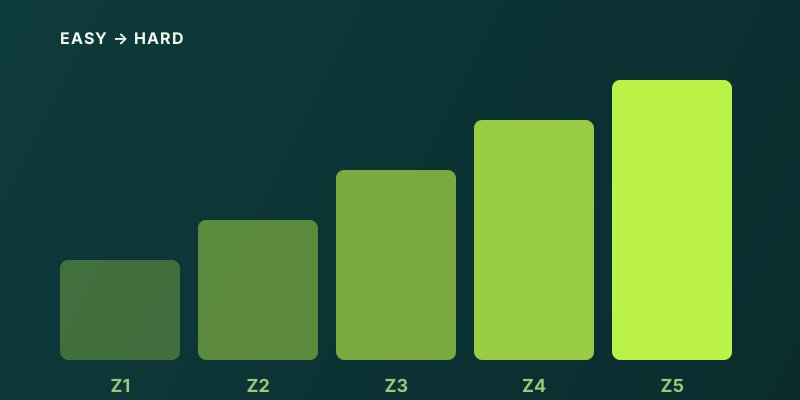
The reference is Functional Threshold Power (FTP), the highest power you can hold for about an hour. Coggan's model divides it into seven zones, from active recovery (under 55% FTP) to neuromuscular power (above 150%). Estimate yours with the FTP calculator.
Pace zones (runners)
Jack Daniels' VDOT takes one recent race result and returns your easy, marathon, threshold, interval and repetition paces. The VDOT calculator is the best starting point for anything from 5K to marathon.
Step 2: Test it
Estimates get you in the right neighborhood. A field test gets you the right house.
- Warm up. 15–20 minutes easy plus a few short surges.
- Go all-in. For FTP or LTHR, a 20–30 minute time trial on a stable course or trainer. For VDOT, a recent race or time trial.
- Record the average, not the peak. Threshold is a sustainable number.
- Re-test every 6–8 weeks. Fitness moves. Your anchor should move with it.
Test once in January and ride those zones until summer, and your "threshold" is now your tempo and your progress stalls.
Step 3: Train by it
Most athletes spend too much time in the "gray zone": moderately hard every day, which accumulates fatigue without driving adaptation.
Stephen Seiler's research points the other way: roughly 80% of sessions easy (zone 1–2) and 20% hard (zone 4+). This is polarized training, and it is the highest-leverage change most amateurs can make. Your easy zone should feel almost annoyingly easy. That is how you know it is set right.
Putting it together
- Choose the anchor that matches your sport and your data.
- Estimate it with the calculator, then verify it with a field test.
- Split it into zones with a documented model (Tanaka, Friel, Coggan, Daniels).
- Distribute the week polarized: mostly easy, occasionally very hard.
- Re-test every couple of months and update the numbers.