How Elite Rowers Train (20 Hours a Week for a 6-Minute Race)
A 2k rowing race lasts six minutes, yet elite crews train 15 to 30 hours a week and spend around 80% of it easy. Why that works, and what to do on the erg.
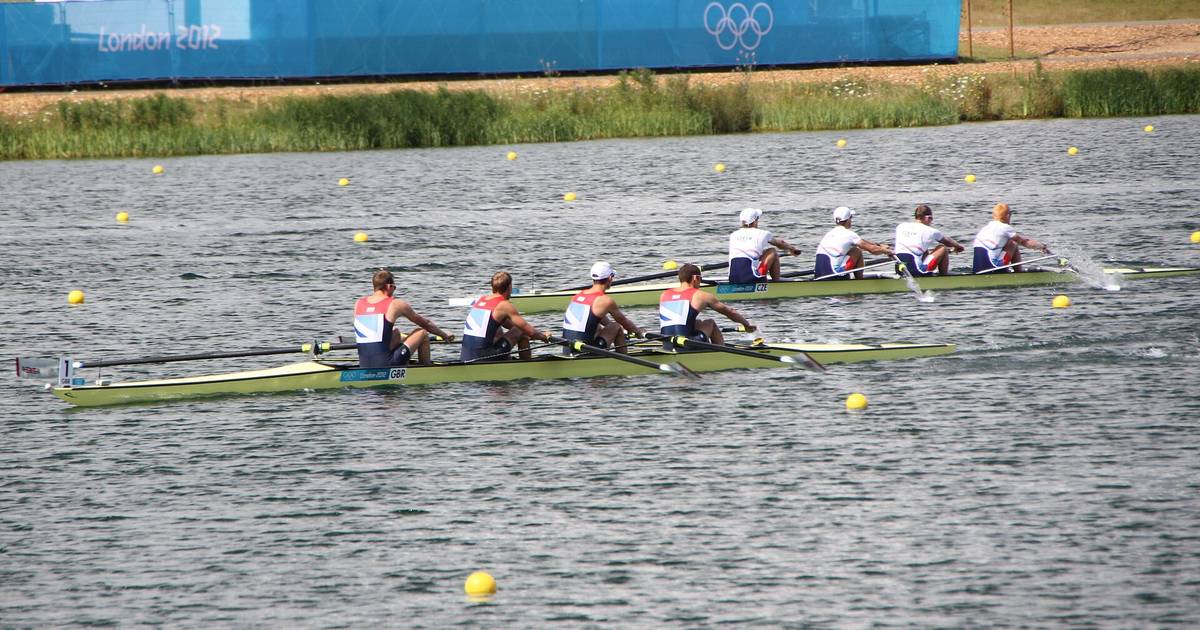
A 2000m rowing race takes about six minutes and finishes with crews grey and blood lactate at extraordinary levels. Elite rowers train for it by going easy: 15 to 30 hours a week, often two or three sessions a day, most of it at conversational effort.
A six-minute race is mostly an aerobic race
Even over six minutes, most of the energy for a 2k is supplied aerobically. The figure most commonly cited is 70 to 75 percent, and published estimates range from roughly 70 to 88 percent depending on method.
If most of the energy is aerobic, most of the training should build the aerobic system. Stephen Seiler, who rowed himself, put it plainly: the race is six or seven minutes and primarily aerobic, so what you need to build is the aerobic engine. The anaerobic side is real. It is not the part that responds to being hammered every day.
The numbers behind "mostly easy"
Rowing has unusually good published data on how elite crews distribute intensity:
- A Norwegian Olympic champion sculler: about 81 percent of training in the lowest intensity zone.
- Nine New Zealand Olympic rowers: roughly 77 / 17 / 6 percent across low, moderate and high intensity.
- German national squad rowers in a controlled study: about 93 to 94 percent low intensity in both the pyramidal and polarized groups.
Low intensity dominates everywhere. The remainder is contested: in the German study, polarized was not statistically better than pyramidal.
The volume, and where it goes
A senior international programme runs 15 to 30 hours a week across six or more days, often 700 to 900 hours a year, with sessions stacked two or three deep on the heaviest days. Documented squads have logged over 100km a week on the water, plus ergometer work, cycling or running as low-impact volume, and weights.
Because a large endurance load suppresses strength adaptation, elite programmes need two to four gym sessions a week to make progress, built around squats and Olympic-lift variants. One session a week is enough to be sore and not enough to get stronger.
The zones, and how they're set
Rowing uses five bands, from UT2 at the easy end through UT1, AT and TR to AN at the top. Our UT2 explainer defines each band and its stroke rates.
In a serious programme the boundaries come from a step test: the athlete rows progressively harder stages while blood lactate is sampled from the ear, and the individual lactate curve sets the band edges. The 2k ergometer test sits alongside as the benchmark and remains the single most used test in the sport.
You can approximate the same structure from your maximum heart rate:
Max heart rate
190bpm
| Zone | Range | What it trains |
|---|---|---|
| UT2 | Utilization 2 (UT2) 105–133 bpm | Long aerobic base, the bedrock of rowing volume. RPE 2–3, steady-state, easy to talk. |
| UT1 | Utilization 1 (UT1) 133–152 bpm | Upper aerobic endurance and efficiency. RPE 4–5, comfortably working. |
| AT | Anaerobic Threshold (AT) 152–162 bpm | Lactate threshold; sustainable race-distance pace. RPE 6–7, hard but controlled. |
| TR | Transport (TR) 162–181 bpm | VO₂max and oxygen transport; 2k-specific. RPE 8–9, very hard. |
| AN | Anaerobic (AN) ≥ 181 bpm | Anaerobic power; starts and sprints. RPE 9–10, maximal. |
UT2 · Utilization 2 (UT2). Long aerobic base, the bedrock of rowing volume. RPE 2–3, steady-state, easy to talk.
UT1 · Utilization 1 (UT1). Upper aerobic endurance and efficiency. RPE 4–5, comfortably working.
AT · Anaerobic Threshold (AT). Lactate threshold; sustainable race-distance pace. RPE 6–7, hard but controlled.
TR · Transport (TR). VO₂max and oxygen transport; 2k-specific. RPE 8–9, very hard.
AN · Anaerobic (AN). Anaerobic power; starts and sprints. RPE 9–10, maximal.
- British Rowing and Concept2 use a five-band model (UT2 → AN). The vast majority of training is steady UT2 work, which builds the aerobic engine a 2k depends on.
- Where you have it, anchor these to your 2k split too: UT2 sits roughly 20–30 s/500 m slower than 2k pace, AT around 8–12 s slower, and TR near 2k pace.
A PDF of your personalized results, with a QR code to reopen them anytime.
Treat the output as a first draft that a proper test would sharpen.
Rowers have the biggest engines in sport
Elite male rowers commonly sit around 60 to 75 ml/kg/min for relative VO2max. The striking figure is the absolute one, frequently 6 to 7 litres of oxygen per minute, because these are very large athletes. VO2max is the strongest single predictor of 2k performance.
Estimate your own from a field test with the VO2max estimator, though for rowers the 2k erg remains the better yardstick.
What this means on an erg at home
Most recreational rowers do the inverse: a few sessions a week, nearly all moderate-to-hard, which feels productive and builds little.
- Row most of your metres easy. Conversational, low rate, UT2. It should feel like under-doing it.
- Set your bands from a test. A recent 2k gives pace anchors. Heart-rate bands give a cross-check.
- Don't sprint your way to a better 2k. The event is mostly aerobic. The aerobic work moves it.
- Lift twice a week or don't count it. One token session won't overcome the endurance load.
- Use the erg for consistency, water for skill. The machine is a superb aerobic tool and an indifferent technique coach.
Where the sport is right now
The reigning Olympic single sculls champions from Paris 2024 are Oliver Zeidler and Karolien Florijn, and Great Britain won the men's eight. The 2026 World Rowing Championships were in Amsterdam from 24 to 30 August. LA 2028 adds beach sprint rowing, including rowing's first mixed Olympic event, a much shorter format in a sport organised around 2000m for a century.
More in this series: Eliud Kipchoge, Jakob Ingebrigtsen, Kilian Jornet, Marianne Vos, Demi Vollering, Tadej Pogačar and Jonas Vingegaard.
Sources
- Frontiers in Physiology, intensity distribution, polarized vs pyramidal
- Frontiers in Physiology, volumes, energetics, VO2max
- British Rowing
- Testing practice review
- British Rowing Plus, programme design and strength
- Stephen Seiler interview
- World Rowing, 2026 Worlds
- World Rowing, LA 2028
Cover photo by Steve Elliott, CC BY-SA 2.0, via Wikimedia Commons.
