How Alex Yee Trains (the Runner Who Wins Triathlons)
Alex Yee won Olympic gold with the fastest run off the bike in the field. How he built a triathlon around that weapon, and how to pace a run on tired legs.
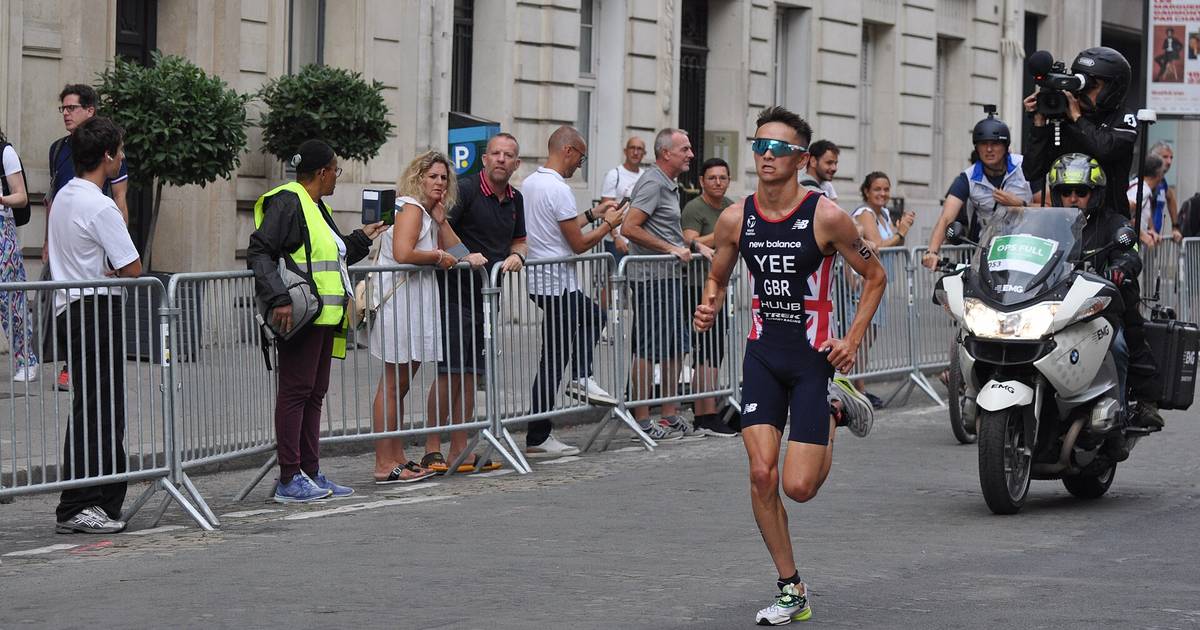
Alex Yee won Olympic triathlon gold in Paris by running off the bike better than anyone else. He sat behind Hayden Wilde's early move, then closed a fourteen-second gap over the final lap. Yee is a runner who happens to do triathlon, and his whole approach protects that run. He is the contrast to Kristian Blummenfelt: long-course and lactate-lab versus short-course and run-first.
A runner first
Before the triathlon golds, Yee ran a 10,000m in the 27-minute range and a 5000m around 13:30. That is a professional track athlete. When the swim and bike are survived rather than won, the race is a 10k or a 5k, and Yee brings a runner's speed to a field of triathletes.
He is coached by Adam Elliott and trains in Loughborough, having come up in Leeds alongside the Brownlee brothers. A normal block is 30 to 35 hours a week across the three sports, with two gym sessions for run durability.
Pace and heart rate, not lab lactate
Yee tracks running by pace, distance and heart rate, and describes heart rate as the metric he uses across all his training to see how his body is coping with the load, alongside how he feels. On the bike he rides to power. The run is anchored to a threshold heart-rate band and a target pace.
The signature session is the brick: a hard bike effort straight into threshold-pace running. The transition is where amateurs lose the most time, and it is the most trainable thing in the sport.
Pacing a run on tired legs
Yee holds his run to a controlled band rather than sprinting out of transition and blowing up. The precise instrument for that is running power: a real-time number that ignores hills and fatigue and tells you whether the effort is sustainable. Its anchor is your running critical power:
Running Critical Power
280W
| Zone | Range | What it trains |
|---|---|---|
| Z1 | Easy ≤ 224 W | Recovery and easy aerobic running below CP. RPE 2–3, conversational. |
| Z2 | Moderate 224–252 W | Aerobic endurance; long-run power. RPE 4–5, steady. |
| Z3 | Threshold 252–280 W | At critical power, tempo / threshold running. RPE 6–7, comfortably hard. |
| Z4 | Interval 280–322 W | Above CP, VO₂max intervals. RPE 8–9, hard. |
| Z5 | Repetition ≥ 322 W | Severe-intensity reps and strides; neuromuscular power. RPE 9–10, very hard to maximal. |
Z1 · Easy. Recovery and easy aerobic running below CP. RPE 2–3, conversational.
Z2 · Moderate. Aerobic endurance; long-run power. RPE 4–5, steady.
Z3 · Threshold. At critical power, tempo / threshold running. RPE 6–7, comfortably hard.
Z4 · Interval. Above CP, VO₂max intervals. RPE 8–9, hard.
Z5 · Repetition. Severe-intensity reps and strides; neuromuscular power. RPE 9–10, very hard to maximal.
- Running power (Stryd) zones anchor to your running Critical Power, not cycling FTP. The two are not interchangeable because running power includes the cost of vertical oscillation and form, not just propulsion.
- Running power responds instantly to hills and wind where pace lags, which makes it excellent for even-effort pacing on undulating courses.
A PDF of your personalized results, with a QR code to reopen them anytime.
Enter your running critical power and it sets your zones for a steady effort off the bike. Yee uses heart rate and pace for the same job, and a defined threshold heart-rate band works the same way.
The low-mileage lesson
When Yee stepped up to the marathon in 2025, he ran 2:06:38 in Valencia, the second-fastest ever by a Briton, on run volume well below a specialist's, because it sat on a triathlon base. Quality can partly substitute for mileage.
2026
Yee's 2026 short-course season has been rocky: two DNFs and a crash-affected fourteenth at his home race in London in July, where he still posted the fastest run split. He paced, rather than raced, the London Marathon in April. His stated focus is short-course triathlon and Los Angeles 2028.
What you can steal from it
- Protect your strongest discipline and build around it. Yee shapes his whole triathlon around the run.
- Practise the transition, not just the parts. Hard bike into threshold run trains the moment that decides races.
- Pace the run to a number. Running power or a threshold heart-rate band keeps you honest when tired legs distort effort.
- Quality can offset mileage. A 2:06 marathon on sub-specialist volume.
More in this series: Kristian Blummenfelt, Cole Hocker, Eliud Kipchoge, Léon Marchand and Jakob Ingebrigtsen.
Sources
Cover photo by Eric Salard, CC BY-SA 2.0, via Wikimedia Commons, from the August 2023 Paris Olympic test event.
.jpg)