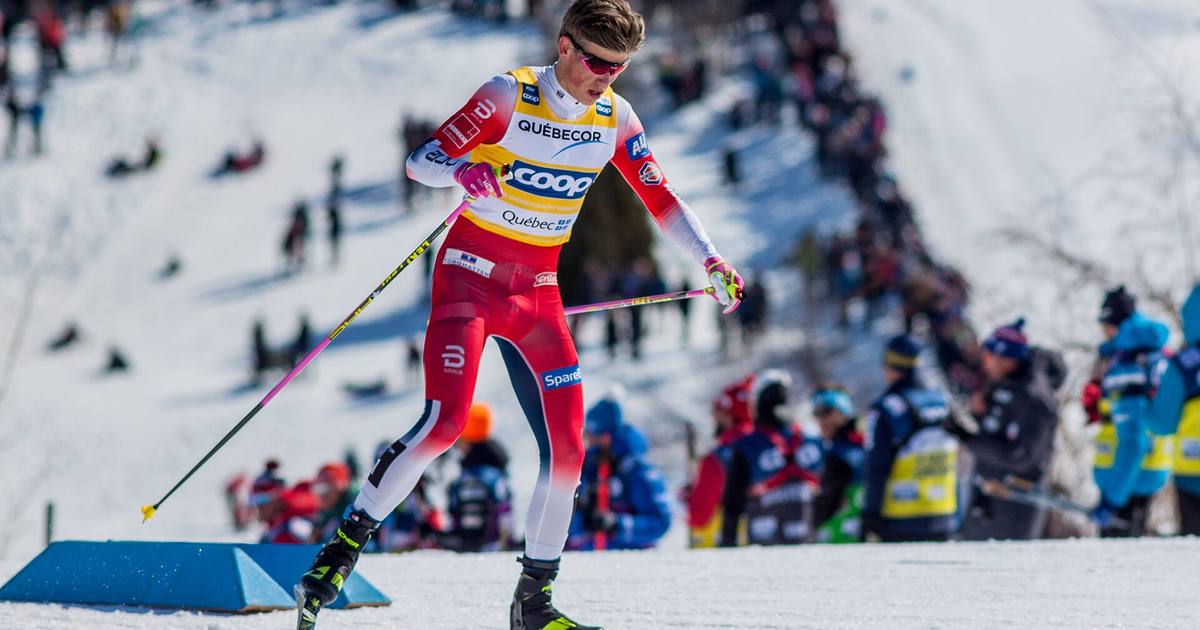
How Johannes Klæbo Trains (Cross-Country Skiing's Bottomless Engine)
Klæbo won all six events at the 2026 Winter Olympics in the most aerobic sport there is. The Norwegian model behind it, and your own I1 to I5 zones.

At the 2026 Winter Olympics, Johannes Høsflot Klæbo won gold in all six men's cross-country skiing events, the most golds anyone has won at a single Winter Games. A year earlier he swept all six at the World Championships. He is the most dominant skier the sport has seen, in the sport that asks the most of the aerobic system.
The most aerobic sport there is
Cross-country skiing uses the whole body, arms and legs together, so it can demand more oxygen than running or cycling. Elite skiers record some of the highest maximal oxygen uptakes ever measured. A world-class distance skier sits close to the ceiling of what a human aerobic system can do.
You do not build that on intensity. You build it on volume, most of it easy. Every sport in this series reaches the same conclusion, from Kipchoge's marathon base to elite rowers' 80-plus percent easy weeks.
The I1 to I5 zones, and where the work goes
Norwegian cross-country skiing organises training into five intensity zones, I1 through I5, from easy aerobic to maximal. An elite ski program spends most of the year in I1 and I2, the conversational end, with a small, carefully placed dose of I3 to I5.
Set the same zones from your maximum heart rate:
Max heart rate
190bpm
| Zone | Range | What it trains |
|---|---|---|
| I1 | I1, Easy 114–137 bpm | Aerobic base (<2 mmol/L lactate). The huge majority of Nordic volume. RPE 2–3, easy, nasal breathing. |
| I2 | I2, Steady 137–156 bpm | Upper aerobic endurance (~2 mmol/L). RPE 4–5, steady. |
| I3 | I3, Threshold 156–165 bpm | Lactate threshold (2.5–4 mmol/L). RPE 6–7, comfortably hard. |
| I4 | I4, VO₂max 165–175 bpm | Maximal aerobic power (4–6 mmol/L). RPE 8–9, hard intervals. |
| I5 | I5, Anaerobic 175–190 bpm | Anaerobic / speed (>6 mmol/L). RPE 9–10, maximal. |
I1 · I1, Easy. Aerobic base (<2 mmol/L lactate). The huge majority of Nordic volume. RPE 2–3, easy, nasal breathing.
I2 · I2, Steady. Upper aerobic endurance (~2 mmol/L). RPE 4–5, steady.
I3 · I3, Threshold. Lactate threshold (2.5–4 mmol/L). RPE 6–7, comfortably hard.
I4 · I4, VO₂max. Maximal aerobic power (4–6 mmol/L). RPE 8–9, hard intervals.
I5 · I5, Anaerobic. Anaerobic / speed (>6 mmol/L). RPE 9–10, maximal.
- The Norwegian/FIS I1–I5 model is the standard across cross-country skiing, biathlon and nordic combined. It pairs heart-rate bands with lactate guideposts (I1 <2 mmol/L up to I5 >6 mmol/L).
- Nordic programs are strongly polarized: enormous volumes of easy I1–I2, with concentrated I3–I5 sessions. Biathletes add the challenge of dropping heart rate fast on the shooting range.
A PDF of your personalized results, with a QR code to reopen them anytime.
It gives you the I1 to I5 bands in beats per minute, so easy skis stay easy and hard sessions stay hard, on snow or on summer roller-skis. The heart-rate zones guide covers why that distribution works.
What we can and can't say about his training
The fine detail of Klæbo's week is not publicly documented, so this is not the place to invent a training diary. His results sit on the sport's standard model at its highest level: a very large annual volume, mostly low-intensity, split between snow and summer roller-skiing, with strength and technique work underneath. His edge is partly the engine and partly world-class sprinting combined with world-class distance skiing, an argument for training the full range of intensities.
2025 and 2026
Klæbo swept all six events at the 2025 World Championships, became the first male skier to reach 100 World Cup victories, won multiple overall World Cup titles, and then won all six men's events at the 2026 Olympics.
What you can steal from it
- Build the engine with volume, mostly easy. The most aerobically demanding sport in the world is built on low-intensity work.
- Set real zones. Use the I1 to I5 bands from your max heart rate.
- Use snow as free aerobic volume. Skiing and roller-skiing load the engine with less impact than running, the logic behind Kilian Jornet's winter on skis.
- Train the whole range. Klæbo is world-class at sprint and distance. Neglect neither.
The same Nordic model underpins Jessie Diggins and, with a rifle attached, Sturla Holm Lægreid and Quentin Fillon Maillet.
More in this series: Therese Johaug, Harald Østberg Amundsen, Jessie Diggins, Sturla Holm Lægreid, Kilian Jornet, elite rowers, Jonas Vingegaard and Eliud Kipchoge.
Sources
Cover photo by Fil.Al, CC BY 2.0, via Wikimedia Commons.
.jpg)