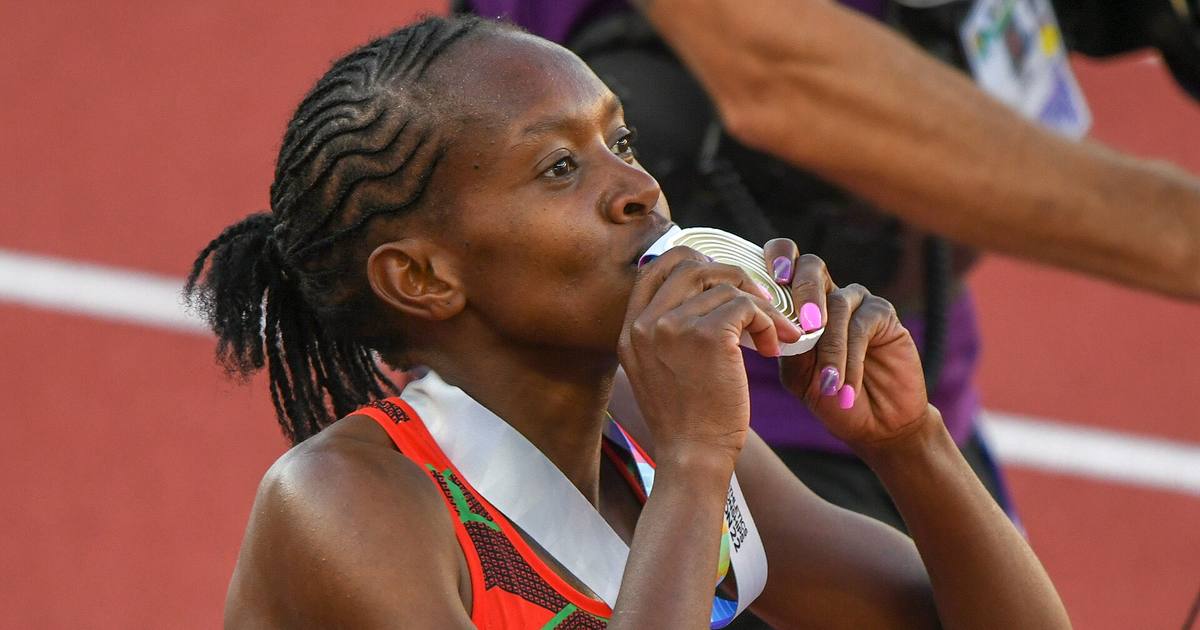
How Faith Kipyegon Trains (the 1500m Record-Holder From Kipchoge's Camp)
Faith Kipyegon holds the 1500m and mile world records, trains in Kipchoge's Kaptagat camp under Patrick Sang, and got faster after becoming a mother.

Faith Kipyegon is the greatest women's middle-distance runner in history: three consecutive Olympic 1500m titles, four world titles, and world records in the 1500m and the mile. She trains in Kaptagat, Kenya, in the same camp as Eliud Kipchoge, under the same coach, Patrick Sang. Much of it came after eighteen months away to have a child.
The same camp, the same coach
Sang has coached Kipyegon since late 2017. She trains in the Global Sports Communication camp at Kaptagat that he built, where Kipchoge also lives and trains during the week. Her preparation runs on the principles in the Kipchoge post: a large aerobic base, controlled easy running, honest pacing on key sessions, and an environment where the correct behaviour is the default.
A 1500m takes under four minutes, yet her training rests on the same aerobic foundation as an athlete racing for two hours. The mile is more aerobic than it feels.
The engine under a four-minute race
Her 1500m world record is 3:48.68, her mile record 4:07.64. In 2025 she attempted the first women's sub-four-minute mile and ran 4:06.91. Those times are speed on top of a deep aerobic engine, which is why her camp looks like a distance runner's.
VDOT turns one race result into your fitness and training paces across distances:
VDOT
49.8
Daniels running fitness score
| Zone | Range | What it trains |
|---|---|---|
| E | Easy / Long 4:54–5:53 /km | Aerobic base, capillaries, fat metabolism; most weekly volume. RPE 3–4, conversational. |
| M | Marathon 4:26–4:51 /km | Marathon-specific endurance and economy. RPE 5–6, steady. |
| T | Threshold 4:16–4:28 /km | Lactate threshold; comfortably-hard tempo and cruise intervals. RPE 7, ~1h race effort. |
| I | Interval 3:51–4:01 /km | VO₂max; 3–5 min hard reps. RPE 9, hard. |
| R | Repetition 3:19–3:42 /km | Speed, economy and running power; short fast reps with full recovery. RPE 9–10, fast and controlled. |
E · Easy / Long. Aerobic base, capillaries, fat metabolism; most weekly volume. RPE 3–4, conversational.
M · Marathon. Marathon-specific endurance and economy. RPE 5–6, steady.
T · Threshold. Lactate threshold; comfortably-hard tempo and cruise intervals. RPE 7, ~1h race effort.
I · Interval. VO₂max; 3–5 min hard reps. RPE 9, hard.
R · Repetition. Speed, economy and running power; short fast reps with full recovery. RPE 9–10, fast and controlled.
- Your VDOT of 49.8 is a single number that captures current running fitness (a 'VO₂max' adjusted for running economy). Every training pace is derived from it.
- VDOT comes from one recent, hard race or time trial. Use a result you raced all-out, ideally 5 km or longer; a half-marathon or 10 km gives the most stable estimate.
- Switch the units toggle to read paces per mile. As you get fitter, re-race; your VDOT and all paces will update.
- These are Daniels’ discrete training paces (E, M, T, I, R), not continuous zones: you run at each one for a specific purpose. The gaps between the harder paces (T, I and R) are intentional, not a glitch.
A PDF of your personalized results, with a QR code to reopen them anytime.
Enter a recent mile or 1500m for the paces you should train at and what your engine is worth over longer distances. The value is the same as in the Josh Kerr and Cole Hocker posts: mile speed and longer-distance fitness share one base, and one result sets your paces everywhere.
Motherhood, and the long game
Kipyegon gave birth to her daughter in 2018 and returned to racing in 2019 after roughly eighteen months, then broke world records and won further Olympic and world titles. A long break does not end an endurance career.
Fitness built over years does not vanish in an eighteen-month interruption, and a career can have its best chapters after one. Marianne Vos shows the same over two decades.
What you can steal from it
- Even short races are aerobic. A 1500m runner trains on a distance runner's base.
- Anchor to a measured result. Use VDOT to turn one race into training paces across distances.
- Fix the environment. Structure your routine so the session is the easy choice.
- Play the long game. An eighteen-month break preceded her best years. Aerobic fitness is durable.
More in this series: Gesa Krause, Eliud Kipchoge, Josh Kerr, Cole Hocker, Sifan Hassan and Jakob Ingebrigtsen.
Sources
Cover photo by Erik van Leeuwen, GFDL, via Wikimedia Commons.
