Intermediate 10k Training Plan: 10 Weeks for 40 to 50 Minutes
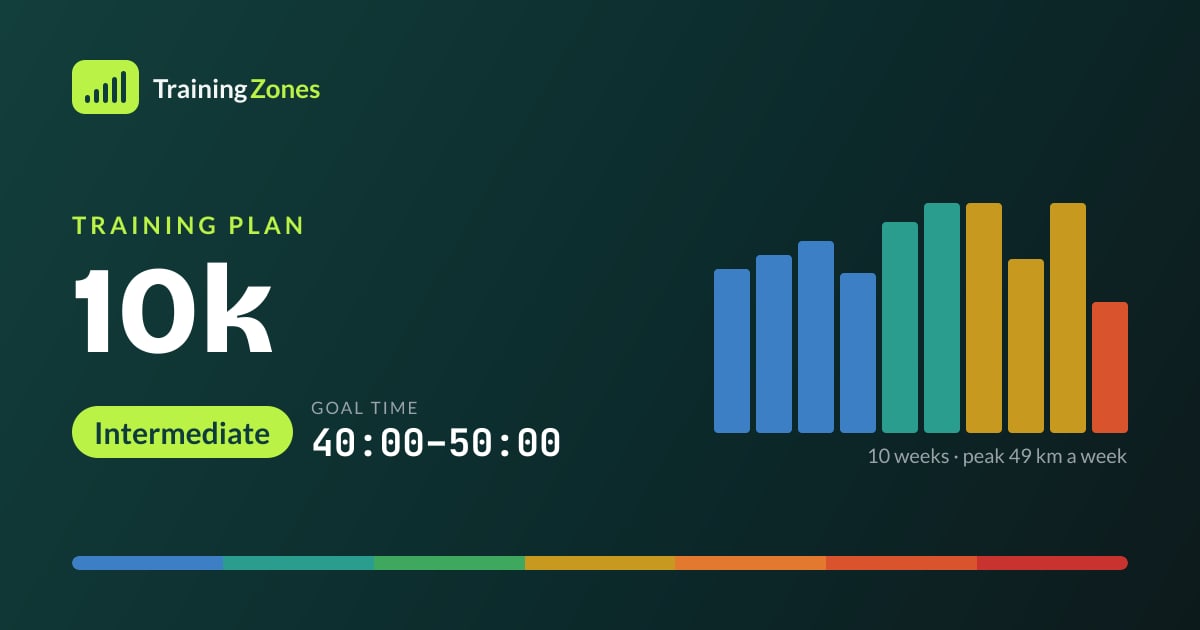
A 10-week intermediate 10k plan for 40 to 50 minute runners: five runs a week, peak 49 km, threshold and 10k-pace reps in 1.6 km blocks. Free.

An intermediate 10k plan runs 10 weeks at five runs a week, peaks at about 49 km, and trains the two paces either side of 10k pace: threshold and VO2max. It fits runners whose fitness predicts a 40 to 50 minute 10k: roughly a 19:20 to 24:00 5k, or a half marathon between about 1:29 and 1:51. Sub-45 is in the middle of this band, sub-40 at its fast edge.
The 10 weeks
Sample plan · Intermediate 10k
10 weeks, 5 runs a week, peak 49 km, longest run 16 km. Built for a recent 5k of 21:00 (VDOT 47.0). 85 % of the running is easy.
| Week | Km | Key sessions | Long run |
|---|---|---|---|
| 1 Base | 35 | Easy running only | 10 km long run |
| 2 Base | 38 | Easy running only | 12 km long run + strides |
| 3 Base | 41 | Tempo run: 15 min T | 12 km long run |
| 4 Base, recovery | 34 | Cruise intervals: 3 × 1 km T (1 min jog) | 10 km long run |
| 5 Build | 45 | Broken tempo: 2 × 10 min T (2 min jog); Long intervals: 4 × 3 min I (3 min jog) | 14 km long run |
| 6 Build | 49 | Tempo run: 20 min T; 5k time trial | 16 km long run + strides |
| 7 Peak | 49 | 10k pace reps: 3 × 1.6 km race pace (90 s jog); Cruise intervals: 3 × 1.6 km T (1 min jog) | 15 km progressive long run |
| 8 Peak, recovery | 37 | 10k pace sets: 2 × (2 × 1 km race pace / 200 m jog), 3 min between sets; Broken tempo: 2 × 8 min T (2 min jog) | 11 km long run |
| 9 Peak | 49 | 10k pace reps: 3 × 1.6 km race pace (90 s jog); Tempo run: 20 min T | 15 km progressive long run |
| 10 Taper | 28 + race | Sharpener: 4 × 2 min race pace (2 min jog); race day | None, race week |
- Base, weeks 1 to 4. 35 to 41 km, long runs of 10 to 12 km. Threshold from week 3: a 15-minute tempo, then 3 × 1 km cruise intervals.
- Build, weeks 5 and 6. Up to 49 km. Two quality days: 2 × 10 minutes broken tempo with 4 × 3 minutes at interval pace, then a 20-minute tempo. A 5k time trial closes week 6. Long runs of 14 and 16 km.
- Peak, weeks 7 to 9. 10k pace joins threshold: 3 × 1.6 km at race pace with 90 seconds of jogging, sets of 2 × 1 km with 200 metre jogs, and cruise intervals or tempo on the second quality day. Long runs of 15 km finish at threshold.
- Taper, week 10. About 55 % of peak volume, four 2-minute race-pace pickups, then race day.
Who counts as intermediate
The level comes from Jack Daniels' VDOT, one number from a recent race that sets every training pace. Intermediate means a predicted 10k of 40 to 50 minutes, roughly VDOT 40 to 52. A 45-minute 10k is VDOT 45.3, a 40-minute 10k VDOT 51.9. The sample runner has a 21:00 5k, VDOT 47, which predicts 43:32.
| 10k finish | Race pace | Easy | Marathon | Threshold | Interval |
|---|---|---|---|---|---|
| 40:00 | 4:00 | 4:45–5:41 | 4:23 | 4:07 | 3:47 |
| 45:00 | 4:30 | 5:18–6:21 | 4:55 | 4:37 | 4:14 |
| 50:00 | 5:00 | 5:51–6:59 | 5:26 | 5:05 | 4:40 |
Where 10k pace sits
Look at the table. For an intermediate runner, 10k pace is 5 to 7 seconds per km faster than threshold and 13 to 20 seconds per km slower than interval pace. It is neither. A 10k lasts 40 to 50 minutes here, shorter than the hour threshold is defined by and far longer than a VO2max interval.
So the plan builds from both sides:
- Threshold pushes the pace you can sustain up. Tempo runs and cruise intervals raise the speed at which lactate stays under control. Every week from 3 to 9 has a threshold session.
- Intervals raise the ceiling. Three- and four-minute reps at VO2max pace in the build make 10k pace a smaller share of your maximum.
- 10k-pace reps join them in the peak. 3 × 1.6 km is 4.8 km at race pace, broken into pieces you can hold on form. The sets in week 8 cut the jog to 200 metres, which is closer to racing.
The easy running around it stays at 85 %. Seiler found well-trained endurance athletes settle on about 80 % of sessions at low intensity. Weekly volume never rises more than 10 % between loading weeks, well inside the 30 % jump Nielsen (2014) linked to more injuries. Weeks 4 and 8 drop to about 75 % for recovery.
Your own plan
The 10k training plan generator builds yours from your recent race, your weeks until race day, your running days and your long-run day. Add a goal like 39:59 to see it next to what your race predicts, with the gap in percent. Enter the week-6 time trial and every pace updates. Free, no account, PDF included.
FAQ
What 5k time do I need for a sub-40 10k? About 19:18, VDOT 51.9. For sub-45, about 21:42.
How many kilometres a week for a sub-45 10k? This plan peaks at 50 km on five days. On four days it also reaches 50 km, with longer runs.
How long should the long run be for a 10k? 14 to 16 km in this sample, 30 % of the week. The plan caps it at 16 km, because longer runs add fatigue without making a 10k faster.
Should I do intervals or tempo for a 10k? Both. Tempo holds the most weight across the plan, intervals come in shorter doses, and 10k-pace reps tie them together in the peak weeks.
Only need your training paces? Enter a recent race:
VDOT
49.8
Daniels running fitness score
| Zone | Range | What it trains |
|---|---|---|
| E | Easy / Long 4:54–5:53 /km | Aerobic base, capillaries, fat metabolism; most weekly volume. RPE 3–4, conversational. |
| M | Marathon 4:26–4:51 /km | Marathon-specific endurance and economy. RPE 5–6, steady. |
| T | Threshold 4:16–4:28 /km | Lactate threshold; comfortably-hard tempo and cruise intervals. RPE 7, ~1h race effort. |
| I | Interval 3:51–4:01 /km | VO₂max; 3–5 min hard reps. RPE 9, hard. |
| R | Repetition 3:19–3:42 /km | Speed, economy and running power; short fast reps with full recovery. RPE 9–10, fast and controlled. |
E · Easy / Long. Aerobic base, capillaries, fat metabolism; most weekly volume. RPE 3–4, conversational.
M · Marathon. Marathon-specific endurance and economy. RPE 5–6, steady.
T · Threshold. Lactate threshold; comfortably-hard tempo and cruise intervals. RPE 7, ~1h race effort.
I · Interval. VO₂max; 3–5 min hard reps. RPE 9, hard.
R · Repetition. Speed, economy and running power; short fast reps with full recovery. RPE 9–10, fast and controlled.
- Your VDOT of 49.8 is a single number that captures current running fitness (a 'VO₂max' adjusted for running economy). Every training pace is derived from it.
- VDOT comes from one recent, hard race or time trial. Use a result you raced all-out, ideally 5 km or longer; a half-marathon or 10 km gives the most stable estimate.
- Switch the units toggle to read paces per mile. As you get fitter, re-race; your VDOT and all paces will update.
- These are Daniels’ discrete training paces (E, M, T, I, R), not continuous zones: you run at each one for a specific purpose. The gaps between the harder paces (T, I and R) are intentional, not a glitch.
A PDF of your personalized results, with a QR code to reopen them anytime.
More in this series: the beginner, advanced and sub-elite 10k plans, the intermediate 5k plan and the intermediate half marathon plan.
Sources
- Seiler 2010, training intensity distribution
- Nielsen et al. 2014, weekly distance progression and injury
Cover image: TrainingZones.