How Taylor Knibb Trains (and Why She Let the Leader Go in Kona)
Taylor Knibb won Kona 2026 in 8:36:29 a year after overheating 3 km from the line. The lesson: race your own limits, not the athlete beside you.
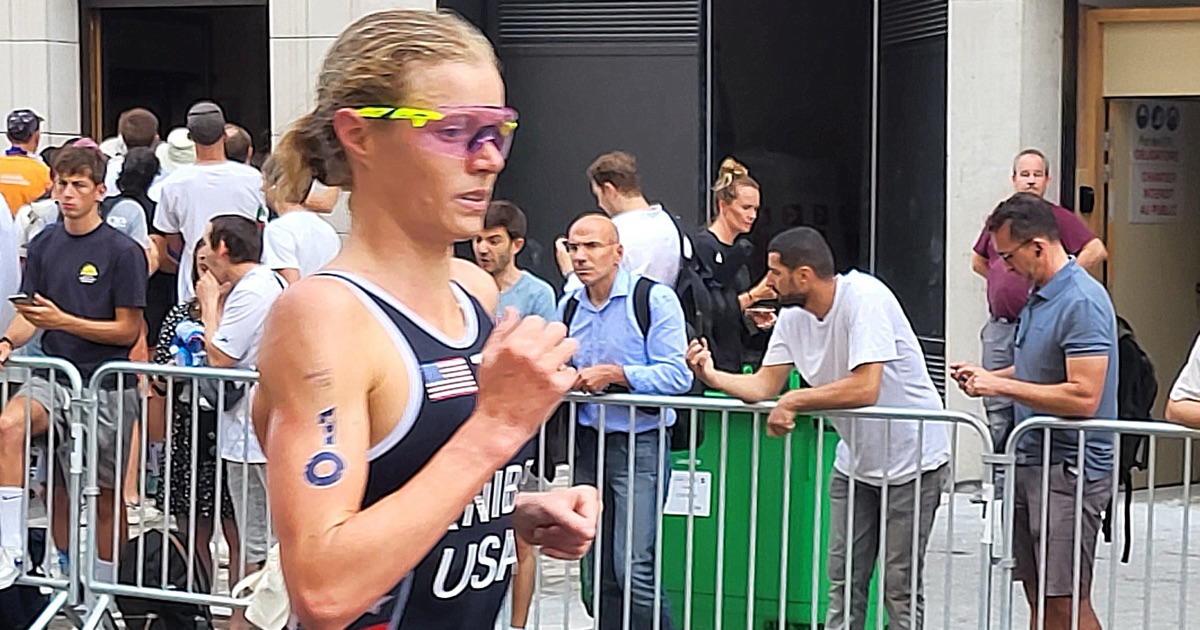
Taylor Knibb won the 2026 Ironman World Championship in Kona in 8:36:29, a year after she overheated and stopped with less than 3 km to go. On 10 October 2026 she swam 52:55, rode the fastest bike split of the day in 4:40:07 and ran a 2:57:46 marathon. When defending champion Solveig Løvseth passed her at mile 21, Knibb let her go. Løvseth collapsed about a kilometer from the finish, and Knibb ran past into the lead. The difference between the two years was where she pointed her attention: at her own body, not at the woman beside her.
The cyclist who also runs
Knibb ran track and cross country at Cornell for four years and swam on the team in her senior year. She has won four Ironman 70.3 world titles (2022, 2023, 2024 and 2026), raced two Olympics in triathlon with a mixed relay silver in Tokyo and Paris, and also rode the Paris Olympic time trial. In June 2026 she won a US national time trial title, and a few weeks before Kona she placed 13th at the UCI world time trial championships.
She has been coached by Dan Lorang since 2024. Her actual training week is not public, so this post does not invent one.
Kona 2025: the limit came early
In 2025 Knibb rode 4:31:00 and started the run 1:43 ahead of Lucy Charles-Barclay. She was still leading with two miles left when she slowed to a walk and sat down on the Queen Ka'ahumanu Highway. Løvseth passed her and won. Medics recorded a core temperature of 104.9°F (40.5°C), taken a while after she had stopped.
Her own summary: "I overheated myself completely with less than 3k to go." Later: "I learned that my limits are closer than I thought." After this year's race she named the mistake. She had "stopped listening to my body and tried to battle it out with a woman."
Kona 2026: let her pass
This time she rode about nine minutes slower than in 2025, still the fastest bike of the day, and led Charles-Barclay by 3:06 into T2. Before the race she had said: "The moment you start racing your competitors is the moment you collapse."
By the Energy Lab, around 23 km into the run, she was struggling. She walked the aid stations to drink and cool down. When Løvseth came past at mile 21, Knibb let her go: "I just had to let her pass me." She credited advice from Paula Newby-Fraser, who told her that when the choice is between racing and reaching the finish, you take the finish. Løvseth faded to eighth in 9:02:09. Knibb won by 3:05 over Laura Philipp.
Heart rate is how amateurs listen to their body
"Listening to your body" sounds vague. In the heat it has a measurable signal. At the same power or pace, heart rate climbs as you get hotter and lose fluid, a process called cardiovascular drift. In one lab study, trained cyclists riding at 35°C saw heart rate rise 11% between minute 15 and minute 45, while it barely moved at 22°C. The athlete next to you does not show up on that number. Your own physiology does.
That is why a heart rate ceiling built from your own maximum is a better race-day guide in the heat than a pace you saw on a cool training day. Set your five zones and decide in advance which zone you will not leave on the bike and the run.
Maximum heart rate
185bpm
| Zone | Range | What it trains |
|---|---|---|
| Z1 | Recovery 93–111 bpm | Active recovery and warm-up; promotes blood flow without adding fatigue. Very easy, RPE 1–2. Full conversation, barely breathing hard. |
| Z2 | Endurance 111–130 bpm | Aerobic base, fat oxidation and capillary density, the bread-and-butter zone. Comfortable, RPE 3–4. Can hold full sentences. |
| Z3 | Tempo 130–148 bpm | Aerobic capacity and muscular endurance; 'moderately hard' steady work. Working, RPE 5–6. Short sentences only. |
| Z4 | Threshold 148–167 bpm | Lactate threshold, your sustainable race-pace ceiling. Hard, RPE 7–8. A few words at a time. |
| Z5 | VO₂max 167–185 bpm | Maximal aerobic power and VO₂max via short, hard intervals. Very hard to maximal, RPE 9–10. No talking. |
Z1 · Recovery. Active recovery and warm-up; promotes blood flow without adding fatigue. Very easy, RPE 1–2. Full conversation, barely breathing hard.
Z2 · Endurance. Aerobic base, fat oxidation and capillary density, the bread-and-butter zone. Comfortable, RPE 3–4. Can hold full sentences.
Z3 · Tempo. Aerobic capacity and muscular endurance; 'moderately hard' steady work. Working, RPE 5–6. Short sentences only.
Z4 · Threshold. Lactate threshold, your sustainable race-pace ceiling. Hard, RPE 7–8. A few words at a time.
Z5 · VO₂max. Maximal aerobic power and VO₂max via short, hard intervals. Very hard to maximal, RPE 9–10. No talking.
- Zones are simple percentages of maximum heart rate (Z1 50–60% up to Z5 90–100%). They are easy to set but assume your HRmax is accurate.
- Heart rate lags effort by 1–3 minutes and drifts upward in heat or dehydration ('cardiac drift'), so treat short, hard efforts by feel.
A PDF of your personalized results, with a QR code to reopen them anytime.
Enter your maximum heart rate and the calculator splits it into five zones as percentages of that maximum. Use a maximum you have actually seen in a hard effort; the max heart rate calculator gives a formula estimate if you have none. If heart rate rises into a higher zone while your pace or power holds steady, the heat is costing you. That is the moment to slow down, cool off at the next aid station and let people go, before you have no choice. The aerobic decoupling calculator shows the same drift after a long session.
What you can steal from it
- Race your own numbers. Knibb's 2025 collapse came from matching a rival, not from a bad plan.
- Set a heart rate ceiling before race day. Build it from your own heart rate zones, not from someone else's pace.
- Expect drift in the heat. The same effort costs more beats per minute after an hour in hot weather.
- Walk the aid stations when you need to. A world champion did it on the way to the title.
- Let people go. Løvseth passed Knibb with about 8 km left and finished eighth.
- Your limit is closer than you think in heat. Knibb's own words, after 104.9°F.
More in this series: Lucy Charles-Barclay, Kristian Blummenfelt, Alex Yee, Mark Allen, and the rest of the 2026 Kona podium: Laura Philipp and Julie Derron, and men's champion Vincent Luis.
Sources
- Slowtwitch race report
- Slowtwitch post-race
- NBC Sports results
- NBC Sports preview
- Wikipedia profile
- Slowtwitch forum, Kona 2025 bike split
- Lafrenz et al. 2008, ambient temperature and cardiovascular drift
Cover photo by Rz98, CC BY-SA 4.0, via Wikimedia Commons.
