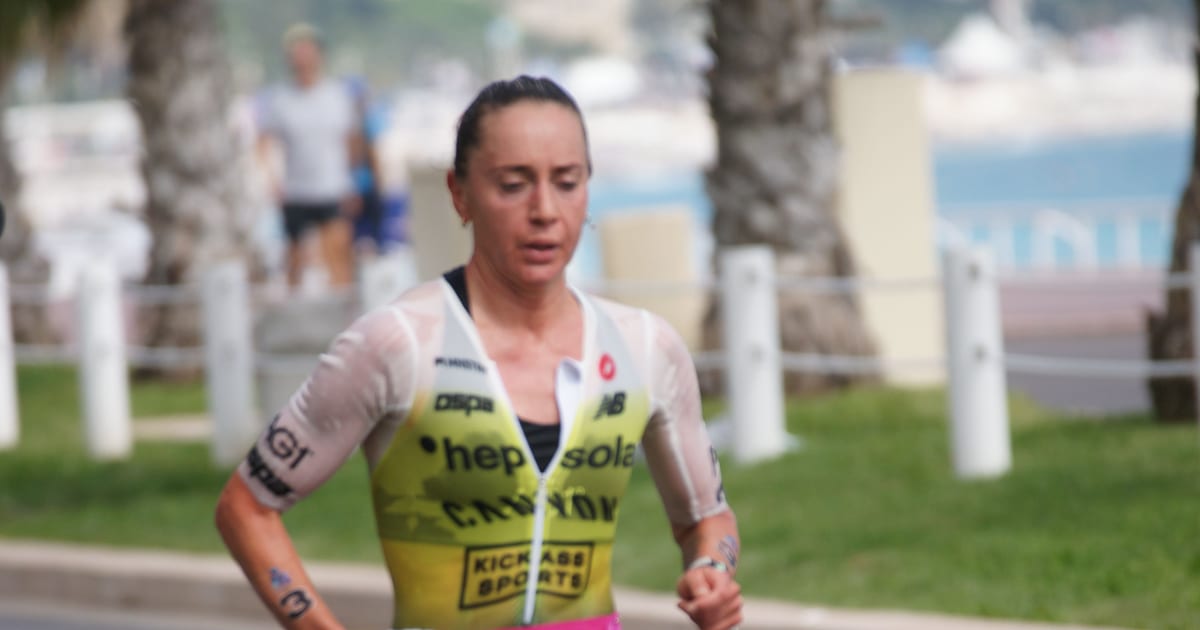
How Laura Philipp Trains (the Late Swimmer Who Rides and Runs Back)
Laura Philipp learned to swim at 24, left the Kona 2026 water 30th and 8:34 down, and still finished second. Why adult swimmers should test their CSS.
Laura Philipp left the water at the 2026 Ironman World Championship in Kona in 30th place, 8:34 behind the leader after a 1:00:03 swim, and still finished second in 8:39:34, 3:05 behind Taylor Knibb. She learned to swim at 24. Her career is the clearest case in the sport that the swim is the leg adults start late, and the one where a simple test tells you exactly where you stand.
The race on 10 October
The swim was the worst of the favorites. "In the swim, I got really seasick. It was quite big waves, so the swim wasn't really good," she said afterwards. Over the 3.86 km course her 1:00:03 works out to roughly 1:33 per 100 m. Knibb swam 52:55, about 1:22 per 100 m.
With no group to ride with, she rode the 180 km alone in 4:43:00 and came off the bike 10th, 9:52 behind Knibb. Then she ran a 2:50:43 marathon, seven minutes faster than the winner's. She was fourth at halfway, third when Lucy Charles-Barclay dropped out, and second when the late leader, defending champion Solveig Løvseth, collapsed in the final mile. The result also won her the Ironman Pro Series title and its $200,000 bonus. "Now I have a full set," she said: a world title (Nice, 2024), a second, and two thirds in Kona (2023 and 2025).
Learning to swim at 24
Philipp did not grow up in a pool. Her youth sport was rock climbing, she cycled about 60 km a day to and from school, and she learned to swim at 24 so she could try a triathlon. Her coach from the start has been Philipp Seipp, now her husband, who first worked with her on technique in all three sports.
That history still shows. Before Kona 2025 she said plainly, "I will not be out of the water in the front," and in 2026 she was not. A decade of professional training has made her one of the strongest riders and runners in the sport. It has not made her a front-pack swimmer.
What is public about her training beyond that is partial. She has described weeks of up to 35 hours. In the winter before her 2025 Challenge Roth win she and Seipp leaned heavily on cross-country skiing, and she does much of her work indoors on the trainer and the treadmill. Her session-by-session week and her swim sets are not published. On pacing she is known for racing by feel and barely checking her watch on the run.
The cheapest leg to measure
For an adult-onset swimmer, the swim is also the easiest discipline to put a number on. A running threshold test is 30 hard minutes, and a cycling one needs a power meter. Swimming needs a pool, a clock and two efforts.
Critical swim speed (CSS) comes from the critical speed model applied to swimming by Wakayoshi and colleagues in 1992: the pace you could, in theory, hold for a long time without fatiguing. The field version uses a 400 m and a 200 m time trial on the same day, with full recovery between them:
CSS (m/s) = 200 / (400 m time − 200 m time)
Swim the 400 m in 7:20 and the 200 m in 3:30, and CSS is 200 / 230 s, about 0.87 m/s, or 1:55 per 100 m. The calculator then sets five zones as offsets from that pace. Threshold (zone 3) runs from 1:53 to 1:57 per 100 m, two seconds either side of CSS. Steady aerobic work (zone 2) sits at 1:57 to 2:03.
Critical Swim Speed
1:35/100m
CSS speed
1.05m/s
| Zone | Range | What it trains |
|---|---|---|
| Z1 | Recovery 1:43–1:47 /100m | Easy technique and recovery swimming. RPE 2–3, smooth. |
| Z2 | Endurance 1:37–1:43 /100m | Aerobic base; long steady sets. RPE 4–5, comfortable. |
| Z3 | Threshold (CSS) 1:33–1:37 /100m | Critical swim speed, your sustainable threshold pace. RPE 6–7, comfortably hard. |
| Z4 | VO₂max 1:29–1:33 /100m | Maximal aerobic; race-pace intervals. RPE 8–9, hard. |
| Z5 | Sprint 1:21–1:29 /100m | Speed and anaerobic power; short fast reps. RPE 9–10, very fast. |
Z1 · Recovery. Easy technique and recovery swimming. RPE 2–3, smooth.
Z2 · Endurance. Aerobic base; long steady sets. RPE 4–5, comfortable.
Z3 · Threshold (CSS). Critical swim speed, your sustainable threshold pace. RPE 6–7, comfortably hard.
Z4 · VO₂max. Maximal aerobic; race-pace intervals. RPE 8–9, hard.
Z5 · Sprint. Speed and anaerobic power; short fast reps. RPE 9–10, very fast.
- Critical Swim Speed is your threshold pace, about 1:35 per 100 m here. It is the slope of the 200 m and 400 m efforts, so both must be genuinely maximal and well-paced.
- Swim CSS as a 400 m and a 200 m time trial on the same session, fully rested between. If the 200 m is not much faster than 400-m pace, you likely didn't pace the 400 m hard enough.
- Heart rate is unreliable in the water, so CSS pace is the most practical anchor for swim training.
A PDF of your personalized results, with a QR code to reopen them anytime.
The value of the number is that it removes guessing. Late starters tend to swim every set at the same effort, which is too hard for long aerobic work and too easy to move threshold. With a CSS pace on the pace clock, the long sets get slower and the threshold sets get honest. Retest every six to eight weeks, because a swimmer who is still learning the stroke can see CSS move quickly.
Philipp's Kona also shows the limit of the swim. Losing 8:34 to the front cost her the lead pack, and she rode and ran back to within three minutes of the win. Over an Ironman, the swim is the shortest leg by time. Measure it, train it at the right pace, and do not let a weak one decide your race.
What you can steal from it
- Test your CSS. A 400 m and 200 m time trial gives you a threshold pace in one pool session.
- Swim zone 2 slower than you think. Steady aerobic sets sit a few seconds per 100 m slower than CSS, not at it.
- Make threshold sets honest. Hold CSS pace on the clock, two seconds either side, rather than swimming by mood.
- Retest often while you are learning. A late starter's CSS moves faster than a lifelong swimmer's.
- Keep the swim in proportion. Philipp lost 8:34 in the water and still finished second by riding and running back.
More in this series: Lucy Charles-Barclay, Kristian Blummenfelt, Alex Yee, Mark Allen, and from the same Kona race Taylor Knibb, Julie Derron and men's champion Vincent Luis. For a lifelong swimmer's view of the same calculator, see Katie Ledecky.
Sources
- Slowtwitch race report
- NBC Sports results
- Big Island Now
- 220 Triathlon
- Triathlon Magazine
- Runner's World Germany
- Challenge Roth
- Wikipedia profile
- Wakayoshi et al. 1992
Cover photo by Dacoucou, CC BY-SA 4.0, via Wikimedia Commons.
