Competitive 100k or 50 Mile Ultra Training Plan: 13-Hour Weeks
A 20-week 100k or 50 mile trail plan for runners racing ultras: six runs, peak 13 hours, 6.5-hour long runs, hills plus tempo, 3,600 m weeks. Free.

A competitive 100k or 50 mile trail plan runs 20 weeks at six runs a week, peaks at about 13 hours, and builds long runs to 6.5 hours with back-to-backs of up to 2.5 hours. It pairs a weekly hill session with a tempo or steady run. It fits runners who race ultras for time or place and train 8 to 11 hours a week. It is written in time and effort, not pace.
The 20 weeks
Sample plan · 100k / 50 mile trail ultra, competitive
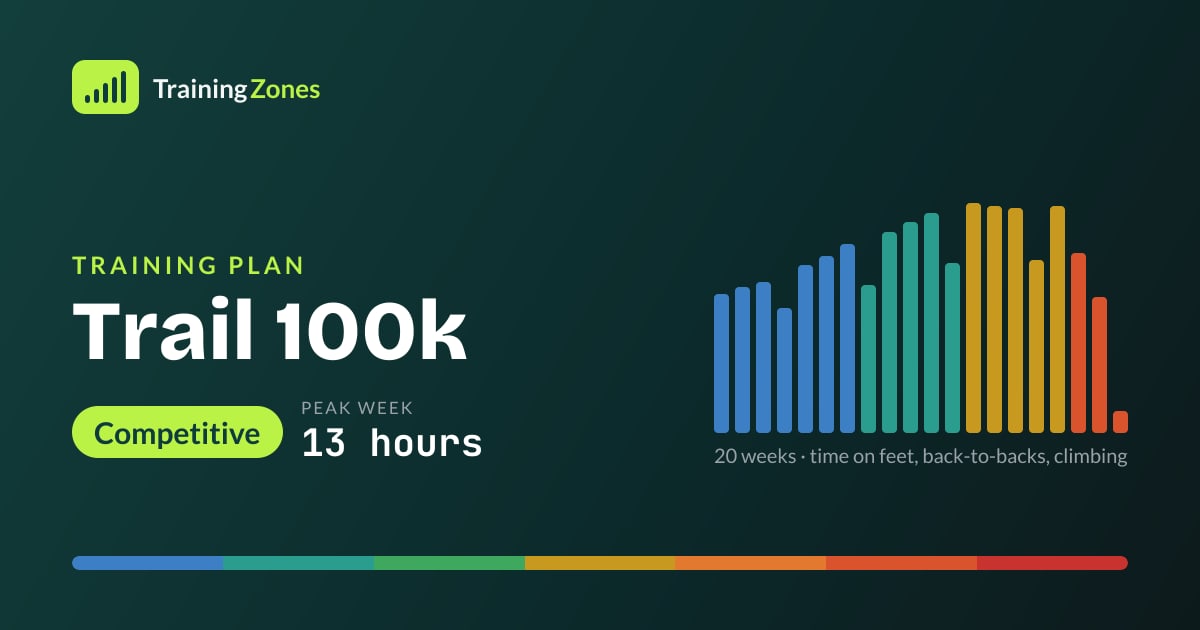
20 weeks, 6 runs a week, peak week 13h 22m, longest run 6h 30m, up to 3600 m of climbing a week for a race with 3000 m. 86 % of the running is easy.
| Week | Time | Key sessions | Long run |
|---|---|---|---|
| 1 Base | 8h 06m · 1200 m | Easy running only | 3h 05m long run |
| 2 Base | 8h 30m · 1300 m | Easy running only | 3h 20m long run with power hiking |
| 3 Base | 8h 50m · 1900 m | Hill repeats: 6 × 3 min I (3 min jog) | 3h 30m long run |
| 4 Base, recovery | 7h 15m · 1200 m | Long hill intervals: 3 × 6 min T (4 min jog) | 2h 45m long run with power hiking |
| 5 Base | 9h 50m · 2050 m | Power-hike repeats: 3 × 8 min power hike (4 min jog) | 3h 50m long run |
| 6 Base | 10h 17m · 2150 m | Hill fartlek: 12 × 90 s I (90 s jog) | 4h 05m long run with power hiking |
| 7 Base | 10h 58m · 2300 m | Hill repeats: 7 × 3 min I (3 min jog) | 4h 25m long run |
| 8 Build, recovery | 8h 34m · 1450 m | Long hill intervals: 3 × 6 min T (4 min jog) | 4h 10m long run with power hiking |
| 9 Build | 11h 43m · 3200 m | Power-hike repeats: 3 × 8 min power hike (4 min jog); Steady run: 75 min M | 5h 50m long run, steady finish |
| 10 Build | 12h 19m · 3300 m | Hill fartlek: 14 × 90 s I (90 s jog); Tempo run: 35 min T | 6h long run with power hiking |
| 11 Build | 12h 47m · 3400 m | Hill repeats: 8 × 3 min I (3 min jog); Steady run: 75 min M | 6h 15m long run, steady finish |
| 12 Build, recovery | 9h 53m · 1600 m | Long hill intervals: 4 × 6 min T (4 min jog) | 4h 55m long run with power hiking |
| 13 Peak | 13h 22m · 3600 m | Power-hike repeats: 4 × 8 min power hike (4 min jog); Tempo run: 35 min T | 6h 30m race rehearsal |
| 14 Peak | 13h 09m · 3600 m | Hill fartlek: 16 × 90 s I (90 s jog); Steady run: 75 min M | 6h 30m long run, steady finish |
| 15 Peak | 13h 08m · 3600 m | Hill repeats: 10 × 3 min I (3 min jog); Tempo run: 40 min T | 6h 30m race rehearsal |
| 16 Peak, recovery | 10h 05m · 1600 m | Long hill intervals: 4 × 6 min T (4 min jog) | 4h 55m long run, steady finish |
| 17 Peak | 13h 11m · 3600 m | Power-hike repeats: 4 × 8 min power hike (4 min jog); Tempo run: 40 min T | 6h 30m longest run: race rehearsal |
| 18 Taper | 10h 28m · 2350 m | Hill fartlek: 11 × 90 s I (90 s jog); Tempo run: 25 min T | 5h 10m long run |
| 19 Taper | 7h 54m · 1700 m | Hill repeats: 6 × 3 min I (3 min jog); Steady run: 65 min M | 3h 55m long run |
| 20 Taper | 1h 17m + race | Race day | None, race week |
The sample runner has six days a week and a race with 3,000 m of climbing:
- Base, weeks 1 to 7. 8.1 to 11 hours. Long runs from 3 h 05 to 4 h 15. The hill session starts in week 3 and rotates through hill repeats, long hill intervals, power-hike repeats and hill fartlek.
- Build, weeks 8 to 12. 11.7 to 12.8 hours around lighter weeks 8 and 12. A tempo run of 35 minutes or a 75-minute steady run joins the hills. Long runs of 5 h 50 to 6 h 15.
- Peak, weeks 13 to 17. About 13 hours. Six-and-a-half-hour long runs and race rehearsals, tempos of up to 40 minutes, climbing of 3,600 m a week.
- Taper, weeks 18 to 20. About 10.5, then 8 hours, then race week.
Who this plan is for
Ultra levels come from experience, because trail finish times depend on the course. Competitive means racing ultras for time or place and 8 to 11 hours a week of running now. The plan starts at about 8 hours. Six days is the default.
Volume is the predictor
Knechtle et al. (2010) studied 169 men in a 100 km race. Among the training variables, weekly kilometres and the speed of training runs predicted race time best. Rüst et al. (2012) compared 100 km runners with marathoners: the ultra runners ran more hours and more kilometres per week, and in them weekly volume, not training speed, was tied to race time.
That shapes the competitive plan:
- 13 hours at the peak, with the long run and back-to-back carrying about two thirds of it.
- 86 % easy, so the volume can be absorbed.
- Two quality days from the build: hills for climbing strength, tempo or steady running for the effort you hold for hours.
- Climbing at 120 % of the race's total in peak weeks, 3,600 m for a 3,000 m race.
Where this plan stops
The generator plans six runs a week, no doubles, and caps the long run at 6.5 hours. Weeks of 13 hours fit that. If you train more, keep the plan's two quality days, the long run and the back-to-back, and add easy time or a second run on easy days. Runs of two hours or more carry the ISSN fuelling target of 30 to 50 g carbohydrate and 450 to 750 mL fluid per hour.
Your own plan
The 100k and 50 mile ultra training plan generator builds yours from your race date, running days, long-run day, experience and the race's total climb. Add your max heart rate and every effort has a heart-rate range. Free, no email, PDF included.
FAQ
How many hours a week for a competitive 100k? This plan peaks at about 13 hours. The research above points to volume as the lever, so more can help if you recover from it.
Why not longer long runs? 6.5 hours plus a 2.5-hour back-to-back already holds nine hours on two days. The plan caps the single run there and uses the back-to-back for the rest of the weekend's time.
Should the tempo run be on trail? On flat or rolling ground, where the effort is easy to hold. Road is fine.
Is the plan the same for 50 miles? Yes. Enter your race's climbing and the weekly targets follow it.
Plan your race fuelling:
목표 탄수화물
60g/h
운동 시간당
총 탄수화물
120g
2시간 세션 전체
세션 길이별 권장 탄수화물
| 1시간 미만보통 물이면 충분 | 0 g/h |
| 1시간에서 2.5시간권장단일 운반 탄수화물 (포도당) | 60 g/h |
| 2.5시간 이상포도당과 과당, 약 2:1 혼합 | 90 g/h |
- 탄수화물은 수분, 나트륨과 함께 섭취하세요. 충분한 물 없이 농축된 연료는 위장에 머물러 불편함을 일으킵니다.
- 높은 탄수화물 섭취율을 견디는 것은 훈련으로 키울 수 있는 능력입니다. 긴 세션에서 레이스 연료 공급을 연습하고 점진적으로 늘리되, 레이스 당일에 새로운 고섭취를 시도하지 마세요.
- 시간당 60g을 넘으면 약 2:1의 포도당 대 과당 혼합을 사용하세요. 포도당만으로는 시간당 약 60g에서 위장 운반체가 포화됩니다.
- 힘든 노력은 탄수화물을 더 빨리 소모하므로, 각 범위의 상단에 가깝게 잡으세요.
당신의 개인 맞춤 결과가 담긴 PDF와, 언제든 다시 열 수 있는 QR 코드.
More in this series: the first-ultra and experienced 100k / 50 mile plans and the competitive 50k plan.
Sources
- Knechtle et al. 2010, predictors of 100 km race time
- Rüst et al. 2012, training of 100 km ultra-marathoners and marathoners
- Tiller et al. 2019, ISSN position stand on ultra-marathon nutrition
Cover image: TrainingZones.