Experienced 50k Ultra Training Plan: Faster on the Climbs
A 16-week 50k trail ultra plan for runners with an ultra behind them: peak 9.5 hours, 4.5-hour long runs, power-hike repeats and climbing targets. Free.

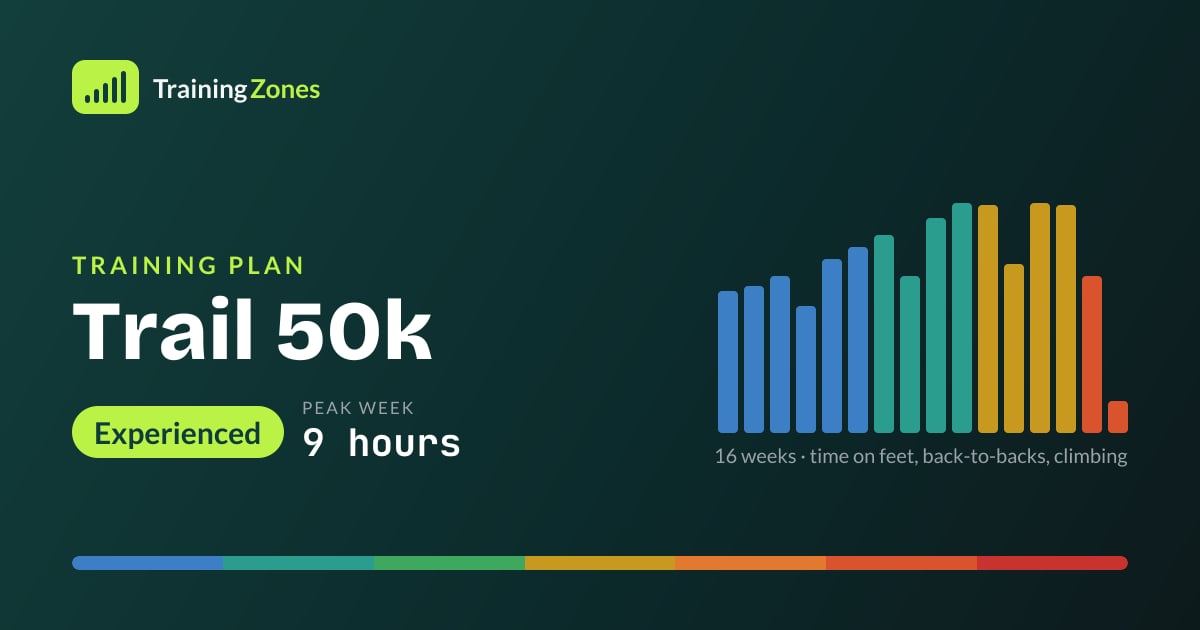
An experienced 50k trail plan runs 16 weeks at five runs a week, peaks at about 9.5 hours, and builds long runs to 4.5 hours with power hiking, followed by back-to-backs of up to 110 minutes. It fits runners who have finished at least one ultra and train 5 to 7 hours a week. It is written in time and effort, not pace.
The 16 weeks
Sample plan · 50k trail ultra, experienced
16 weeks, 5 runs a week, peak week 9h 25m, longest run 4h 30m, up to 1600 m of climbing a week for a race with 1500 m. 89 % of the running is easy.
| Week | Time | Key sessions | Long run |
|---|---|---|---|
| 1 Base | 5h 45m · 400 m | Easy running only | 2h 10m long run |
| 2 Base | 5h 59m · 450 m | Easy running only | 2h 20m long run with power hiking |
| 3 Base | 6h 23m · 850 m | Hill repeats: 5 × 3 min I (3 min jog) | 2h 30m long run |
| 4 Base, recovery | 5h 14m · 400 m | Long hill intervals: 3 × 6 min T (4 min jog) | 2h long run with power hiking |
| 5 Base | 7h 04m · 950 m | Power-hike repeats: 3 × 8 min power hike (4 min jog) | 2h 45m long run |
| 6 Base | 7h 35m · 1000 m | Hill fartlek: 10 × 90 s I (90 s jog) | 3h long run with power hiking |
| 7 Build | 8h 06m · 1300 m | Hill repeats: 6 × 3 min I (3 min jog) | 3h 55m long run with power hiking |
| 8 Build, recovery | 6h 23m · 700 m | Long hill intervals: 3 × 6 min T (4 min jog) | 3h 05m long run, steady finish |
| 9 Build | 8h 48m · 1400 m | Power-hike repeats: 3 × 8 min power hike (4 min jog) | 4h 20m long run with power hiking |
| 10 Build | 9h 25m · 1600 m | Hill fartlek: 11 × 90 s I (90 s jog) | 4h 30m long run, steady finish |
| 11 Peak | 9h 16m · 1600 m | Hill repeats: 7 × 3 min I (3 min jog) | 4h 30m race rehearsal |
| 12 Peak, recovery | 6h 52m · 750 m | Long hill intervals: 3 × 6 min T (4 min jog) | 3h 25m long run, steady finish |
| 13 Peak | 9h 25m · 1600 m | Power-hike repeats: 3 × 8 min power hike (4 min jog) | 4h 30m race rehearsal |
| 14 Peak | 9h 15m · 1600 m | Hill fartlek: 13 × 90 s I (90 s jog) | 4h 30m longest run: race rehearsal |
| 15 Taper | 6h 23m · 850 m | Hill repeats: 5 × 3 min I (3 min jog) | 3h 10m long run |
| 16 Taper | 1h 17m + race | Race day | None, race week |
The sample runner has five days a week and a race with 1,500 m of climbing:
- Base, weeks 1 to 6. 5.8 to 7.6 hours. Long runs from 2 h 10 to 3 hours. From week 3 the hill session rotates through 5 × 3 minutes uphill, 3 × 6 minutes at threshold, 3 × 8 minutes of power hiking and hill fartlek.
- Build, weeks 7 to 10. 8.1 to 9.4 hours. Long runs of 3 h 55 to 4 h 30, back-to-backs of 95 to 110 minutes.
- Peak, weeks 11 to 14. Four-and-a-half-hour race rehearsals in race kit around a lighter week 12. Weekly climbing reaches about the race's 1,500 m.
- Taper, weeks 15 and 16. About 6.5 hours, then race week.
Who this plan is for
Ultra levels come from experience, because trail finish times depend on the course. Experienced means at least one ultra finished and 5 to 7 hours a week of running now. The plan starts at about 5.8 hours. Every session is minutes at an effort, with heart-rate ranges if you add your max heart rate.
Hiking is a skill you train
After a first ultra, the distance is known. On a mountain 50k a large share of the time goes into the climbs, and on steep climbs the fastest way up is usually a walk.
Giovanelli et al. (2016) measured runners on inclines from 9 to 39 degrees at the same vertical speed. On every incline steeper than about 16 degrees, walking cost less energy than running. Minetti et al. (2002) found the most economical mountain paths sit around 20 to 30 % gradient for both gaits. On those grades, a strong hike saves energy for the rest of the race.
So the plan trains hiking like any other skill:
- Power-hike repeats in the hill rotation: 8 minutes of hard hiking on a steep climb or treadmill, with an easy walk or jog down.
- Power hiking inside long runs, every second long run, about a fifth of its time.
- Race rehearsals in the peak where you hike every steep section at the effort you plan for race day.
Around that, the plan keeps the structure that makes the climbing possible: 89 % easy running, weekly time rising at most 10 % between loading weeks, and climbing that builds toward the race's own total.
Your own plan
The 50k ultra training plan generator builds yours from your race date, running days, long-run day, experience and the race's total climb. Every session shows time, effort, climbing and purpose, with the fuelling target on runs of two hours or more. Free, no account, PDF included.
FAQ
How steep is steep enough to hike? The research puts the switch point at about 16 degrees, roughly a 29 % grade. On race day, hike earlier than that if it keeps your effort easy.
What should I eat on the long runs? The ISSN position stand recommends 30 to 50 g carbohydrate and 450 to 750 mL fluid per hour in an ultra. Practise it on every run of two hours or more.
Can I train for a mountain 50k without mountains? Yes, with less precision. Use the steepest hill you have for repeats and a treadmill at maximum incline for power hiking.
How is this different from the first-ultra plan? About two more hours a week at the peak, long runs an hour longer, and power-hike repeats in the rotation.
Plan your race fuelling:
목표 탄수화물
60g/h
운동 시간당
총 탄수화물
120g
2시간 세션 전체
세션 길이별 권장 탄수화물
| 1시간 미만보통 물이면 충분 | 0 g/h |
| 1시간에서 2.5시간권장단일 운반 탄수화물 (포도당) | 60 g/h |
| 2.5시간 이상포도당과 과당, 약 2:1 혼합 | 90 g/h |
- 탄수화물은 수분, 나트륨과 함께 섭취하세요. 충분한 물 없이 농축된 연료는 위장에 머물러 불편함을 일으킵니다.
- 높은 탄수화물 섭취율을 견디는 것은 훈련으로 키울 수 있는 능력입니다. 긴 세션에서 레이스 연료 공급을 연습하고 점진적으로 늘리되, 레이스 당일에 새로운 고섭취를 시도하지 마세요.
- 시간당 60g을 넘으면 약 2:1의 포도당 대 과당 혼합을 사용하세요. 포도당만으로는 시간당 약 60g에서 위장 운반체가 포화됩니다.
- 힘든 노력은 탄수화물을 더 빨리 소모하므로, 각 범위의 상단에 가깝게 잡으세요.
당신의 개인 맞춤 결과가 담긴 PDF와, 언제든 다시 열 수 있는 QR 코드.
More in this series: the first-ultra and competitive 50k plans and the experienced 100k / 50 mile plan.
Sources
- Giovanelli et al. 2016, energetics of steep uphill running and walking
- Minetti et al. 2002, energy cost at extreme slopes
- Tiller et al. 2019, ISSN position stand on ultra-marathon nutrition
Cover image: TrainingZones.