Advanced 5k Training Plan: 8 Weeks for 17 to 20 Minutes
An 8-week advanced 5k plan for 17 to 20 minute runners: six runs a week, peak 59 km, 5 × 1000 m at interval pace, 11 × 200 m reps. Built for sub-18. Free.

An advanced 5k plan runs 8 weeks at six runs a week, peaks at about 59 km, and builds to 5 × 1000 m at interval pace and 11 × 200 m at repetition pace. It fits runners whose 5k sits between 17 and 20 minutes, roughly a 35 to 41 minute 10k. Sub-19 and sub-18 are both inside this band.
The 8 weeks
Sample plan · Advanced 5k
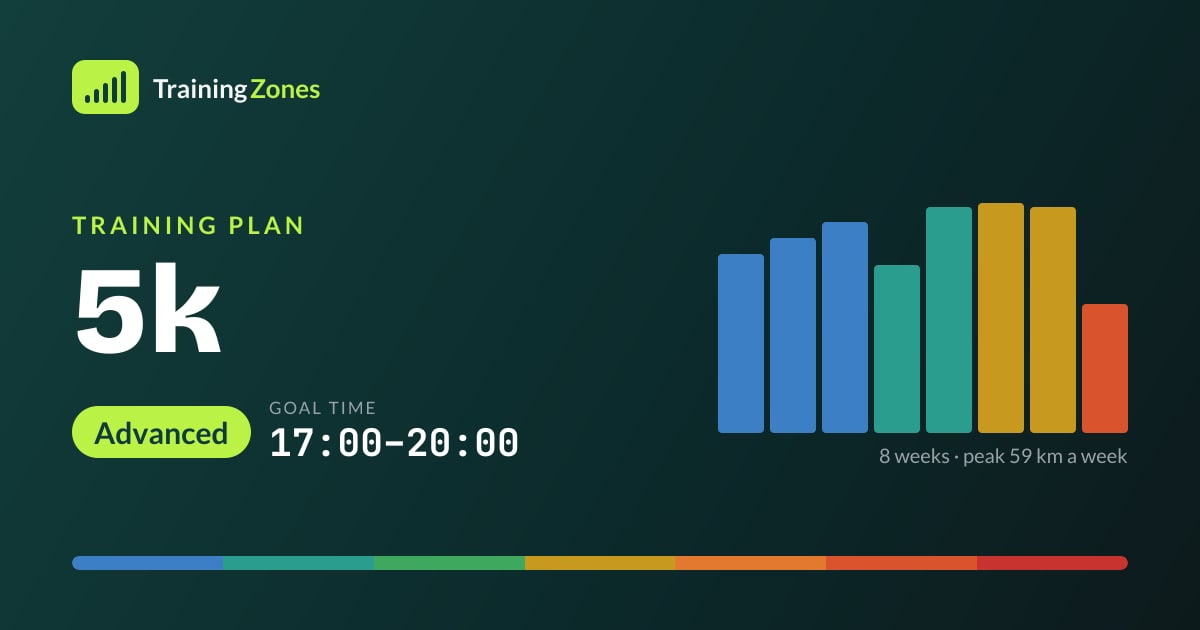
8 weeks, 6 runs a week, peak 59 km, longest run 15 km. Built for a recent 5k of 18:00 (VDOT 56.3). 89 % of the running is easy.
| Week | Km | Key sessions | Long run |
|---|---|---|---|
| 1 Base | 46 | Easy running only | 13 km long run |
| 2 Base | 50 | Easy running only | 15 km long run + strides |
| 3 Base | 54 | Tempo run: 15 min T | 14 km long run |
| 4 Build, recovery | 43 | Cruise intervals: 3 × 1.6 km T (1 min jog); Long intervals: 4 × 3 min I (3 min jog) | 12 km long run |
| 5 Build | 58 | Tempo run: 20 min T; 30/30 intervals: 2 × (15 × 30 s I / 30 s jog), 3 min between sets | 15 km long run + strides |
| 6 Peak | 59 | Long intervals: 4 × 4 min I (4 min jog); 200 m reps: 11 × 200 m R (200 m jog) | 15 km long run + strides |
| 7 Peak | 58 | 1000 m repeats: 5 × 1000 m I (400 m jog); 300 m reps: 8 × 300 m R (300 m jog) | 14 km long run |
| 8 Taper | 33 + race | Sharpener: 6 × 200 m R (200 m jog); race day | None, race week |
- Base, weeks 1 to 3. 46 to 54 km, long runs of 13 to 15 km. A 15-minute tempo in week 3.
- Build, weeks 4 and 5. Week 4 is lighter: 3 × 1.6 km cruise intervals and 4 × 3 minutes at interval pace. Week 5: a 20-minute tempo and two sets of 15 × 30/30.
- Peak, weeks 6 and 7. 4 × 4 minutes and 5 × 1000 m at interval pace, 11 × 200 m and 8 × 300 m at repetition pace. Long runs of 14 to 15 km.
- Taper, week 8. Six 200 m reps, easy running, race day.
Who counts as advanced
The level comes from Jack Daniels' VDOT, one number from a recent race that sets every training pace. Advanced means a 5k of 17 to 20 minutes, roughly VDOT 50 to 60. A 19-minute 5k is VDOT 52.9, an 18-minute 5k VDOT 56.3. Sub-17 is where the sub-elite band starts. The sample runner has an 18:00 5k.
| 5k finish | Race pace | Easy | Marathon | Threshold | Interval |
|---|---|---|---|---|---|
| 17:00 | 3:24 | 4:13–5:03 | 3:52 | 3:40 | 3:21 |
| 18:30 | 3:42 | 4:34–5:28 | 4:12 | 3:58 | 3:38 |
| 20:00 | 4:00 | 4:54–5:53 | 4:32 | 4:16 | 3:55 |
Same sessions, bigger doses
The advanced plan uses the same session types as the intermediate one. What changes is the dose. Side by side in the peak weeks:
- Long intervals: 4 × 4 minutes instead of 4 × 3.
- 1000 m repeats: five instead of three.
- 200 m reps: eleven instead of eight.
- 300 m reps: eight instead of six.
The generator sets each dose as minutes at intensity. It starts from a value per level and grows about 10 % per loading week. Daniels' limits then cap it against your weekly distance: interval work at about 8 % of the week, repetition work at about 5 %, rounded to whole reps. A runner on 59 km a week can hold about twice the repetition volume of a beginner on 30, so the reps grow with the week around them.
The frame around those sessions:
- Two hard days that never touch, and a rest day after the long run.
- 89 % easy running. Haugen (2022) found world-class distance runners keep at least 80 % of their volume at low intensity.
- Strides and hill sprints on easy days. Short, fast, fully recovered efforts that train speed without adding fatigue. Paavolainen (1999) found explosive-type strength training improved 5k time through running economy and muscle power, with no change in VO2max. Hill sprints are the running version of that stimulus.
Your own plan
The 5k training plan generator builds all 8 weeks from your 5k or parkrun time, your weeks until race day, your running days and your long-run day. Add a goal like 17:59 and it shows the gap to your prediction. Free, no account, PDF included.
FAQ
What pace do I need for a sub-18 5k? 3:36 per km, VDOT 56.3. A 10k of 37:20 predicts it.
How many kilometres a week for a sub-18 5k? This plan peaks at 60 km on six days. On five days the target is the same, with longer mid-week runs.
Why is the long run only 15 km for a 5k? The 5k long run is capped at 28 % of the week and 14 km of running, plus strides. It builds aerobic volume without cutting into the two quality days.
Should I race parkruns during the plan? Only in place of a quality session. The plan never puts two hard days in a row, and a hard parkrun counts as one.
Only need your training paces? Enter a recent race:
VDOT
49.8
Daniels 러닝 피트니스 점수
| 존 | 범위 | 무엇을 단련하는가 |
|---|---|---|
| E | 쉬움 / 롱런 4:54–5:53 /km | 유산소 기초, 모세혈관, 지방 대사; 주간 볼륨의 대부분. RPE 3–4, 대화 가능. |
| M | 마라톤 4:26–4:51 /km | 마라톤 특화 지구력과 경제성. RPE 5–6, 꾸준함. |
| T | 역치 4:16–4:28 /km | 젖산 역치; 편안하게 힘든 템포와 크루즈 인터벌. RPE 7, 약 1시간 레이스 강도. |
| I | 인터벌 3:51–4:01 /km | VO₂max; 3–5분 강한 반복. RPE 9, 힘듦. |
| R | 리피티션 3:19–3:42 /km | 스피드, 경제성, 러닝 파워; 충분한 회복과 함께하는 짧고 빠른 반복. RPE 9–10, 빠르고 통제됨. |
E · 쉬움 / 롱런. 유산소 기초, 모세혈관, 지방 대사; 주간 볼륨의 대부분. RPE 3–4, 대화 가능.
M · 마라톤. 마라톤 특화 지구력과 경제성. RPE 5–6, 꾸준함.
T · 역치. 젖산 역치; 편안하게 힘든 템포와 크루즈 인터벌. RPE 7, 약 1시간 레이스 강도.
I · 인터벌. VO₂max; 3–5분 강한 반복. RPE 9, 힘듦.
R · 리피티션. 스피드, 경제성, 러닝 파워; 충분한 회복과 함께하는 짧고 빠른 반복. RPE 9–10, 빠르고 통제됨.
- 당신의 VDOT 49.8은 현재 러닝 체력을 담아낸 단일 수치입니다(러닝 경제성을 반영해 조정한 'VO₂max'). 모든 훈련 페이스가 여기서 도출됩니다.
- VDOT는 최근의 강도 높은 레이스나 타임 트라이얼 하나에서 나옵니다. 전력을 다해 레이스한 결과를 사용하세요. 이상적으로는 5 km 이상이며, 하프 마라톤이나 10 km가 가장 안정적인 추정치를 줍니다.
- 단위 토글을 전환하면 마일당 페이스로 볼 수 있습니다. 체력이 향상되면 다시 레이스하세요. VDOT와 모든 페이스가 갱신됩니다.
- 이것은 다니얼스의 개별 훈련 페이스(E, M, T, I, R)이며 연속된 존이 아닙니다. 각 페이스를 특정 목적에 맞춰 달립니다. 더 힘든 페이스(T, I, R) 사이의 간격은 오류가 아니라 의도된 것입니다.
당신의 개인 맞춤 결과가 담긴 PDF와, 언제든 다시 열 수 있는 QR 코드.
More in this series: the beginner, intermediate and sub-elite 5k plans and the advanced 10k plan.
Sources
- Haugen et al. 2022, training of world-class distance runners
- Paavolainen et al. 1999, explosive-strength training and 5k performance
Cover image: TrainingZones.