Beginner 5k Training Plan: 8 Weeks for Sub-30 and Sub-25 Goals
An 8-week beginner 5k plan for 25 to 35 minute runners: four runs a week, peak 30 km, 87 % easy, 30/30 intervals and short reps. Free, from your time.

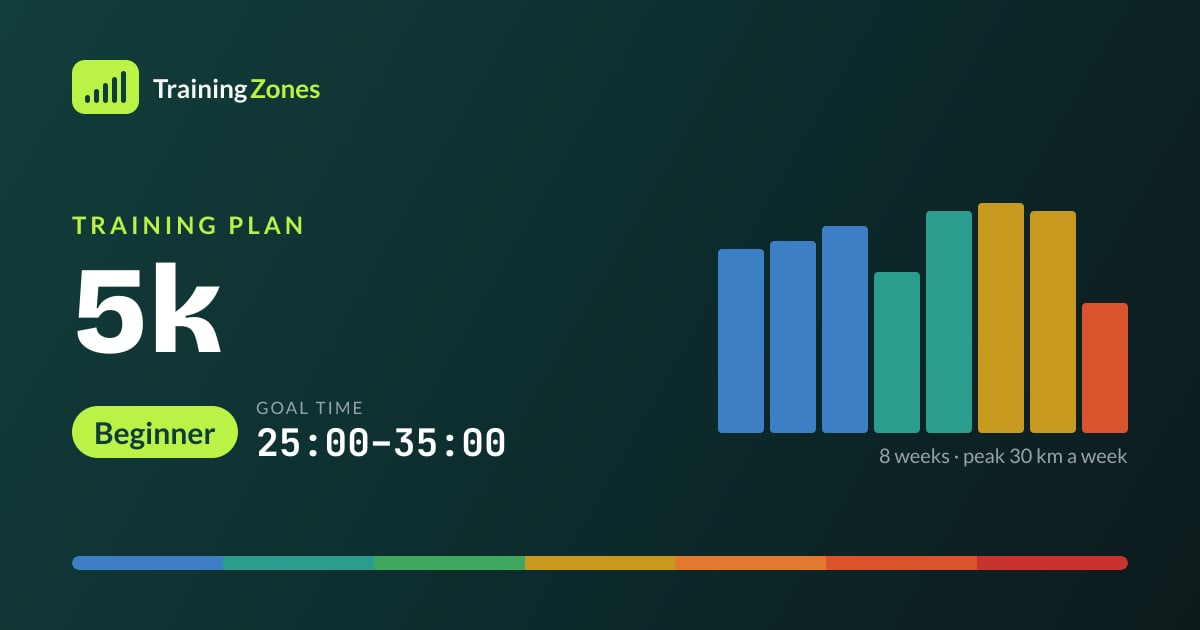
A beginner 5k plan runs 8 weeks at four runs a week, peaks at about 30 km, and keeps 87 % of the running easy. It fits runners whose current 5k sits between 25 and 35 minutes. Sub-30 sits in the middle of the band, sub-25 at its fast edge.
The 8 weeks
Sample plan · Beginner 5k
8 weeks, 4 runs a week, peak 30 km, longest run 9 km. Built for a recent 5k of 27:00 (VDOT 35.0). 87 % of the running is easy.
| Week | Km | Key sessions | Long run |
|---|---|---|---|
| 1 Base | 24 | Easy running only | 6 km long run |
| 2 Base | 25 | Easy running only | 8 km long run + strides |
| 3 Base | 27 | Tempo run: 15 min T | 7 km long run |
| 4 Build, recovery | 21 | Cruise intervals: 3 × 1 km T (1 min jog) | 6 km long run |
| 5 Build | 29 | Tempo run: 15 min T; 30/30 intervals: 2 × (10 × 30 s I / 30 s jog), 3 min between sets | 9 km long run + strides |
| 6 Peak | 30 | Long intervals: 3 × 3 min I (3 min jog); 200 m reps: 6 × 200 m R (200 m jog) | 9 km long run + strides |
| 7 Peak | 29 | 1000 m repeats: 3 × 1000 m I (400 m jog); 300 m reps: 5 × 300 m R (300 m jog) | 8 km long run |
| 8 Taper | 17 + race | Sharpener: 6 × 200 m R (200 m jog); race day | None, race week |
- Base, weeks 1 to 3. 24 to 27 km a week, long runs of 6 to 8 km with strides. One 15-minute tempo in week 3.
- Build, weeks 4 and 5. Week 4 is lighter, with 3 × 1 km cruise intervals. Week 5 adds a second quality day: a 15-minute tempo and two sets of 10 × 30 seconds fast, 30 seconds jog.
- Peak, weeks 6 and 7. 3 × 3 minutes and 3 × 1000 m at interval pace, plus 200 m and 300 m reps at repetition pace. Long runs of 8 to 9 km.
- Taper, week 8. Six 200 m reps early in the week, easy running, then race day.
Who counts as a beginner
The plan reads your level from Jack Daniels' VDOT, a single number from a recent race that sets every training pace. Beginner means a 5k slower than 25:00. A 30-minute 5k is VDOT 30.8, a 25-minute 5k VDOT 38.3. The sample runner has a 27:00 5k, VDOT 35.
| 5k finish | Race pace | Easy | Marathon | Threshold | Interval |
|---|---|---|---|---|---|
| 25:00 | 5:00 | 6:03–7:14 | 5:38 | 5:16 | 4:50 |
| 30:00 | 6:00 | 7:11–8:32 | 6:43 | 6:16 | 5:45 |
| 35:00 | 7:00 | 8:17–9:48 | 7:47 | 7:15 | 6:40 |
Easy pace is about one to nearly three minutes per km slower than 5k pace. Those easy paces are the ones to check your watch against.
No recent race? Pick the beginner level in the generator. Week 1 then starts with a 5k time trial and your paces appear once you enter it.
A small dose of speed, done right
A 5k is fast, and a beginner plan still needs speed. The question is how to get it without the kind of session that leaves you wrecked for three days.
The plan's answer is short, broken work. The 30/30 session in week 5 alternates 30 seconds at VO2max pace with 30 seconds of jogging. Billat (2000) found this format kept runners at VO2max longer than a continuous hard run at a slightly slower speed, and earlier studies found it well tolerated even by untrained people. Twenty reps feel manageable. Ten minutes of continuous hard running does not.
The 200 m and 300 m reps in the peak are repetition pace: faster than 5k pace, with full recovery. They train speed and running form rather than aerobic fitness, so they feel quick but never desperate.
Everything else is easy, and that is on purpose:
- 87 % easy. Seiler found well-trained endurance athletes settle on about 80 % of sessions at low intensity.
- Weekly km rise at most 10 % between loading weeks. Nielsen (2014) found runners who added more than 30 % over two weeks got injured more often than those under 10 %.
Your own plan
The sample is one runner with four free days. The 5k training plan generator builds yours from your 5k or parkrun time, your weeks until race day, your running days and your long-run day. Every session shows pace, distance and purpose. Add a goal like 24:59 and it shows the gap to your prediction. Free, no account, PDF included.
FAQ
How long does it take to go from 30 to 25 minutes in the 5k? That is a jump from VDOT 30.8 to 38.3, a lot for one 8-week block. Run this plan, race, enter the new time and run it again. Each block resets the paces.
Can I train for a 5k on three days a week? Yes. The peak target stays at 30 km on three days, with longer easy runs.
How long should my long run be for a 5k? About 28 % of the week, capped at 14 km. In this sample that is 6 to 9 km.
Are intervals safe for a beginner? In small doses, yes. This plan starts at about 10 minutes of interval running per session and never schedules two hard days in a row.
Only need your training paces? Enter a recent race:
VDOT
49.8
Daniels 러닝 피트니스 점수
| 존 | 범위 | 무엇을 단련하는가 |
|---|---|---|
| E | 쉬움 / 롱런 4:54–5:53 /km | 유산소 기초, 모세혈관, 지방 대사; 주간 볼륨의 대부분. RPE 3–4, 대화 가능. |
| M | 마라톤 4:26–4:51 /km | 마라톤 특화 지구력과 경제성. RPE 5–6, 꾸준함. |
| T | 역치 4:16–4:28 /km | 젖산 역치; 편안하게 힘든 템포와 크루즈 인터벌. RPE 7, 약 1시간 레이스 강도. |
| I | 인터벌 3:51–4:01 /km | VO₂max; 3–5분 강한 반복. RPE 9, 힘듦. |
| R | 리피티션 3:19–3:42 /km | 스피드, 경제성, 러닝 파워; 충분한 회복과 함께하는 짧고 빠른 반복. RPE 9–10, 빠르고 통제됨. |
E · 쉬움 / 롱런. 유산소 기초, 모세혈관, 지방 대사; 주간 볼륨의 대부분. RPE 3–4, 대화 가능.
M · 마라톤. 마라톤 특화 지구력과 경제성. RPE 5–6, 꾸준함.
T · 역치. 젖산 역치; 편안하게 힘든 템포와 크루즈 인터벌. RPE 7, 약 1시간 레이스 강도.
I · 인터벌. VO₂max; 3–5분 강한 반복. RPE 9, 힘듦.
R · 리피티션. 스피드, 경제성, 러닝 파워; 충분한 회복과 함께하는 짧고 빠른 반복. RPE 9–10, 빠르고 통제됨.
- 당신의 VDOT 49.8은 현재 러닝 체력을 담아낸 단일 수치입니다(러닝 경제성을 반영해 조정한 'VO₂max'). 모든 훈련 페이스가 여기서 도출됩니다.
- VDOT는 최근의 강도 높은 레이스나 타임 트라이얼 하나에서 나옵니다. 전력을 다해 레이스한 결과를 사용하세요. 이상적으로는 5 km 이상이며, 하프 마라톤이나 10 km가 가장 안정적인 추정치를 줍니다.
- 단위 토글을 전환하면 마일당 페이스로 볼 수 있습니다. 체력이 향상되면 다시 레이스하세요. VDOT와 모든 페이스가 갱신됩니다.
- 이것은 다니얼스의 개별 훈련 페이스(E, M, T, I, R)이며 연속된 존이 아닙니다. 각 페이스를 특정 목적에 맞춰 달립니다. 더 힘든 페이스(T, I, R) 사이의 간격은 오류가 아니라 의도된 것입니다.
당신의 개인 맞춤 결과가 담긴 PDF와, 언제든 다시 열 수 있는 QR 코드.
More in this series: the intermediate, advanced and sub-elite 5k plans and the beginner 10k plan.
Sources
- Billat et al. 2000, intermittent runs at VO2max velocity
- Seiler 2010, training intensity distribution
- Nielsen et al. 2014, weekly distance progression and injury
Cover image: TrainingZones.