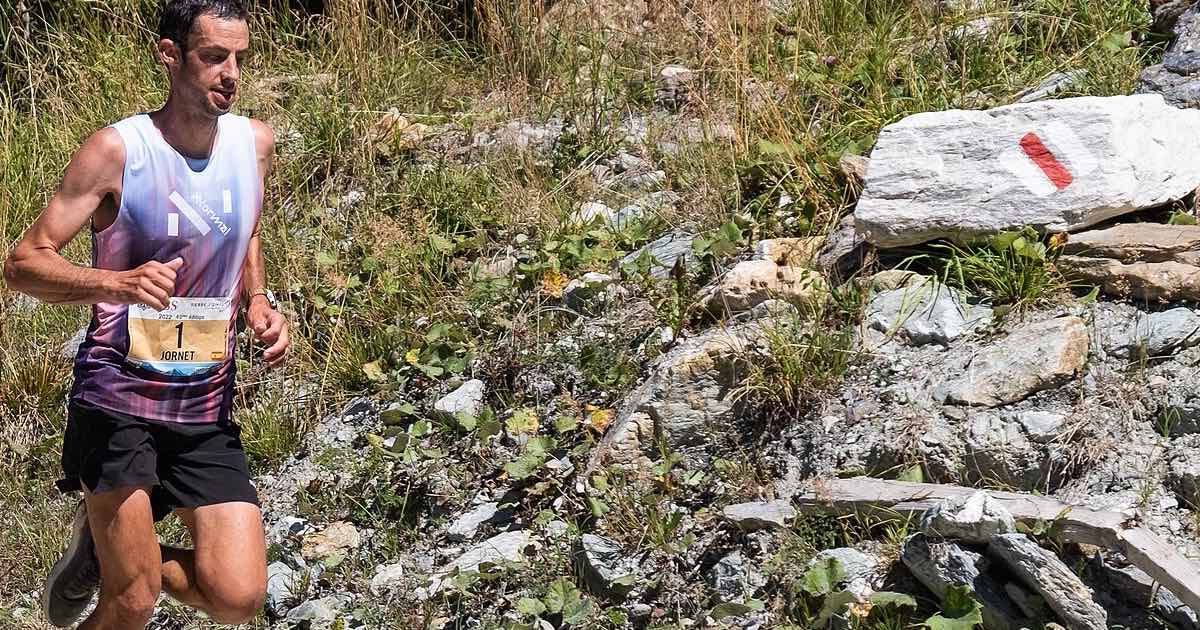
How Kilian Jornet Trains (and Why He Counts Metres, Not Kilometres)
Kilian Jornet measures training in vertical gain, builds a 3 to 4 month easy base every year, and coaches himself by feel. The method and the 2026 season.

Ask Kilian Jornet how his week went and the unit is metres climbed, not kilometres. For a mountain athlete the load that matters is measured upwards, and his whole method follows from that. His 2026 season also shows that a huge aerobic engine and a durable body are two different projects.
Vertical is the unit
An hour on a road and an hour up a 20 percent slope are the same duration and completely different training. Pace collapses once the gradient forces everyone to power-hike. What survives is vertical gain per hour, and it behaves like flat pace: repeatable and comparable week to week. The ski mountaineering and uphill calculator is built around it:
Kadar menegak ujian
1200m/h
daripada TT menegak anda
Kadar daki mudah
840m/h
~70% daripada ujian
| Zon | Julat | Apa yang dilatihnya |
|---|---|---|
| Z1 | Pemulihan 95–114 bpm | Turunan mudah dan pemulihan. RPE 1–2. |
| Z2 | Daya Tahan 114–143 bpm | Asas pendakian aerobik jauh. RPE 3–4, tempo daki sepanjang hari. |
| Z3 | Tempo 143–162 bpm | Tempo pendakian berterusan. RPE 5–6, bekerja. |
| Z4 | Ambang 162–175 bpm | Ambang pendakian-perlumbaan. RPE 7–8, sukar. |
| Z5 | VO₂max 175–190 bpm | Tanjakan curam dan pendakian akhir. RPE 9–10, maksimum. |
Z1 · Pemulihan. Turunan mudah dan pemulihan. RPE 1–2.
Z2 · Daya Tahan. Asas pendakian aerobik jauh. RPE 3–4, tempo daki sepanjang hari.
Z3 · Tempo. Tempo pendakian berterusan. RPE 5–6, bekerja.
Z4 · Ambang. Ambang pendakian-perlumbaan. RPE 7–8, sukar.
Z5 · VO₂max. Tanjakan curam dan pendakian akhir. RPE 9–10, maksimum.
- Skimo ditentukan pada pendakian, jadi kadar pendakian menegak (Vm/j) ialah penambat prestasi utama. Kadar ujian anda di sini kira-kira 1200 m/j; aturkan tempo pendakian jauh hampir 840–1140 m/j.
- Gunakan zon kadar jantung di atas untuk latihan harian dan panduan kadar-menegak untuk mengatur tempo perlumbaan dan selang pendakian. Kedua-duanya bersama mengatasi mana-mana satu sahaja.
PDF keputusan peribadi anda, dengan kod QR untuk membukanya semula bila-bila masa.
Do a hard, sustained climb, enter the vertical gained and the time, and you get zones in the unit the mountain charges you in.
Three or four months of easy, every year
The structural feature of Jornet's year is a long aerobic block. In his words:
I always do a long aerobic base period for 3-4 months with moderate to long distance journeys. That's a must for me to build the base fitness to then do the specific training.
Race-pace and threshold work comes late, six or seven weeks out from a target. His reported distribution is around 80 to 90 percent easy, the same territory as polarized training, reached by feel. Most amateurs invert the order: sharp in January, sharp all year, no base underneath. The aerobic base training guide makes the same argument at amateur scale.
Winter is for skis
From roughly November to May, Jornet's training is dominated by ski mountaineering, which he races seriously. Skinning uphill gives the cardiovascular load of running uphill with a fraction of the eccentric damage, because there is no downhill pounding. A winter of huge aerobic volume, and a seasonal break for the tendons. If you live near snow, ski touring is the closest thing to free aerobic volume. The ski touring zones page covers the nordic side.
Self-coached, by feel
Jornet has no personal coach. He consults sports scientists, but the plan and the daily steering are his own:
I train based on feel, and use my heart rate to see if I have a cardiac response that might suggest if I'm tired or fresh.
Heart rate is not setting the session. It is a freshness check, the more useful job for HR where terrain makes pace meaningless. A drifting resting heart rate, or an oddly low heart rate on an easy climb, says more about readiness than any workout number.
He also says:
If you don't have pleasure when you train, you will never improve!
The number nobody has measured
You will read that Jornet's VO2max is around 90. It traces back to informal estimates and back-calculations from race results, not a published lab test, and Jornet has said he has not done the standard protocol. The engine is extraordinary. The number is folklore. For your own figure, use an estimate from a field test.
2026: the engine was never the problem
Jornet built 2026 as a compressed season: Western States in June, Sierre-Zinal in August, UTMB at the end of August, chasing a record fifth UTMB title.
At Zegama in May, a race he has won a record eleven times, he picked up a leg problem and faded to 43rd. He took time off running, started Western States anyway, ran with the lead group early, and pulled out at Dusty Corners around mile 38 as the knee got worse. His team said continuing no longer felt like the right decision. Sierre-Zinal and UTMB followed later in the season.
The Ingebrigtsen post shows the same pattern: two of the most gifted endurance athletes of this era both lost seasons to a joint or tendon, not to fitness. Aerobic capacity and structural durability are separate accounts. Almost all zone advice, including ours, is about the first one.
What you can steal from it
- Measure the load your sport applies. For mountain athletes that is rate of climb, not flat pace.
- Build base before sharpness, every year. Three to four months easy, then six or seven weeks specific.
- Use winter for low-impact volume. Ski touring loads the engine without pounding the tissue.
- Let heart rate report on freshness, not dictate pace.
- Treat famous physiological numbers as gossip until you see the protocol.
- Enjoy it, or you won't keep doing it. Nobody is consistent for years at something they hate.
More in this series: Rémi Bonnet, Jakob Ingebrigtsen, Eliud Kipchoge, Tadej Pogačar and Jonas Vingegaard.
Sources
Cover photo by Christian David, CC BY-SA 4.0, via Wikimedia Commons.
