Finding Your Maximum Heart Rate
What max heart rate is, why the 220 minus age rule is shaky, and how to estimate or field-test yours. Includes a six-formula calculator.

Your maximum heart rate (HRmax) anchors every heart-rate zone. Get it wrong by 10 beats and every zone shifts by 5–10 bpm.
What max heart rate is
HRmax is the highest your heart can beat during all-out effort. It is largely genetic, drifts down slowly with age, and is not a measure of fitness.
You can't train your max heart rate up. Its only job is to anchor your zones.
Estimate it in five seconds
The 220 − age rule is easy to remember but was never derived from solid data. It runs high for older athletes and low for some younger ones. Tanaka (208 − 0.7 × age) is more accurate. Drop your age in below to see six published formulas side by side:
Aanbevolen HRmax
184bpm
Tanaka (2001)
Gemiddelde van alle 6 modellen
183bpm
gebruik dit bij twijfel
Zes gepubliceerde voorspellers, naast elkaar (±10–12 bpm typische foutmarge)
| Fox / Haskell (1971) | 185 bpm |
| Tanaka (2001)Aanbevolen | 184 bpm |
| Gellish (2007) | 183 bpm |
| Nes (2013) | 189 bpm |
| Gulati, vrouwen (2010) | 175 bpm |
| Londeree & Moeschberger | 181 bpm |
| Gemiddelde van alle zes modellengemiddelde van de bovenstaande voorspellers | 183 bpm |
- We bevelen Tanaka (2001) aan omdat deze opnieuw is afgeleid uit een meta-analyse van 18.712 personen en over leeftijden heen nauwkeuriger is dan de oude regel 220 min leeftijd, die voor oudere sporters vaak te hoog uitvalt.
- De door formules voorspelde HRmax heeft een standaarddeviatie van ongeveer ±10–12 bpm, dus twee sporters van dezelfde leeftijd kunnen 20+ bpm verschillen. Gebruik het alleen als startpunt.
- Doe voor nauwkeurigheid een maximale veldtest (bijv. een zware heuvelherhalingssessie of een begeleide ramptest) en lees je echte HRmax af van het apparaat.
Een PDF met je resultaten, plus een QR-code om ze altijd opnieuw te openen.
Test it for real
A field test beats any equation. After a thorough warm-up:
- Run or ride 2–3 minutes hard uphill.
- Recover briefly, then go again, building to an all-out final 30 seconds.
- The highest number you see is close to your true HRmax.
Maximal effort, not for beginners. Stop if you feel unwell. One good test lasts years, since HRmax drops only about 0.7 bpm per year.
Then build your zones
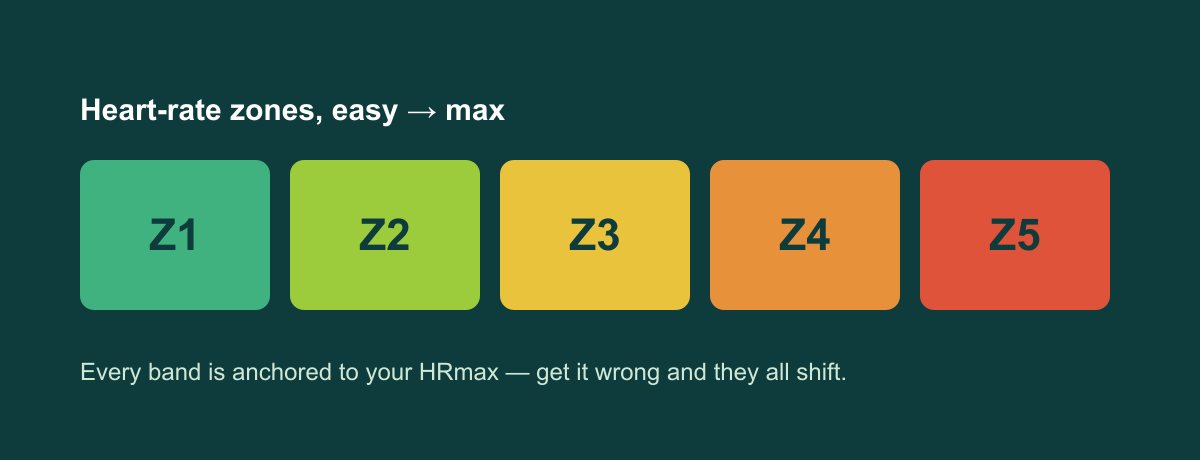
- Heart-rate zone calculator: the standard %HRmax 5-zone split.
- LTHR zones: anchor to lactate-threshold heart rate instead.
- Max heart rate calculator: the six-formula tool above.