Sub-Elite Marathon Training Plan: 16 Weeks, 120 km Peak, 2:20 to 2:45
A 16-week sub-elite marathon plan for 2:20 to 2:45 runners: six runs a week, peak 120 km, 34 km long runs, marathon pace plus threshold combos. Free.

A sub-elite marathon plan runs 16 weeks at six runs a week, peaks at 120 km, and holds 34 km long runs for most of the build. It fits runners whose races predict a 2:20 to 2:45 marathon: roughly a 14:30 to 17:15 5k, or a half marathon between about 1:07 and 1:19.
The 16 weeks
Sample plan · Sub-elite marathon
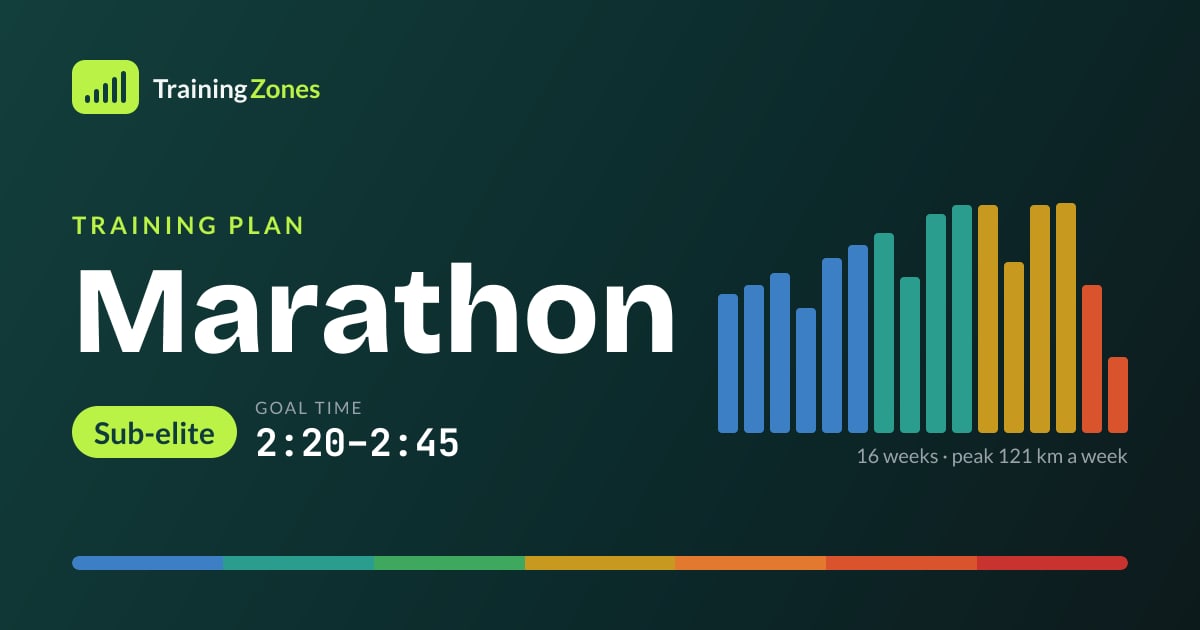
16 weeks, 6 runs a week, peak 121 km, longest run 35 km. Built for a recent 5k of 16:00 (VDOT 64.6). 84 % of the running is easy.
| Week | Km | Key sessions | Long run |
|---|---|---|---|
| 1 Base | 73 | Easy running only | 32 km long run |
| 2 Base | 78 | Easy running only | 35 km long run + strides |
| 3 Base | 84 | Easy running only | 34 km long run |
| 4 Base, recovery | 66 | Progression run: 16 min M · 16 min T | 30 km long run |
| 5 Base | 92 | Cruise intervals: 4 × 1.6 km T (1 min jog) | 34 km long run |
| 6 Base | 99 | Tempo run: 25 min T | 35 km long run + strides |
| 7 Build | 105 | Cruise intervals: 5 × 1.6 km T (1 min jog); Long intervals: 4 × 3 min I (3 min jog) | 34 km long run |
| 8 Build, recovery | 82 | Broken tempo: 2 × 11 min T (2 min jog); 30/15 sets: 2 × (13 × 30 s I / 15 s jog), 3 min between sets | 34 km long run |
| 9 Build | 115 | Tempo run: 30 min T; Hill repeats: 11 × 75 s I (2 min jog) | 34 km long run |
| 10 Build | 120 | Progression run: 34 min M · 34 min T; 5k time trial | 34 km progressive long run |
| 11 Peak | 120 | Marathon-pace run: 11 km M; Cruise intervals: 5 × 1.6 km T (1 min jog) | 34 km long run with marathon-pace finish |
| 12 Peak, recovery | 90 | Marathon-pace alternations: 8 × 1 km M (1000 m jog); Broken tempo: 2 × 11 min T (2 min jog) | 34 km long run |
| 13 Peak | 120 | Marathon plus threshold combo: 4 km M · 1 km T · 4 km M · 1 km T; Tempo run: 30 min T | 34 km long run with marathon-pace finish |
| 14 Peak | 121 | Marathon-pace run: 12 km M; Progression run: 34 min M · 34 min T | 34 km long run with marathon-pace finish |
| 15 Taper | 78 | Marathon-pace alternations: 8 × 1 km M (1000 m jog) | 24 km dress rehearsal |
| 16 Taper | 40 + race | Sharpener: 3 × 1.6 km M (1 min jog); race day | None, race week |
- Base, weeks 1 to 6. From 73 to 99 km. Long runs start at 32 km, because a runner at this level arrives with the base already built. Quality is threshold: progressions, 4 × 1.6 km cruise intervals, a 25-minute tempo.
- Build, weeks 7 to 10. 105 to 120 km. Threshold grows to a 30-minute tempo and a 34-minute marathon-pace plus 34-minute threshold progression. Short VO2max work (30/15 sets, 11 hill repeats of 75 seconds) keeps the top end sharp. A 5k time trial closes week 10.
- Peak, weeks 11 to 14. Three weeks at 120 km around a 90 km recovery week. Mid-week marathon-pace runs of 11 and 12 km, 8 × 1 km alternations, and the marathon plus threshold combination. Long runs of 34 km finish with 8, 10, then 16 km at marathon pace.
- Taper, weeks 15 and 16. A 24 km dress rehearsal with 10 km at marathon pace, then race week.
Who counts as sub-elite
Sub-elite is the level just below professional: fast club and championship runners. Here it means a predicted marathon faster than 2:45, roughly VDOT 59 and up in Jack Daniels' system. A 2:30 marathon is VDOT 66. The sample runner has a 16:00 5k, VDOT 64.6, which predicts 2:33.
| Marathon finish | Race pace | Easy | Threshold | Interval |
|---|---|---|---|---|
| 2:20 | 3:19 | 3:39–4:23 | 3:10 | 2:54 |
| 2:33 | 3:37 | 3:57–4:45 | 3:26 | 3:09 |
| 2:45 | 3:55 | 4:16–5:07 | 3:42 | 3:24 |
Easy pace at this level is still 20 to 70 seconds per km slower than marathon pace.
Volume is the difference, and where this plan stops
The paces in the table follow the same formula as a beginner's. What changes at this level is how much running sits under them.
This plan peaks at 120 km, about 75 miles, inside the 70 to 85 mile band of Pfitzinger's higher Advanced Marathoning schedules. Haugen (2022) found world-class marathoners run 160 to 220 km a week in mid-preparation, over 11 to 14 sessions. Casado (2021) found world-class performance is best predicted by the volume of easy running plus deliberate practice of tempo and short intervals. That is the same shape as this plan, at a larger scale.
The generator has limits a sub-elite runner should know:
- Six runs a week, no doubles. Past 120 km, single runs get too long to recover from. If you already run twice a day, take the plan's quality sessions and long runs and split the easy days yourself.
- The long run caps at 34 km. At sub-elite easy pace that is about 2 hours 20 minutes, so the long runs hold at 34 km from week 5 instead of growing.
- The dress rehearsal is capped at 24 km. It is a race-kit run, not a last long run.
Your plan from your race
The marathon training plan generator builds the full 16 weeks from your recent race, your weeks, your days and your long-run day. Add a goal time and it shows the gap to your prediction. Free, no email, PDF included, and the week-10 time trial updates every pace.
FAQ
How many kilometres a week for a 2:30 marathon? This plan peaks at 120 km on six days. The world-class range reported by Haugen is 160 to 220 km, so there is room above it if you recover well.
Do I need doubles for a sub-2:40 marathon? Not for the volume in this plan. Six runs averaging 20 km reach 120 km. Doubles make sense once single runs would have to average well over 20 km.
Why are there so few hard sessions? 84 % of the running is easy. Two quality days and a long run with a marathon-pace finish are enough stimulus. More would cut into the easy volume that predicts performance at this level.
Can I use the plan for a shorter build? Yes. The generator accepts 12 to 24 weeks. A 12-week build starts at higher volume and shortens the base phase.
Only need your training paces? Enter a recent race:
VDOT
49.8
skor kecergasan larian Daniels
| Zon | Julat | Apa yang dilatihnya |
|---|---|---|
| E | Mudah / Jauh 4:54–5:53 /km | Asas aerobik, kapilari, metabolisme lemak; kebanyakan volum mingguan. RPE 3–4, boleh berbual. |
| M | Marathon 4:26–4:51 /km | Daya tahan dan ekonomi khusus marathon. RPE 5–6, mantap. |
| T | Ambang 4:16–4:28 /km | Ambang laktat; tempo selesa sukar dan selang jelajah. RPE 7, usaha perlumbaan ~1j. |
| I | Selang 3:51–4:01 /km | VO₂max; ulangan sukar 3–5 min. RPE 9, sukar. |
| R | Ulangan 3:19–3:42 /km | Kelajuan, ekonomi dan kuasa larian; ulangan pantas pendek dengan pemulihan penuh. RPE 9–10, pantas dan terkawal. |
E · Mudah / Jauh. Asas aerobik, kapilari, metabolisme lemak; kebanyakan volum mingguan. RPE 3–4, boleh berbual.
M · Marathon. Daya tahan dan ekonomi khusus marathon. RPE 5–6, mantap.
T · Ambang. Ambang laktat; tempo selesa sukar dan selang jelajah. RPE 7, usaha perlumbaan ~1j.
I · Selang. VO₂max; ulangan sukar 3–5 min. RPE 9, sukar.
R · Ulangan. Kelajuan, ekonomi dan kuasa larian; ulangan pantas pendek dengan pemulihan penuh. RPE 9–10, pantas dan terkawal.
- VDOT anda iaitu 49.8 ialah satu nombor yang menangkap kecergasan larian semasa (suatu 'VO₂max' yang diselaraskan untuk ekonomi larian). Setiap tempo latihan diterbitkan daripadanya.
- VDOT datang daripada satu perlumbaan atau ujian masa baru-baru ini yang sukar. Gunakan keputusan yang anda lari habis-habisan, sebaik-baiknya 5 km atau lebih panjang; separuh marathon atau 10 km memberi anggaran paling stabil.
- Tukar suis unit untuk membaca tempo per batu. Apabila anda menjadi lebih cergas, berlumba semula; VDOT dan semua tempo anda akan dikemas kini.
- Ini ialah pace latihan Daniels yang berasingan (E, M, T, I, R), bukan zon berterusan: anda berlari pada setiap pace untuk tujuan tertentu. Jurang antara pace yang lebih keras (T, I dan R) adalah sengaja, bukan ralat.
PDF keputusan peribadi anda, dengan kod QR untuk membukanya semula bila-bila masa.
Race report: Berlin Marathon 2026 results, the winners, the course record and the numbers.
More in this series: the beginner, intermediate and advanced marathon plans, and the sub-elite half marathon plan.
Sources
- Haugen et al. 2022, training of world-class distance runners
- Casado et al. 2021, predictors of world-class long-distance performance
- Bosquet et al. 2007, tapering meta-analysis
- Jones 2024, physiological resilience
Cover image: TrainingZones.