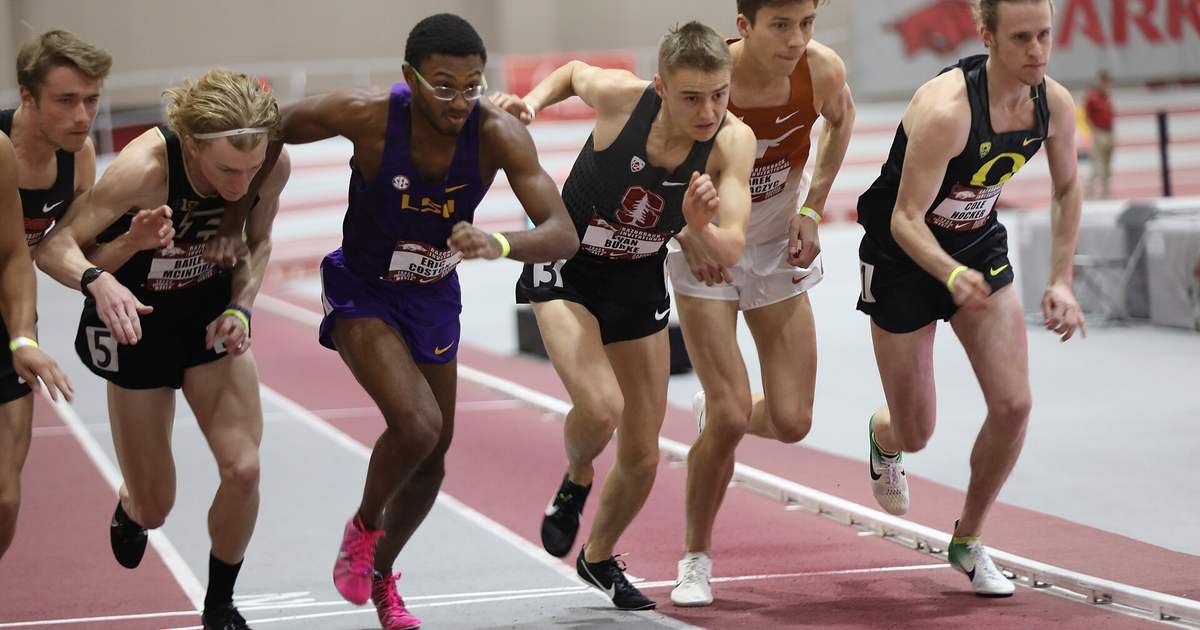
How Cole Hocker Trains (One Engine, From the Mile to the 5000)
Cole Hocker is Olympic 1500m champion, world 5000m champion and the second-fastest indoor miler ever. How one number predicts your pace at every distance.

Cole Hocker's defining quality is range. Olympic 1500m gold in 2024 in an Olympic-record 3:27.65. The world 5000m title in Tokyo a year later. An indoor mile of 3:45.94 in early 2026, an American record and the second-fastest in history behind Jakob Ingebrigtsen. That range is a live demonstration that these distances run on one engine.
The span, in numbers
1500m: 3:27.65. 5000m: 12:58.30 at the 2025 World Championships, which he won. Mile: 3:47.43 outdoors, 3:45.94 indoors, a fraction behind Ingebrigtsen's world record. A runner who can win a kick-decided 1500 and grind out a 5000 title against specialists.
The outdoor mile world record moved in 2026 to Josh Kerr's 3:42.66. In that company, what sets Hocker apart is how far up in distance his speed carries.
Range is one engine, expressed at different speeds
The same aerobic engine underpins the mile and the 5000. A miler's finishing speed sits on top of it. A 5000m runner's durability draws from it. That is why a fast mile predicts a competitive 5000, and vice versa.
VDOT formalises this. Jack Daniels' system takes one race result, derives a single fitness number, and projects equivalent times and training paces from 1500m to the marathon:
VDOT
49.8
Daniels løpeformscore
| Sone | Område | Hva den trener |
|---|---|---|
| E | Lett / Langtur 4:54–5:53 /km | Aerob grunnform, kapillærer, fettforbrenning; mesteparten av ukentlig volum. RPE 3–4, samtalefart. |
| M | Maraton 4:26–4:51 /km | Maratonspesifikk utholdenhet og økonomi. RPE 5–6, jevnt. |
| T | Terskel 4:16–4:28 /km | Laktatterskel; behagelig hardt tempo og cruise-intervaller. RPE 7, ~1 t konkurranseinnsats. |
| I | Intervall 3:51–4:01 /km | VO₂max; 3–5 min harde drag. RPE 9, hardt. |
| R | Repetisjon 3:19–3:42 /km | Fart, økonomi og løpeeffekt; korte raske drag med full pause. RPE 9–10, raskt og kontrollert. |
E · Lett / Langtur. Aerob grunnform, kapillærer, fettforbrenning; mesteparten av ukentlig volum. RPE 3–4, samtalefart.
M · Maraton. Maratonspesifikk utholdenhet og økonomi. RPE 5–6, jevnt.
T · Terskel. Laktatterskel; behagelig hardt tempo og cruise-intervaller. RPE 7, ~1 t konkurranseinnsats.
I · Intervall. VO₂max; 3–5 min harde drag. RPE 9, hardt.
R · Repetisjon. Fart, økonomi og løpeeffekt; korte raske drag med full pause. RPE 9–10, raskt og kontrollert.
- Din VDOT på 49.8 er et enkelt tall som fanger din nåværende løpeform (en «VO₂max» justert for løpeøkonomi). Hver treningsfart utledes fra den.
- VDOT kommer fra ett nylig, hardt løp eller en tempotest. Bruk et resultat du løp for fullt, helst 5 km eller lengre; et halvmaraton eller 10 km gir det mest stabile estimatet.
- Bytt enhetsbryteren for å lese farter per mile. Etter hvert som du blir i bedre form, løp på nytt; din VDOT og alle farter oppdateres.
- Dette er Daniels’ atskilte treningstempoer (E, M, T, I, R), ikke sammenhengende soner: du løper i hvert tempo med et bestemt formål. Hullene mellom de hardere tempoene (T, I og R) er tilsiktet, ikke en feil.
En PDF med resultatene dine, pluss en QR-kode for å åpne dem igjen senere.
Enter a recent race at any distance and it tells you what your engine is worth everywhere else, plus your training paces. Hocker is the top of that table. Yours stops you guessing 5k pace from 10k feel and keeps your easy runs easy.
What we know about his training
Hocker is 25, coached by Ben Thomas, and trains in Oregon. The fine detail of his week is not well documented, so no invented session breakdown here. The outline is the one every good middle-distance programme shares: a large base of easy mileage, a small dose of very fast race-specific work, and patience. His finishing kick is built on being aerobically strong enough to have something left when everyone else is empty.
Ingebrigtsen's route is the systematised Norwegian method. Hocker's is the American collegiate-to-pro track tradition. Both end in a big aerobic engine and a sharp finish.
What you can steal from it
- Treat your distances as one engine. Mile speed and 5k fitness are the same base expressed differently. Train the base, sharpen the ends.
- Use one result to set everything. A recent race plus VDOT gives you equivalent times and your correct training paces.
- Build the kick on aerobic strength. A finish like Hocker's is being fresh enough to use your leg speed. Most of that work is easy running.
- Keep easy days easy so fast days can be fast.
More in this series: Josh Kerr, Jakob Ingebrigtsen, Eliud Kipchoge, Courtney Dauwalter and Alex Yee.
Sources
Cover photo by jenaragon94, CC BY 2.0, via Wikimedia Commons.
