Intermediate Maintenance Running Plan: 30 to 50 km a Week
An intermediate maintenance running plan for 30 to 50 km a week: five runs, threshold plus intervals weekly, 4-week blocks, and why easy-only fails.

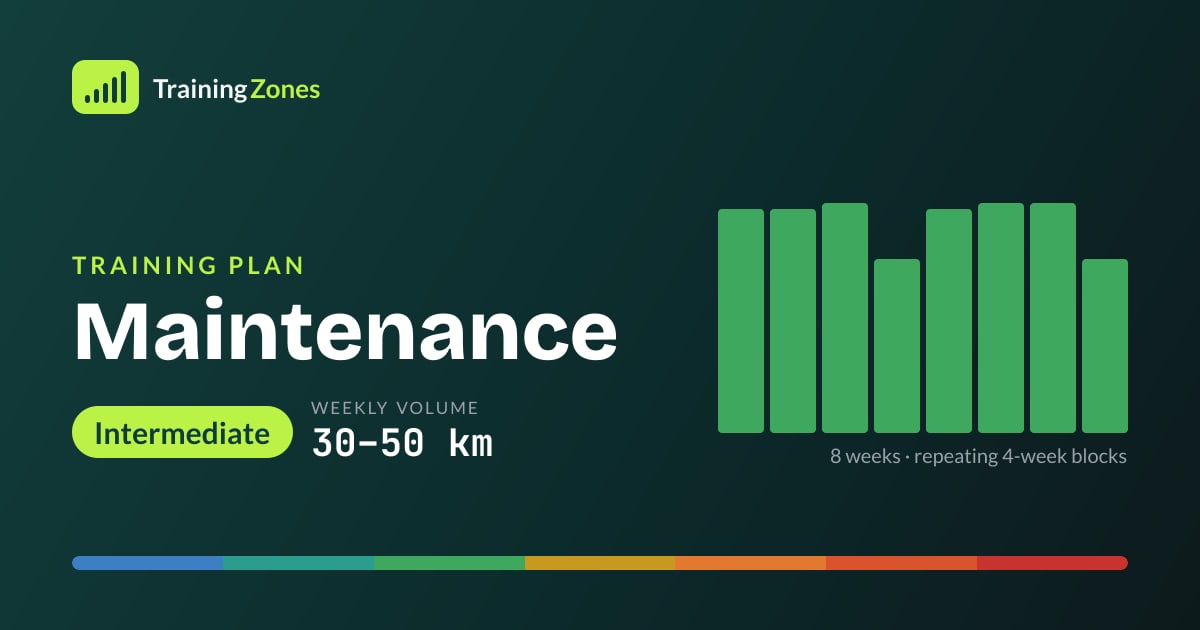
An intermediate maintenance plan holds 40 km a week on five runs, with one threshold and one interval session in every loading week. It runs in four-week blocks, three steady weeks and one lighter. It fits runners who train 30 to 50 km a week between races, after a marathon, or through a busy stretch of life.
The 8 weeks
Sample plan · Intermediate maintenance
8 weeks, 5 runs a week, 41 km a week, longest run 14 km. Built for a recent 5k of 21:00 (VDOT 47.0). 75 % of the running is easy.
| Week | Km | Key sessions | Long run |
|---|---|---|---|
| 1 Maintain | 40 | Cruise intervals: 3 × 1.6 km T (1 min jog); Long intervals: 4 × 3 min I (3 min jog) | 14 km long run |
| 2 Maintain | 40 | Tempo run: 20 min T; 30/15 sets: 2 × (13 × 30 s I / 15 s jog), 3 min between sets | 14 km progressive long run |
| 3 Maintain | 41 | Broken tempo: 2 × 9 min T (2 min jog); Hill repeats: 10 × 75 s I (2 min jog) | 14 km long run |
| 4 Maintain, recovery | 31 | Progression run: 13 min M · 13 min T; 1000 m repeats: 3 × 1000 m I (400 m jog) | 8 km long run |
| 5 Maintain | 40 | Cruise intervals: 3 × 1.6 km T (1 min jog); Long intervals: 4 × 3 min I (3 min jog) | 14 km long run |
| 6 Maintain | 41 | Tempo run: 20 min T; 30/15 sets: 2 × (13 × 30 s I / 15 s jog), 3 min between sets | 14 km progressive long run |
| 7 Maintain | 41 | Broken tempo: 2 × 9 min T (2 min jog); 5k time trial | 14 km long run |
| 8 Maintain, recovery | 31 | Progression run: 13 min M · 13 min T; 1000 m repeats: 3 × 1000 m I (400 m jog) | 8 km long run |
The sample runner has a 21:00 5k and runs five days a week:
- Weeks 1 to 3. About 40 km each. Threshold rotates through 3 × 1.6 km cruise intervals, a 20-minute tempo and 2 × 9 minutes broken tempo. Intervals rotate through 4 × 3 minutes, 30/15 sets and 10 hill repeats of 75 seconds. The 14 km long run alternates easy and progressive.
- Week 4. 31 km. A 13-minute marathon-pace plus 13-minute threshold progression and 3 × 1000 m, with a shorter long run.
- Weeks 5 to 8. The same block again, with a 5k time trial in week 7 in place of the interval session.
Who this plan is for
Maintenance levels come from how much you run, because there is no race time to aim at. Intermediate is 30 to 50 km a week. Enter your own volume in the generator and the plan holds it. Leave it empty and it uses 40 km. A recent race sets every pace through Jack Daniels' VDOT.
The easy-only trap
The natural move between races is to keep running and drop the hard sessions. It feels like rest. It costs fitness.
Hickson et al. (1985) took people who had just trained for ten weeks, running and cycling, and kept their six days a week and their session length for fifteen more, with the intensity cut by a third. VO2max dropped. Long-term endurance, the time they could hold a hard effort, fell by 21 %. A second group cut the intensity by two thirds and lost even more.
The opposite experiment went the other way. Keeping the intensity while cutting to two or four days a week held VO2max for fifteen weeks (Hickson and Rosenkoetter 1981). A review of the maintenance research found the same: endurance holds on as few as two sessions a week, or with volume cut by a third to two thirds, as long as intensity stays (Spiering et al. 2021).
That is the design of this plan:
- Threshold and intervals every loading week, at full pace. These are the two things that keep what you built.
- Flat volume. No weekly increase, because nothing is being built.
- A lighter fourth week at 75 %, so the block can repeat without fatigue piling up.
- A 5k time trial in week 7, so the paces follow your fitness instead of lagging behind it.
About three quarters of the running stays easy.
Your own plan
The maintenance running plan generator builds your block from your weekly volume, your running days, your long-run day and a recent race. Pick 4, 8 or 12 weeks. Every session shows pace, distance and purpose. Free, no account, PDF included.
When the next race is set, move to a race plan for your distance.
FAQ
Can I maintain fitness on 30 km a week if I used to run 50? Often, yes. Endurance held with volume cut by a third to two thirds when intensity stayed (Spiering et al. 2021). Enter 30 km as your weekly volume and the plan keeps both quality sessions.
How long does a maintenance block last? Four, eight or twelve weeks. The research covers up to 15 weeks, so the plan stops at 12.
What if I feel fresher than expected? Enter your week-7 time trial. If it is faster, every pace moves up for the next block.
Can I race a parkrun during the block? Yes, in place of the interval session. Never add it on top, or two hard days end up back to back.
Only need your training paces? Enter a recent race:
VDOT
49.8
índice de condicionamento de corrida de Daniels
| Zona | Faixa | O que treina |
|---|---|---|
| E | Fácil / Longo 4:54–5:53 /km | Base aeróbica, capilares, metabolismo de gordura; a maior parte do volume semanal. RPE 3–4, conversável. |
| M | Maratona 4:26–4:51 /km | Resistência e economia específicas de maratona. RPE 5–6, estável. |
| T | Limiar 4:16–4:28 /km | Limiar de lactato; tempo confortavelmente difícil e intervalos de cruzeiro. RPE 7, esforço de prova de ~1h. |
| I | Intervalo 3:51–4:01 /km | VO₂max; repetições intensas de 3–5 min. RPE 9, difícil. |
| R | Repetição 3:19–3:42 /km | Velocidade, economia e potência de corrida; repetições curtas e rápidas com recuperação completa. RPE 9–10, rápido e controlado. |
E · Fácil / Longo. Base aeróbica, capilares, metabolismo de gordura; a maior parte do volume semanal. RPE 3–4, conversável.
M · Maratona. Resistência e economia específicas de maratona. RPE 5–6, estável.
T · Limiar. Limiar de lactato; tempo confortavelmente difícil e intervalos de cruzeiro. RPE 7, esforço de prova de ~1h.
I · Intervalo. VO₂max; repetições intensas de 3–5 min. RPE 9, difícil.
R · Repetição. Velocidade, economia e potência de corrida; repetições curtas e rápidas com recuperação completa. RPE 9–10, rápido e controlado.
- Seu VDOT de 49.8 é um único número que captura o condicionamento de corrida atual (um 'VO₂max' ajustado pela economia de corrida). Todo ritmo de treino é derivado dele.
- O VDOT vem de uma prova ou contrarrelógio recente e intenso. Use um resultado que você correu no máximo, idealmente 5 km ou mais; uma meia maratona ou 10 km dão a estimativa mais estável.
- Alterne as unidades para ler ritmos por milha. À medida que melhora, corra novamente; seu VDOT e todos os ritmos serão atualizados.
- Estes são os ritmos de treino distintos de Daniels (E, M, T, I, R), não zonas contínuas: você corre em cada ritmo com um objetivo específico. Os intervalos entre os ritmos mais difíceis (T, I e R) são intencionais, não um erro.
Um PDF com seus resultados personalizados, além de um QR code para reabri-los a qualquer momento.
More in this series: the beginner, advanced and sub-elite maintenance plans, and the intermediate marathon plan.
Sources
- Hickson et al. 1985, reduced training intensity
- Hickson and Rosenkoetter 1981, reduced training frequency
- Spiering et al. 2021, minimal dose to maintain performance
Cover image: TrainingZones.