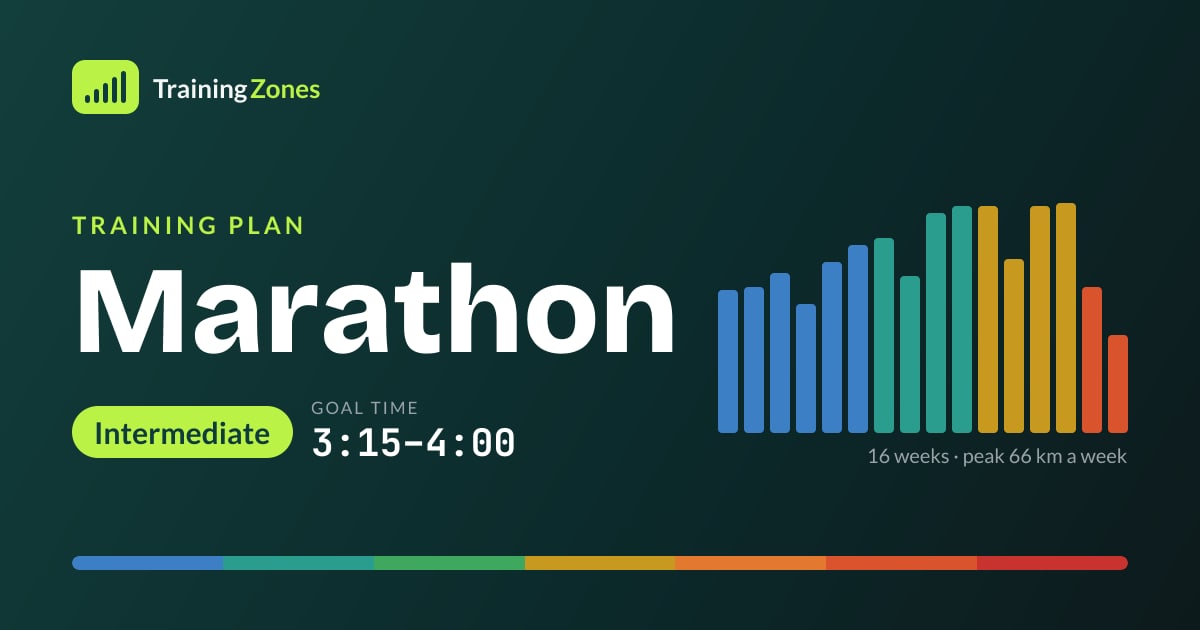
Intermediate Marathon Training Plan: 16 Weeks to a 3:15 to 4:00 Finish
A 16-week intermediate marathon plan for 3:15 to 4:00 runners: five runs a week, peak 66 km, 29 km long runs that finish at marathon pace. Free.

An intermediate marathon plan runs 16 weeks at five runs a week, peaks at 66 km, and tops out with 29 km long runs that finish at marathon pace. It fits runners whose recent races predict a 3:15 to 4:00 marathon: roughly a 20:30 to 25:00 5k, or a half marathon between about 1:34 and 1:56. Sub-4 is where this band starts, sub-3:30 sits in the middle.
The 16 weeks
Sample plan · Intermediate marathon
16 weeks, 5 runs a week, peak 66 km, longest run 29 km. Built for a recent 5k of 21:00 (VDOT 47.0). 80 % of the running is easy.
| Week | Km | Key sessions | Long run |
|---|---|---|---|
| 1 Base | 41 | Easy running only | 18 km long run |
| 2 Base | 42 | Easy running only | 20 km long run + strides |
| 3 Base | 46 | Easy running only | 20 km long run |
| 4 Base, recovery | 37 | Progression run: 11 min M · 11 min T | 16 km long run |
| 5 Base | 49 | Cruise intervals: 3 × 1.6 km T (1 min jog) | 22 km long run |
| 6 Base | 54 | Tempo run: 20 min T | 25 km long run + strides |
| 7 Build | 56 | Cruise intervals: 3 × 1.6 km T (1 min jog); Long intervals: 3 × 3 min I (3 min jog) | 25 km long run |
| 8 Build, recovery | 45 | Broken tempo: 2 × 8 min T (2 min jog); 30/15 sets: 2 × (13 × 30 s I / 15 s jog), 3 min between sets | 20 km long run |
| 9 Build | 63 | Tempo run: 20 min T; Hill repeats: 7 × 75 s I (2 min jog) | 28 km long run |
| 10 Build | 65 | Progression run: 24 min M · 24 min T; 5k time trial | 29 km progressive long run |
| 11 Peak | 65 | Marathon-pace run: 6 km M; Cruise intervals: 3 × 1.6 km T (1 min jog) | 29 km long run with marathon-pace finish |
| 12 Peak, recovery | 50 | Marathon-pace alternations: 5 × 1 km M (1000 m jog); Broken tempo: 2 × 8 min T (2 min jog) | 22 km long run |
| 13 Peak | 65 | Marathon-pace run: 7 km M; Tempo run: 20 min T | 29 km long run with marathon-pace finish |
| 14 Peak | 66 | Marathon-pace alternations: 8 × 1 km M (1000 m jog); Progression run: 24 min M · 24 min T | 28 km long run with marathon-pace finish |
| 15 Taper | 42 | Marathon-pace run: 5 km M | 19 km dress rehearsal |
| 16 Taper | 28 + race | Sharpener: 3 × 1.6 km M (1 min jog); race day | None, race week |
The sample runner has a 21:00 5k and runs five days a week. Four phases carry them to the start line:
- Base, weeks 1 to 6. Volume climbs from 41 to 54 km. Quality starts small: an 11-minute progression from marathon pace to threshold in week 4, then cruise intervals and a 20-minute tempo. Long runs grow from 18 to 25 km.
- Build, weeks 7 to 10. Threshold stays and short VO2max work arrives: 3 × 3 minutes, 30/15 sets, 75-second hill repeats. A 5k time trial in week 10 checks your paces.
- Peak, weeks 11 to 14. Marathon pace becomes the centre. Mid-week runs of 6 to 7 km at marathon pace, 1 km alternations, and 28 to 29 km long runs that close with 8 to 15 km at marathon pace.
- Taper, weeks 15 and 16. Volume falls to 65 % of peak, then 45 %. A 19 km dress rehearsal with 8 km at marathon pace opens the taper.
Weeks 4, 8 and 12 drop to about 75 % so the body absorbs the work.
Who counts as intermediate
Intermediate is a fitness band, not a number of years in the sport. The plan reads a recent race with Jack Daniels' VDOT, one number that sets every training pace, and predicts your marathon from it. Intermediate means a predicted 3:15 to 4:00, roughly VDOT 38 to 49. A 21:00 5k is VDOT 47 and predicts about 3:21.
Slower than 4:00 and the plan treats you as a beginner, peaking at 50 km. Faster than 3:15 and the peak rises from 65 to 85 km.
| Marathon finish | Race pace | Easy | Threshold | Interval |
|---|---|---|---|---|
| 3:15 | 4:37 | 5:00–5:59 | 4:21 | 3:59 |
| 3:38 | 5:09 | 5:33–6:38 | 4:50 | 4:26 |
| 4:00 | 5:41 | 6:06–7:17 | 5:19 | 4:53 |
Marathon pace is the race pace here, so it has no column of its own. Easy running sits 25 to 95 seconds per km slower, and most of the plan happens there.
Why the long run matters most at this level
Marathon pace feels easy at 10 km. The race is decided after 30, when glycogen runs low and form slips. What carries you there is durability: how well your pace and economy survive hours of fatigue. Jones (2024) calls it the fourth dimension of endurance performance, next to VO2max, threshold and economy.
The plan trains it directly. Every peak-phase long run puts the marathon-pace block at the end, on legs that already carry 13 to 21 km. The last one, two weeks out, has 15 km at goal effort. Nothing else in the week matters as much.
The rest of the design keeps you healthy enough to get there:
- 80 % of the running is easy. Seiler found that well-trained endurance athletes settle on about 80 % of sessions at low intensity.
- Weekly volume rises at most 10 % between loading weeks. Nielsen (2014) found runners who added more than 30 % over two weeks got hurt more often than those under 10 %.
- Race-pace volume rises as the race approaches, the pattern Haugen (2022) found in world-class marathoners.
Build your own version
The sample is one runner. The marathon training plan generator takes your recent race, the weeks you have, your running days and your long-run day, and rebuilds every session at your paces. It is free, with no email and no account. You get a PDF and a link you can come back to.
If you add a goal time, the plan shows it next to what your race predicts and trains you at today's fitness. Enter the week-10 time trial result and every pace moves.
FAQ
Is 16 weeks enough for an intermediate marathon plan? Yes, if you already run about 35 to 40 km a week. The generator accepts 12 to 24 weeks. Longer plans stretch the base phase, shorter ones start closer to peak volume.
How many kilometres a week do I need for a 3:30 marathon? A 3:30 marathon is about VDOT 44.5, inside the intermediate band. The plan peaks at 65 km on four or five days. On three days it caps at 58 km, because each run can only be so long.
Should my long runs be at marathon pace? No. They start easy and finish at marathon pace, and only in the peak phase. Base-phase long runs stay fully easy.
What if my goal is faster than my race predicts? The plan shows both times and the gap in percent. Paces come from the race. Retest in week 10 and let the new result move them.
Only need your training paces? Enter a recent race:
VDOT
49.8
índice de condicionamento de corrida de Daniels
| Zona | Faixa | O que treina |
|---|---|---|
| E | Fácil / Longo 4:54–5:53 /km | Base aeróbica, capilares, metabolismo de gordura; a maior parte do volume semanal. RPE 3–4, conversável. |
| M | Maratona 4:26–4:51 /km | Resistência e economia específicas de maratona. RPE 5–6, estável. |
| T | Limiar 4:16–4:28 /km | Limiar de lactato; tempo confortavelmente difícil e intervalos de cruzeiro. RPE 7, esforço de prova de ~1h. |
| I | Intervalo 3:51–4:01 /km | VO₂max; repetições intensas de 3–5 min. RPE 9, difícil. |
| R | Repetição 3:19–3:42 /km | Velocidade, economia e potência de corrida; repetições curtas e rápidas com recuperação completa. RPE 9–10, rápido e controlado. |
E · Fácil / Longo. Base aeróbica, capilares, metabolismo de gordura; a maior parte do volume semanal. RPE 3–4, conversável.
M · Maratona. Resistência e economia específicas de maratona. RPE 5–6, estável.
T · Limiar. Limiar de lactato; tempo confortavelmente difícil e intervalos de cruzeiro. RPE 7, esforço de prova de ~1h.
I · Intervalo. VO₂max; repetições intensas de 3–5 min. RPE 9, difícil.
R · Repetição. Velocidade, economia e potência de corrida; repetições curtas e rápidas com recuperação completa. RPE 9–10, rápido e controlado.
- Seu VDOT de 49.8 é um único número que captura o condicionamento de corrida atual (um 'VO₂max' ajustado pela economia de corrida). Todo ritmo de treino é derivado dele.
- O VDOT vem de uma prova ou contrarrelógio recente e intenso. Use um resultado que você correu no máximo, idealmente 5 km ou mais; uma meia maratona ou 10 km dão a estimativa mais estável.
- Alterne as unidades para ler ritmos por milha. À medida que melhora, corra novamente; seu VDOT e todos os ritmos serão atualizados.
- Estes são os ritmos de treino distintos de Daniels (E, M, T, I, R), não zonas contínuas: você corre em cada ritmo com um objetivo específico. Os intervalos entre os ritmos mais difíceis (T, I e R) são intencionais, não um erro.
Um PDF com seus resultados personalizados, além de um QR code para reabri-los a qualquer momento.
Race report: Berlin Marathon 2026 results, the winners, the course record and the numbers.
More in this series: the beginner, advanced and sub-elite marathon plans, and the intermediate half marathon plan.
Sources
- Seiler 2010, training intensity distribution
- Haugen et al. 2022, training of world-class distance runners
- Nielsen et al. 2014, weekly distance progression and injury
- Bosquet et al. 2007, tapering meta-analysis
- Jones 2024, physiological resilience
Cover image: TrainingZones.