
Finding Your Maximum Heart Rate
What max heart rate is, why the 220 minus age rule is shaky, and how to estimate or field-test yours. Includes a six-formula calculator.

Your maximum heart rate (HRmax) anchors every heart-rate zone. Get it wrong by 10 beats and every zone shifts by 5–10 bpm.
What max heart rate is
HRmax is the highest your heart can beat during all-out effort. It is largely genetic, drifts down slowly with age, and is not a measure of fitness.
You can't train your max heart rate up. Its only job is to anchor your zones.
Estimate it in five seconds
The 220 − age rule is easy to remember but was never derived from solid data. It runs high for older athletes and low for some younger ones. Tanaka (208 − 0.7 × age) is more accurate. Drop your age in below to see six published formulas side by side:
HRmax recomendada
184bpm
Tanaka (2001)
Promedio de los 6 modelos
183bpm
si dudas, usa este
Seis predictores publicados, uno al lado del otro (error típico de ±10–12 bpm)
| Fox / Haskell (1971) | 185 bpm |
| Tanaka (2001)Recomendado | 184 bpm |
| Gellish (2007) | 183 bpm |
| Nes (2013) | 189 bpm |
| Gulati, mujeres (2010) | 175 bpm |
| Londeree & Moeschberger | 181 bpm |
| Promedio de los seis modelosmedia de los predictores anteriores | 183 bpm |
- Recomendamos Tanaka (2001) porque se volvió a derivar a partir de un metaanálisis de 18.712 personas y es más precisa en todas las edades que la antigua regla de 220 menos la edad, que tiende a quedarse alta para atletas mayores.
- La HRmax predicha por fórmula tiene una desviación estándar de aproximadamente ±10–12 bpm, así que dos atletas de la misma edad pueden diferir en más de 20 bpm. Úsala solo como punto de partida.
- Para mayor precisión, haz una prueba de campo máxima (por ejemplo, una sesión dura de repeticiones en cuesta o un test de rampa supervisado) y lee tu HRmax real en el dispositivo.
Un PDF con tus resultados personalizados, más un código QR para volver a abrirlos cuando quieras.
Test it for real
A field test beats any equation. After a thorough warm-up:
- Run or ride 2–3 minutes hard uphill.
- Recover briefly, then go again, building to an all-out final 30 seconds.
- The highest number you see is close to your true HRmax.
Maximal effort, not for beginners. Stop if you feel unwell. One good test lasts years, since HRmax drops only about 0.7 bpm per year.
Then build your zones
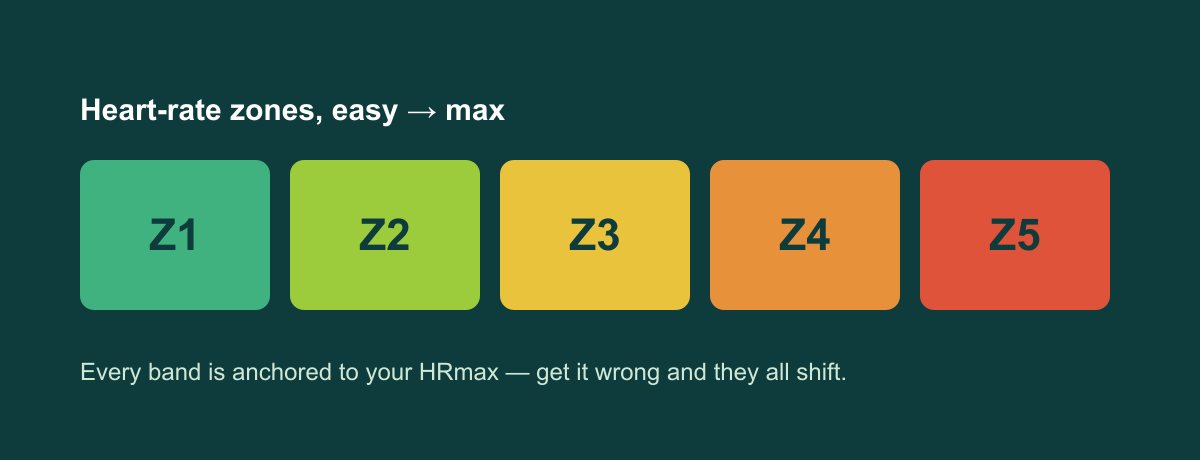
- Heart-rate zone calculator: the standard %HRmax 5-zone split.
- LTHR zones: anchor to lactate-threshold heart rate instead.
- Max heart rate calculator: the six-formula tool above.