Competitive 50k Ultra Training Plan: Racing on Trail
A 16-week 50k trail ultra plan for runners racing for time or place: six runs, peak 11 hours, 5-hour long runs, hill sessions plus tempo. Free.

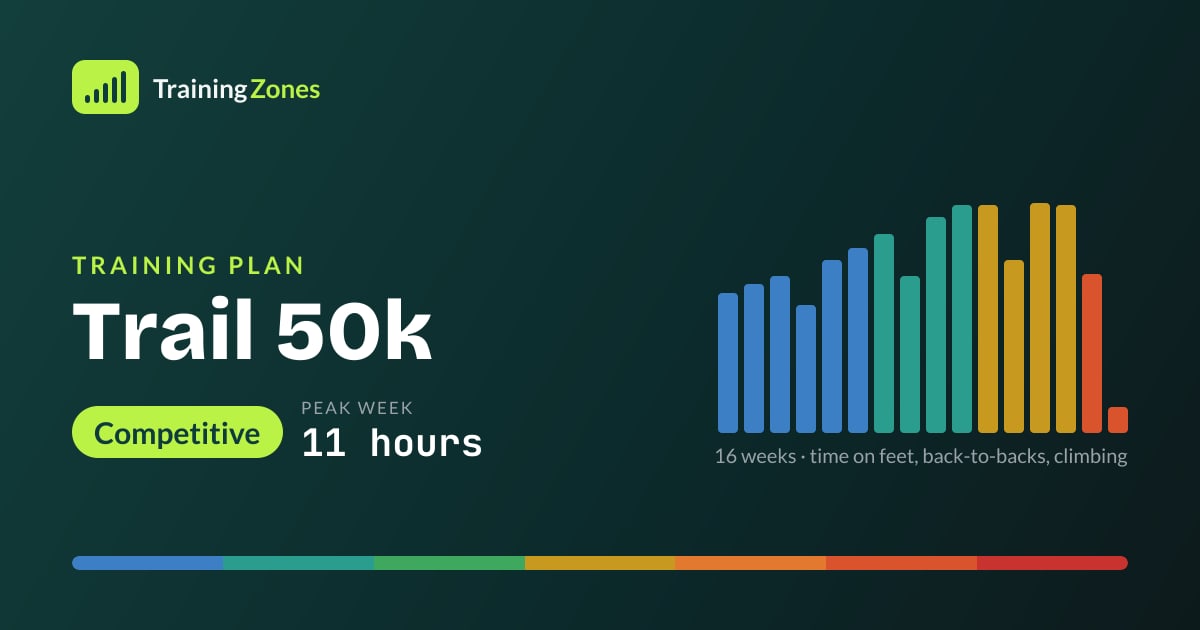
A competitive 50k trail plan runs 16 weeks at six runs a week, peaks at about 11 hours, and pairs a weekly hill session with a tempo or steady run, around 5-hour long runs. It fits runners who race ultras for time or place and train 7 to 10 hours a week. It is written in time and effort, not pace.
The 16 weeks
Sample plan · 50k trail ultra, competitive
16 weeks, 6 runs a week, peak week 11h 17m, longest run 5h, up to 1800 m of climbing a week for a race with 1500 m. 85 % of the running is easy.
| Week | Time | Key sessions | Long run |
|---|---|---|---|
| 1 Base | 6h 56m · 500 m | Easy running only | 2h 40m long run |
| 2 Base | 7h 20m · 500 m | Easy running only | 2h 50m long run with power hiking |
| 3 Base | 7h 40m · 1050 m | Hill repeats: 6 × 3 min I (3 min jog) | 3h long run |
| 4 Base, recovery | 6h 20m · 550 m | Long hill intervals: 3 × 6 min T (4 min jog) | 2h 25m long run with power hiking |
| 5 Base | 8h 30m · 1150 m | Power-hike repeats: 3 × 8 min power hike (4 min jog) | 3h 20m long run |
| 6 Base | 9h 07m · 1300 m | Hill fartlek: 12 × 90 s I (90 s jog) | 3h 35m long run with power hiking |
| 7 Build | 9h 47m · 1600 m | Hill repeats: 7 × 3 min I (3 min jog); Tempo run: 30 min T | 4h 45m long run with power hiking |
| 8 Build, recovery | 7h 44m · 650 m | Long hill intervals: 3 × 6 min T (4 min jog) | 3h 45m long run, steady finish |
| 9 Build | 10h 33m · 1750 m | Power-hike repeats: 3 × 8 min power hike (4 min jog); Tempo run: 30 min T | 5h long run with power hiking |
| 10 Build | 11h 14m · 1800 m | Hill fartlek: 14 × 90 s I (90 s jog); Steady run: 75 min M | 5h long run, steady finish |
| 11 Peak | 11h 12m · 1800 m | Hill repeats: 8 × 3 min I (3 min jog); Tempo run: 35 min T | 5h race rehearsal |
| 12 Peak, recovery | 8h 28m · 900 m | Long hill intervals: 4 × 6 min T (4 min jog) | 4h 10m long run, steady finish |
| 13 Peak | 11h 17m · 1800 m | Power-hike repeats: 4 × 8 min power hike (4 min jog); Tempo run: 35 min T | 5h race rehearsal |
| 14 Peak | 11h 14m · 1800 m | Hill fartlek: 16 × 90 s I (90 s jog); Steady run: 75 min M | 5h longest run: race rehearsal |
| 15 Taper | 7h 49m · 1000 m | Hill repeats: 6 × 3 min I (3 min jog); Tempo run: 25 min T | 3h 50m long run |
| 16 Taper | 1h 17m + race | Race day | None, race week |
The sample runner has six days a week and a race with 1,500 m of climbing:
- Base, weeks 1 to 6. 6.9 to 9.1 hours. Long runs from 2 h 40 to 3 h 35. The hill session rotates through 3-minute hill repeats, 3 × 6 minutes at threshold, power-hike repeats and hill fartlek.
- Build, weeks 7 to 10. 9.8 to 11.2 hours. A second quality day arrives: a 30-minute tempo or a 75-minute steady run. Long runs of 4 h 45 to 5 hours, back-to-backs of about two hours.
- Peak, weeks 11 to 14. 11 hours a week, five-hour race rehearsals, tempo runs of 35 minutes, climbing up to 1,800 m a week.
- Taper, weeks 15 and 16. About 8 hours, then race week.
Who this plan is for
Ultra levels come from experience, because trail finish times depend on the course. Competitive means racing ultras for time or place and 7 to 10 hours a week of running now. The plan starts at about 7 hours, so it assumes a solid base. Six days is the default; five works with less volume on the weekdays.
Speed still matters in an ultra
Knechtle et al. (2010) looked at 169 men who ran a 100 km race and asked which training variables predicted their time. Two came out on top: weekly kilometres and the average speed of their training runs. Faster training went with faster racing, even at 100 km.
That is why the competitive plan keeps two quality days:
- Hills every week, for climbing strength and VO2max on terrain that spares the legs.
- Tempo or steady running from the build phase: 30 to 35 minutes at threshold or 75 minutes at long-race effort. It raises the effort you can hold for hours.
- Steady finishes in every second build long run, so running well late in a race is practised.
Volume carries the rest. Rüst et al. (2012) found ultra runners rely on training volume more than marathoners do. So 85 % of the running stays easy, the long run and back-to-back hold the weekend, and weekly time never rises more than 10 % between loading weeks.
Your own plan
The 50k ultra training plan generator builds yours from your race date, running days, long-run day, experience and the race's total climb. Add your max heart rate and every effort has a heart-rate range, and runs of two hours or more carry the ISSN fuelling target of 30 to 50 g carbohydrate an hour. Free, no email, PDF included.
FAQ
Why no pace targets at all? On trail the same effort covers very different paces. The tempo and steady runs are best done on flat or rolling ground, where you can check pace against the effort chart if you want to.
How much climbing should I do each week? This plan builds to 120 % of the race's climbing at the peak for competitive runners. For a 1,500 m race that is 1,800 m a week.
Is 11 hours enough to race a 50k? It is where this plan tops out for a 50k. If you already train more, keep the two quality days and the weekend and add easy time around them.
When should the tempo run be on the road? Whenever you can. Flat ground makes the effort easier to hold and to judge.
Plan your race fuelling:
Glucides cibles
60g/h
Par heure d'exercice
Glucides totaux
120g
Sur votre séance de 2 heures
Glucides recommandés selon la durée de la séance
| Moins d'1 heureL'eau suffit généralement | 0 g/h |
| 1 à 2,5 heuresRecommandéUn seul glucide transportable (glucose) | 60 g/h |
| 2,5 heures ou plusGlucose plus fructose, près d'un mélange 2:1 | 90 g/h |
- Associez les glucides aux fluides et au sodium. Un carburant concentré sans assez d'eau reste dans l'intestin et provoque de l'inconfort.
- Tolérer des apports élevés en glucides est une compétence qui se travaille. Entraînez votre stratégie de carburant de course lors de séances longues et augmentez progressivement, n'essayez jamais un nouvel apport élevé le jour de la course.
- Au-dessus de 60 g par heure, utilisez un mélange glucose-fructose proche de 2:1. Le glucose seul sature le transporteur intestinal à environ 60 g par heure.
- Les efforts intenses brûlent les glucides plus vite, placez-vous donc vers le haut de chaque plage.
Un PDF de vos résultats, avec un QR code pour les rouvrir à tout moment.
More in this series: the first-ultra and experienced 50k plans and the competitive 100k / 50 mile plan.
Sources
- Knechtle et al. 2010, predictors of 100 km race time
- Rüst et al. 2012, training of 100 km ultra-marathoners and marathoners
- Tiller et al. 2019, ISSN position stand on ultra-marathon nutrition
Cover image: TrainingZones.