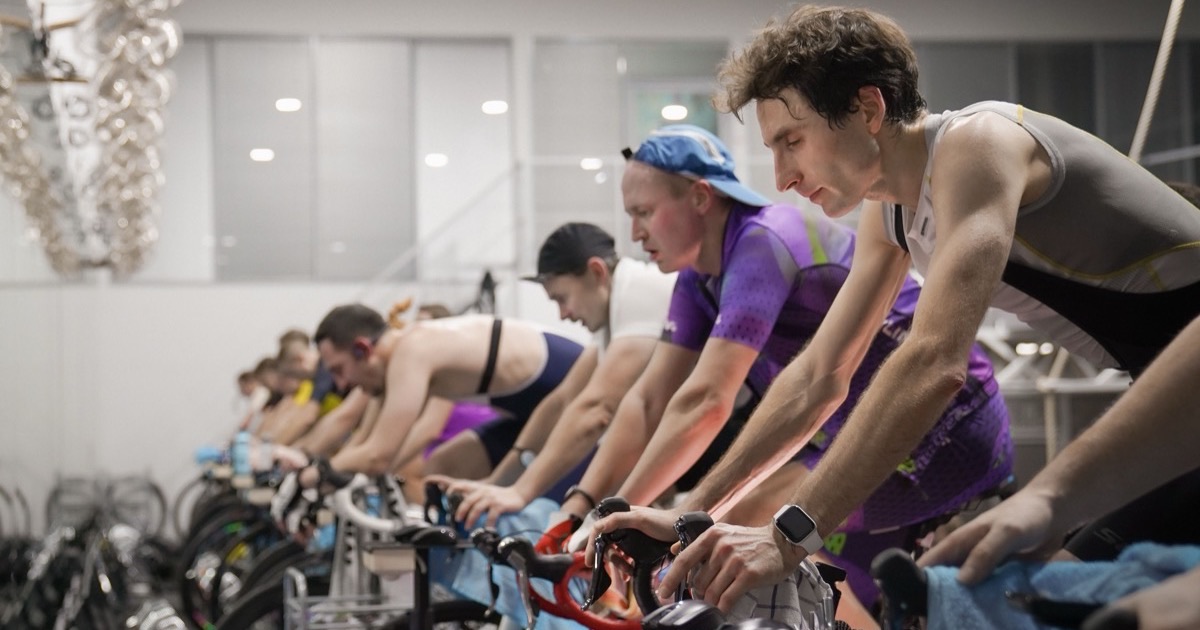
Managing Training Load: TSS, CTL, ATL and the Numbers That Actually Matter
How to monitor endurance training load: normalised power, TSS, ATL/CTL/TSB, the acute:chronic workload ratio, and why load is feedback, not a target.
Managing training load means staying between too little to improve and too much to absorb. This guide covers the metrics that make load visible, drawing on Mike Posthumus's framework in Science to Sport's Monitoring Cyclist Training Load, and the one rule that outranks every number.
External load vs internal load
- External load is the work you did: watts, kilometers, meters climbed. A power meter is the classic tool.
- Internal load is how your body responded: heart rate, perceived effort, how wrecked you feel the next morning.
The external number is not automatically better. Posthumus notes there is "currently no peer-reviewed evidence demonstrating that power-based longitudinal load monitoring is more effective than methods using heart rate (HR), rating of perceived exertion (RPE), or subjective feeling." A heart-rate strap or an honest RPE score works.
The session metrics: NP, IF and TSS
Cycling software builds its load model on three numbers from Hunter Allen and Andrew Coggan's Training and Racing with a Power Meter.
Normalised Power (NP) is a weighted average that reflects the physiological cost of a ride better than average power. If your NP was 300 watts, the session was "equivalent to maintaining the same constant power (300 watts) for the same duration," surges included.
Intensity Factor (IF) is NP divided by your FTP, the power you can hold for roughly 30–90 minutes. IF 1.0 means you rode the whole session at threshold.
Training Stress Score (TSS) combines intensity and duration:
TSS = (NP / FTP)² × Duration (hours) × 100
"By definition, 100 TSS is the hardest you could possibly ride for 1 hour." A two-hour endurance ride at IF 0.65 scores about 85 TSS. A one-hour threshold test scores 100.
Without a power meter, multiply session RPE (1–10) by duration in minutes to get session-RPE load (sRPE), a validated stand-in.
FTP
250W
Sweet Spot
220–235W
88–94 % FTP
| Zone | Plage | Ce que cela développe |
|---|---|---|
| Z1 | Récupération active ≤ 138 W | Récupération ; fait tourner les jambes sans ajouter de charge. RPE 1–2, très facile. |
| Z2 | Endurance 139–188 W | Base aérobie, oxydation des graisses, allure tenable toute la journée. RPE 3–4, conversationnel. |
| Z3 | Tempo 189–225 W | Endurance aérobie et efficacité musculaire. RPE 5–6, confortablement difficile. |
| Z4 | Seuil 226–263 W | Seuil lactique, travail à la FTP, le plafond tenable. RPE 7–8, répétitions de 10–30 min. |
| Z5 | VO₂max 264–300 W | Puissance aérobie maximale ; intervalles de 3–8 min. RPE 9, très difficile. |
| Z6 | Capacité anaérobie 301–375 W | Capacité anaérobie ; efforts de 30 s–3 min. RPE 9–10, proche du maximal. |
| Z7 | Puissance neuromusculaire ≥ 376 W | Puissance de sprint et neuromusculaire. RPE 10, sprints à fond. |
Z1 · Récupération active. Récupération ; fait tourner les jambes sans ajouter de charge. RPE 1–2, très facile.
Z2 · Endurance. Base aérobie, oxydation des graisses, allure tenable toute la journée. RPE 3–4, conversationnel.
Z3 · Tempo. Endurance aérobie et efficacité musculaire. RPE 5–6, confortablement difficile.
Z4 · Seuil. Seuil lactique, travail à la FTP, le plafond tenable. RPE 7–8, répétitions de 10–30 min.
Z5 · VO₂max. Puissance aérobie maximale ; intervalles de 3–8 min. RPE 9, très difficile.
Z6 · Capacité anaérobie. Capacité anaérobie ; efforts de 30 s–3 min. RPE 9–10, proche du maximal.
Z7 · Puissance neuromusculaire. Puissance de sprint et neuromusculaire. RPE 10, sprints à fond.
- Le modèle à sept zones d'Andrew Coggan exprime chaque zone en pourcentage de la Functional Threshold Power. Le Sweet Spot (220–235 W, 88–94 % FTP) se situe entre Tempo et Seuil et procure un fort stimulus d'entraînement pour une fatigue modérée.
- La FTP est la puissance que vous pourriez théoriquement tenir environ une heure. Refaites le test toutes les 4 à 6 semaines ; une FTP périmée fausse toutes les zones.
Un PDF de vos résultats, avec un QR code pour les rouvrir à tout moment.
The long-term model: ATL, CTL and TSB
A single session's TSS is noise. The signal is how scores accumulate and decay:
- Acute Training Load (ATL): the last 7 days. Your fatigue.
- Chronic Training Load (CTL): the last 42 days. Your fitness.
- Training Stress Balance (TSB): CTL minus ATL. Your freshness, or "form".
Fitness builds and fades slowly (42 days). Fatigue arrives and clears fast (7 days). Form is high when you have a deep base and recently backed off: race-day state.
The metrics are computed as an exponentially weighted moving average (EWMA), which weights recent days more heavily:
ATL_today = ATL_yesterday × e^(−1/7) + TSS_today × (1 − e^(−1/7))
CTL_today = CTL_yesterday × e^(−1/42) + TSS_today × (1 − e^(−1/42))
TSB = CTL − ATL
The research Posthumus cites found that an EWMA of training load "can track both performance and risk of illness and injury extremely well," better than a simple rolling average.
The acute:chronic workload ratio
The acute:chronic workload ratio (ACWR) is acute load divided by chronic load. Spike acute load far above your chronic base and injury and illness risk climbs. Murray and colleagues found that an EWMA-based ratio "provides a more sensitive indicator of injury likelihood than rolling averages." It quantifies the oldest coaching rule: do not increase training too fast.
There is no universal "right" number
Optimal values are individual. Posthumus gives ranges:
- Optimal CTL runs "from 70 TSS/day for some competitive age group athletes, to as high as 140 CTL for pro tour riders."
- Optimal race-day TSB varies too: some athletes "perform better with a TSB in the range of +10 to +20, whereas some simply feel better at a TSB of −5 to +5."
Pair load with performance over months. If CTL keeps climbing while performance stalls, you have passed your range.
Load is feedback, not a target
The rule Posthumus is most emphatic about:
Training should never be prescribed with the sole purpose of achieving load goals.
Build the plan first: the right intensity distribution and the right zones for each session. Then use load metrics to check the plan is followed and fitness is trending up. Junk miles to hit a CTL number are fatigue without adaptation.
No model is complete. Performance "is extremely complex and there is currently no model which may account for all possible factors contributing to human variance." Posthumus notes that "asking the athlete 'How do you feel?' can elicit valuable feedback" and may be "more sensitive for the early detection of overreaching" than any power metric. The Lamberts Submaximal Cycle Test formalises this with heart rate, power and recovery at a fixed effort.
Putting it together
- Score every session: TSS with power, session-RPE (effort × minutes) otherwise.
- Watch the trend, not the day. Let CTL rise gradually. Cap week-to-week jumps.
- Peak by raising form. Build chronic load, then taper so TSB swings positive into your key event.
- Anchor it to feel and performance. When the numbers and your body disagree, your body wins.
- Never train to hit a number.
For how to structure the training itself, see training philosophies and heart-rate zones. Set benchmarks with the FTP and LTHR zones calculators.
Sources
- Posthumus, M. Monitoring Cyclist Training Load (Part 1): External Load & Modern Cycling Metrics. Science to Sport, 20 October 2025.
- Allen, H. & Coggan, A. Training and Racing with a Power Meter. 2nd ed. VeloPress, 2010.
- Murray, N.B., Gabbett, T.J., Townshend, A.D. & Blanch, P. Calculating acute:chronic workload ratios using exponentially weighted moving averages provides a more sensitive indicator of injury likelihood than rolling averages. British Journal of Sports Medicine, 2017; 51(9): 749–754.
- Lamberts, R.P., Swart, J., Noakes, T.D. & Lambert, M.I. A novel submaximal cycle test to monitor fatigue and predict cycling performance. British Journal of Sports Medicine, 2011; 45(10): 797–804.