How Nadia Battocletti Trains (Olympic Silver off 90km a Week)
Battocletti has Olympic and world 10,000m silver on 80 to 90km a week, coached by her father. The low-volume, cross-country-built system behind it.

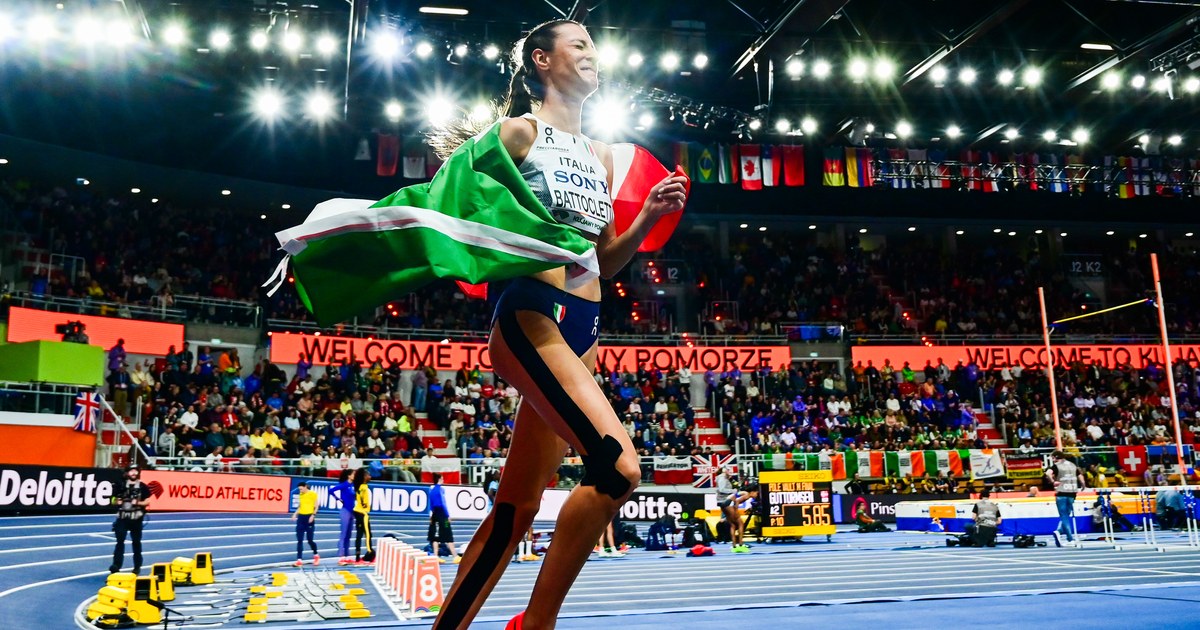
Nadia Battocletti has ten major medals since 2024: Olympic 10,000m silver in Paris, world 10,000m silver and 5000m bronze in Tokyo, world indoor 3000m gold in Toruń, and a sixth European title in Birmingham. She does it on a training week a club runner would call light, coached by her father, off a base built in winter mud.
The number that stops you
Battocletti puts her typical week at 80 to 90km, rising to around 110km at the winter peak, plus one gym session a week in preparation blocks. She has said this is less than most of the people she races.
Eliud Kipchoge covers north of 200km a week. Jakob Ingebrigtsen sits around 160 to 180km with two double-threshold days on top. Battocletti runs roughly half of Kipchoge's week and took Olympic silver over 25 laps off it, in an Italian record of 30:43.35.
Low mileage is not better. Kipchoge's 200km does something 90km cannot. But the number alone says little. What decides whether 90km is enough is how much of it is easy, how consistently it is repeated, and how many years of base sit under it. Battocletti has run European cross-country championships since she was a teenager.
For most runners: a week works because the easy running is easy, the argument in how to train zone 2. Volume you cannot recover from is damage.
Cross country is the base
"Cross country is really important to middle distance running," Battocletti has said, "because during the winter you have to put a lot of kilometres in and it gives you strength."
Before she was a track medallist she was the best young cross-country runner in Europe: eight European medals across U20 and U23, five of them gold, four of those individual titles. The track results came out of that base.
Mud, grass and hills load the legs in a way flat road does not, so you get strength work without a gym. Rough ground also caps your pace: you cannot race an easy run when the surface will not let you.
A coach who is also her father
Giuliano Battocletti ran 27:45.74 for 10,000m, 13:20.88 for 5000m, 60:47 for the half marathon and 2:11:59 for the marathon, won the senior European Cross Country title in Ferrara in 1998, and made 17 appearances for Italy. He coaches his daughter and rides a bike alongside her sessions.
Her take: "A coach is not someone who just writes the training. It's people who understand you."
Ingebrigtsen caps every repetition with a lactate reading. Battocletti has a man on a bike who has run 2:11 and can see when she is pushing. Both solve the same problem: endurance athletes run easy days too hard and hard days too hard. Something outside your own enthusiasm has to hold the ceiling.
Her altitude work runs out of Font-Romeu in the French Pyrenees, around 1800m: track sessions, tempo on a 1km loop, long runs around Lac de Matemale.
Birmingham, and what a championship rewards
The 5000m final on 11 August was the slowest winning time in European Championships history. Battocletti won in 15:37.84, more than 74 seconds outside her 14:23.15 personal best. Maureen Koster dragged the field along and faded to sixth. Battocletti sat, moved just before 200m to go, and covered the last lap in 59.2 and the last 200m in 28.2. Marta García took silver in 15:39.98, Italian teammate Micol Majori bronze in 15:40.65.
A championship final is 4800m of positioning followed by a 60-second race, won by whoever has a kick left. Battocletti did it in a summer she has called inconsistent, after pulling out of Monaco with anaemia-related fatigue.
Three days later, the 10,000m on 14 August: another cagey race, won in 31:41.17, more than a minute outside her 30:38.23 best. Megan Keith stretched the field with seven laps left. Battocletti went past with 200m to run and closed in 28.2 seconds, the identical split from the 5000m. Koster took silver, Belgium's Jana van Lent bronze in 31:47.81. She is the first athlete to complete back-to-back 5000m/10,000m doubles at a European Championships, after the same sweep in Rome in 2024.
Turning her numbers into yours
Her 14:23.15 and your 5k are the same kind of data point: one race result that fixes your training paces across every distance. That is what VDOT does.
VDOT
49.8
Daniels रनिंग फ़िटनेस स्कोर
| ज़ोन | रेंज | यह क्या प्रशिक्षित करता है |
|---|---|---|
| E | आसान / लॉन्ग 4:54–5:53 /km | एरोबिक आधार, केशिकाएँ, फैट मेटाबॉलिज़्म; अधिकांश साप्ताहिक वॉल्यूम। RPE 3–4, बातचीत वाली। |
| M | मैराथन 4:26–4:51 /km | मैराथन-विशिष्ट एंड्योरेंस और इकॉनमी। RPE 5–6, स्थिर। |
| T | थ्रेशोल्ड 4:16–4:28 /km | लैक्टेट थ्रेशोल्ड; आरामदायक-कठिन टेम्पो और क्रूज़ इंटरवल। RPE 7, ~1 घंटे का रेस प्रयास। |
| I | इंटरवल 3:51–4:01 /km | VO₂max; 3–5 मिनट के कठिन रेप्स। RPE 9, कठिन। |
| R | रिपीटीशन 3:19–3:42 /km | गति, इकॉनमी और रनिंग पावर; पूर्ण रिकवरी के साथ छोटे तेज़ रेप्स। RPE 9–10, तेज़ और नियंत्रित। |
E · आसान / लॉन्ग. एरोबिक आधार, केशिकाएँ, फैट मेटाबॉलिज़्म; अधिकांश साप्ताहिक वॉल्यूम। RPE 3–4, बातचीत वाली।
M · मैराथन. मैराथन-विशिष्ट एंड्योरेंस और इकॉनमी। RPE 5–6, स्थिर।
T · थ्रेशोल्ड. लैक्टेट थ्रेशोल्ड; आरामदायक-कठिन टेम्पो और क्रूज़ इंटरवल। RPE 7, ~1 घंटे का रेस प्रयास।
I · इंटरवल. VO₂max; 3–5 मिनट के कठिन रेप्स। RPE 9, कठिन।
R · रिपीटीशन. गति, इकॉनमी और रनिंग पावर; पूर्ण रिकवरी के साथ छोटे तेज़ रेप्स। RPE 9–10, तेज़ और नियंत्रित।
- आपका 49.8 का VDOT एक एकल संख्या है जो वर्तमान रनिंग फ़िटनेस को दर्शाती है (रनिंग इकॉनमी के लिए समायोजित एक 'VO₂max')। हर ट्रेनिंग पेस इसी से निकाली जाती है।
- VDOT एक हालिया, कठिन रेस या टाइम ट्रायल से आता है। ऐसा परिणाम लें जिसे आपने पूरी ताकत से दौड़ा हो, आदर्श रूप से 5 किमी या उससे लंबा; हाफ-मैराथन या 10 किमी सबसे स्थिर अनुमान देता है।
- प्रति मील पेस पढ़ने के लिए यूनिट टॉगल बदलें। जैसे-जैसे आप फ़िट होते हैं, फिर से रेस करें; आपका VDOT और सभी पेस अपडेट हो जाएँगे।
- ये डैनियल्स की अलग-अलग ट्रेनिंग पेस हैं (E, M, T, I, R), लगातार ज़ोन नहीं: आप हर पेस पर एक खास मकसद से दौड़ते हैं। कठिन पेस (T, I और R) के बीच के अंतर जानबूझकर हैं, कोई गड़बड़ी नहीं।
आपके वैयक्तिक परिणामों वाली PDF, साथ में उन्हें कभी भी फिर खोलने के लिए QR कोड।
Enter a recent race and you get easy, threshold and interval paces plus equivalent times at other distances. The easy pace decides whether your 90km is training or fatigue.
What you can steal from it
- Volume is a means, not a score. 80 to 90km a week produced Olympic 10,000m silver. Ask what your kilometres are for.
- Build the base in winter, on rough ground. Hills, grass and trails give strength and cap your pace for you.
- Something has to hold the ceiling. A lactate meter, a coach on a bike, or a heart-rate cap from the heart-rate zone calculator.
- Championships reward the kick, not the clock. If the goal is a place, practise racing out of a slow, tactical pace.
- Anchor everything to a measured result. Use VDOT to turn one race into your training paces.
More in this series: Faith Kipyegon, Sifan Hassan, Jakob Ingebrigtsen, Eliud Kipchoge and Josh Kerr.
Sources
- Wikipedia
- World Athletics
- Athletics Weekly interview
- Athletics Weekly race report
- European Athletics 5000m report
- European Athletics 10,000m report
Cover photo by Erik van Leeuwen, GFDL, via Wikimedia Commons.
