Advanced 10k Training Plan: 10 Weeks for 35 to 40 Minutes
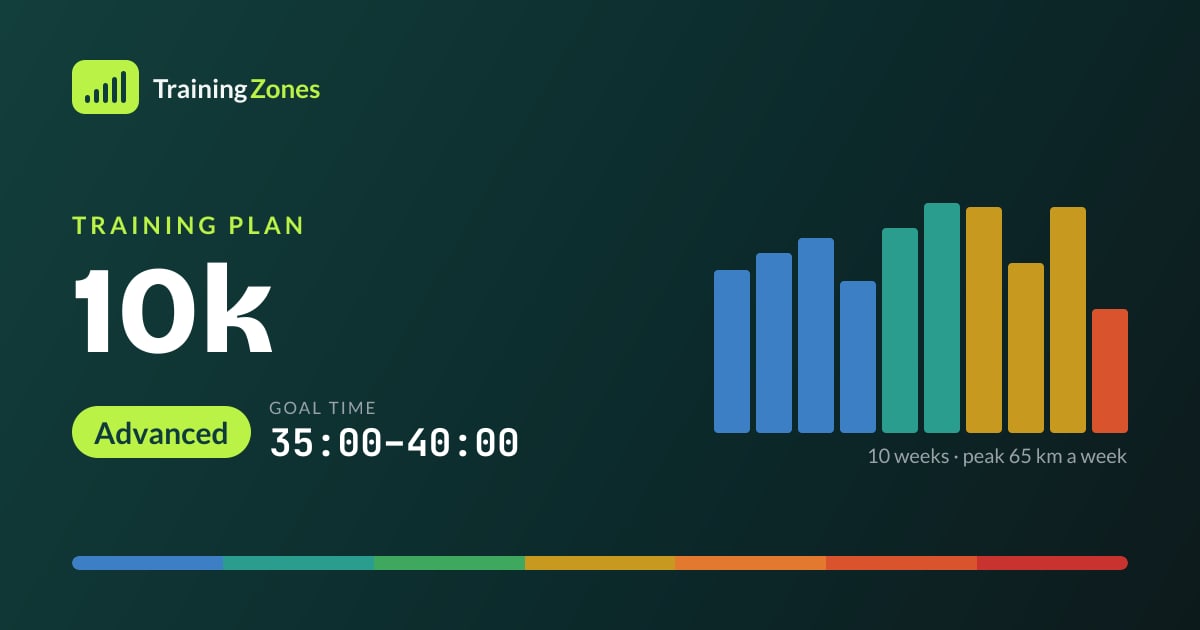
A 10-week advanced 10k plan for 35 to 40 minute runners: six runs a week, peak 65 km, 86 % easy, 25-minute tempos and 10k-pace reps. Free, from your race.

An advanced 10k plan runs 10 weeks at six runs a week, peaks at about 65 km, and keeps 86 % of that running easy. It fits runners whose fitness predicts a 35 to 40 minute 10k: roughly a 16:50 to 19:20 5k, or a half marathon between about 1:17 and 1:29. Sub-38 sits in the middle, sub-35 at the fast edge.
The 10 weeks
Sample plan · Advanced 10k
10 weeks, 6 runs a week, peak 65 km, longest run 17 km. Built for a recent 5k of 18:00 (VDOT 56.3). 86 % of the running is easy.
| Week | Km | Key sessions | Long run |
|---|---|---|---|
| 1 Base | 46 | Easy running only | 13 km long run |
| 2 Base | 51 | Easy running only | 16 km long run + strides |
| 3 Base | 55 | Tempo run: 15 min T | 16 km long run |
| 4 Base, recovery | 43 | Cruise intervals: 3 × 1.6 km T (1 min jog) | 13 km long run |
| 5 Build | 58 | Broken tempo: 2 × 11 min T (2 min jog); Long intervals: 4 × 4 min I (4 min jog) | 16 km long run |
| 6 Build | 65 | Tempo run: 25 min T; 5k time trial | 17 km long run + strides |
| 7 Peak | 64 | 10k pace reps: 3 × 1.6 km race pace (90 s jog); Cruise intervals: 4 × 1.6 km T (1 min jog) | 16 km progressive long run |
| 8 Peak, recovery | 48 | 10k pace sets: 2 × (2 × 1 km race pace / 200 m jog), 3 min between sets; Broken tempo: 2 × 9 min T (2 min jog) | 14 km long run |
| 9 Peak | 64 | 10k pace reps: 3 × 1.6 km race pace (90 s jog); Tempo run: 25 min T | 16 km progressive long run |
| 10 Taper | 35 + race | Sharpener: 4 × 2 min race pace (2 min jog); race day | None, race week |
- Base, weeks 1 to 4. 46 to 55 km, long runs of 13 to 16 km. Threshold from week 3: a 15-minute tempo, then 3 × 1.6 km cruise intervals.
- Build, weeks 5 and 6. Up to 65 km. 2 × 11 minutes broken tempo with 4 × 4 minutes at interval pace, then a 25-minute tempo. A 5k time trial closes week 6. Long runs of 16 and 17 km.
- Peak, weeks 7 to 9. 3 × 1.6 km at 10k pace, sets of 2 × 1 km with 200 metre jogs, 4 × 1.6 km cruise intervals and a 25-minute tempo. Long runs of 16 km finish with 3 km at threshold.
- Taper, week 10. About 55 % of peak volume, four 2-minute race-pace pickups, then race day.
Who counts as advanced
The level comes from Jack Daniels' VDOT, one number from a recent race that sets every training pace. Advanced means a predicted 10k of 35 to 40 minutes, roughly VDOT 52 to 61. A 38-minute 10k is VDOT 55.2. Breaking 40 is where this plan begins. The sample runner has an 18:00 5k, VDOT 56.3, which predicts 37:20.
| 10k finish | Race pace | Easy | Marathon | Threshold | Interval |
|---|---|---|---|---|---|
| 35:00 | 3:30 | 4:11–5:01 | 3:50 | 3:38 | 3:20 |
| 37:30 | 3:45 | 4:28–5:21 | 4:06 | 3:53 | 3:33 |
| 40:00 | 4:00 | 4:45–5:41 | 4:23 | 4:07 | 3:47 |
More easy running, not more intervals
Compare this plan with the intermediate version. The advanced runner gets about 15 more kilometres a week at the peak. Almost none of that is hard. The quality sessions are a little longer: tempo from 20 to 25 minutes, cruise intervals from three reps to four, VO2max reps from three minutes to four. The rest is easy running, and the easy share rises from 85 to 86 %.
That is the pattern in the research. Casado (2021) found world-class distance performance is best predicted by the volume of easy running plus deliberate practice of tempo and short intervals. Haugen (2022) found world-class runners keep at least 80 % of their volume at low intensity at every point of the year. This plan follows it: more easy running under the same two quality days.
The structure around it:
- Two quality days that never touch, and a rest day after the long run.
- Weekly volume rises at most 10 % between loading weeks.
- Recovery weeks 4 and 8 at about 75 % volume.
Your own plan
The 10k training plan generator builds all 10 weeks from your recent race, your weeks until race day, your running days and your long-run day. Add a goal like 37:59 and it shows the gap to your prediction. The week-6 time trial updates every pace. Free, no email, PDF included.
FAQ
What 5k time do I need for a sub-38 10k? About 18:20, VDOT 55.2. A half marathon of 1:24 predicts the same.
How many kilometres a week for a sub-38 10k? This plan peaks at 65 km on six days. On five days it caps at 65 km too, with longer mid-week runs.
Why is there only one VO2max session a week? In the build, one VO2max and one threshold session share the week. In the peak, 10k-pace reps take the VO2max slot. The race runs 7 to 8 seconds per km faster than threshold and 10 to 13 seconds per km slower than interval pace, so the plan spends more of its time near threshold.
Can I use this plan for a 10k in the middle of a marathon build? Better to run the marathon plan and race the 10k as a tune-up. This plan's taper and peak are built around the 10k itself.
Only need your training paces? Enter a recent race:
VDOT
49.8
punteggio di forma nella corsa di Daniels
| Zona | Intervallo | Cosa allena |
|---|---|---|
| E | Facile / Lungo 4:54–5:53 /km | Base aerobica, capillari, metabolismo dei grassi; gran parte del volume settimanale. RPE 3–4, conversazionale. |
| M | Maratona 4:26–4:51 /km | Resistenza ed economia specifiche per la maratona. RPE 5–6, costante. |
| T | Soglia 4:16–4:28 /km | Soglia del lattato; tempo comodamente duro e cruise interval. RPE 7, sforzo gara ~1h. |
| I | Intervallo 3:51–4:01 /km | VO₂max; ripetute dure di 3–5 min. RPE 9, duro. |
| R | Ripetizione 3:19–3:42 /km | Velocità, economia e potenza nella corsa; ripetute brevi e veloci con recupero completo. RPE 9–10, veloce e controllato. |
E · Facile / Lungo. Base aerobica, capillari, metabolismo dei grassi; gran parte del volume settimanale. RPE 3–4, conversazionale.
M · Maratona. Resistenza ed economia specifiche per la maratona. RPE 5–6, costante.
T · Soglia. Soglia del lattato; tempo comodamente duro e cruise interval. RPE 7, sforzo gara ~1h.
I · Intervallo. VO₂max; ripetute dure di 3–5 min. RPE 9, duro.
R · Ripetizione. Velocità, economia e potenza nella corsa; ripetute brevi e veloci con recupero completo. RPE 9–10, veloce e controllato.
- Il tuo VDOT di 49.8 è un singolo numero che riassume la tua forma attuale nella corsa (un 'VO₂max' corretto per l'economia di corsa). Ogni ritmo di allenamento ne deriva.
- Il VDOT proviene da una gara recente e dura o da una prova a cronometro. Usa un risultato corso a tutta, idealmente di 5 km o più; una mezza maratona o una 10 km danno la stima più stabile.
- Cambia l'interruttore delle unità per leggere i ritmi al miglio. Man mano che migliori, gareggia di nuovo; il tuo VDOT e tutti i ritmi si aggiorneranno.
- Sono i ritmi di allenamento distinti di Daniels (E, M, T, I, R), non zone continue: corri a ciascun ritmo per uno scopo specifico. Gli spazi tra i ritmi più duri (T, I e R) sono voluti, non un errore.
Un PDF con i tuoi risultati, più un codice QR per riaprirli quando vuoi.
More in this series: the beginner, intermediate and sub-elite 10k plans, the advanced 5k plan and the advanced half marathon plan.
Sources
- Casado et al. 2021, predictors of world-class long-distance performance
- Haugen et al. 2022, training of world-class distance runners
Cover image: TrainingZones.