
Finding Your Maximum Heart Rate
What max heart rate is, why the 220 minus age rule is shaky, and how to estimate or field-test yours. Includes a six-formula calculator.

Your maximum heart rate (HRmax) anchors every heart-rate zone. Get it wrong by 10 beats and every zone shifts by 5–10 bpm.
What max heart rate is
HRmax is the highest your heart can beat during all-out effort. It is largely genetic, drifts down slowly with age, and is not a measure of fitness.
You can't train your max heart rate up. Its only job is to anchor your zones.
Estimate it in five seconds
The 220 − age rule is easy to remember but was never derived from solid data. It runs high for older athletes and low for some younger ones. Tanaka (208 − 0.7 × age) is more accurate. Drop your age in below to see six published formulas side by side:
推奨HRmax
184bpm
Tanaka (2001)
全6モデルの平均
183bpm
迷ったらこれを使ってください
公表された6つの予測式を並べて比較(典型誤差 ±10〜12 bpm)
| Fox / Haskell (1971) | 185 bpm |
| Tanaka (2001)推奨 | 184 bpm |
| Gellish (2007) | 183 bpm |
| Nes (2013) | 189 bpm |
| Gulati, women (2010) | 175 bpm |
| Londeree & Moeschberger | 181 bpm |
| 6モデルすべての平均上記の予測式の平均 | 183 bpm |
- Tanaka (2001) を推奨します。これは18,712名のメタ分析から再導出されたもので、年配のアスリートで高めに出やすい古い「220引く年齢」のルールよりも、幅広い年齢で正確だからです。
- 式で予測したHRmaxは標準偏差がおよそ ±10〜12 bpm あり、同じ年齢でも2人のアスリートで20 bpm以上違うことがあります。あくまで出発点として使ってください。
- 正確さを求めるなら、最大強度のフィールドテスト(例:きつい坂道ダッシュの反復や、監督下のランプテスト)を行い、デバイスから本当のHRmaxを読み取ってください。
パーソナライズされた結果のPDFと、いつでも再表示できるQRコード付き。
Test it for real
A field test beats any equation. After a thorough warm-up:
- Run or ride 2–3 minutes hard uphill.
- Recover briefly, then go again, building to an all-out final 30 seconds.
- The highest number you see is close to your true HRmax.
Maximal effort, not for beginners. Stop if you feel unwell. One good test lasts years, since HRmax drops only about 0.7 bpm per year.
Then build your zones
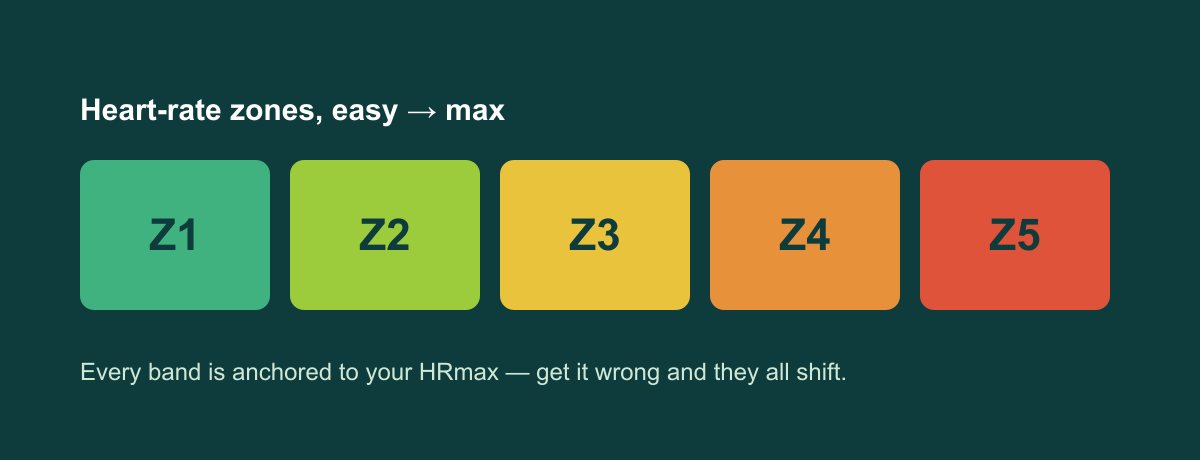
- Heart-rate zone calculator: the standard %HRmax 5-zone split.
- LTHR zones: anchor to lactate-threshold heart rate instead.
- Max heart rate calculator: the six-formula tool above.