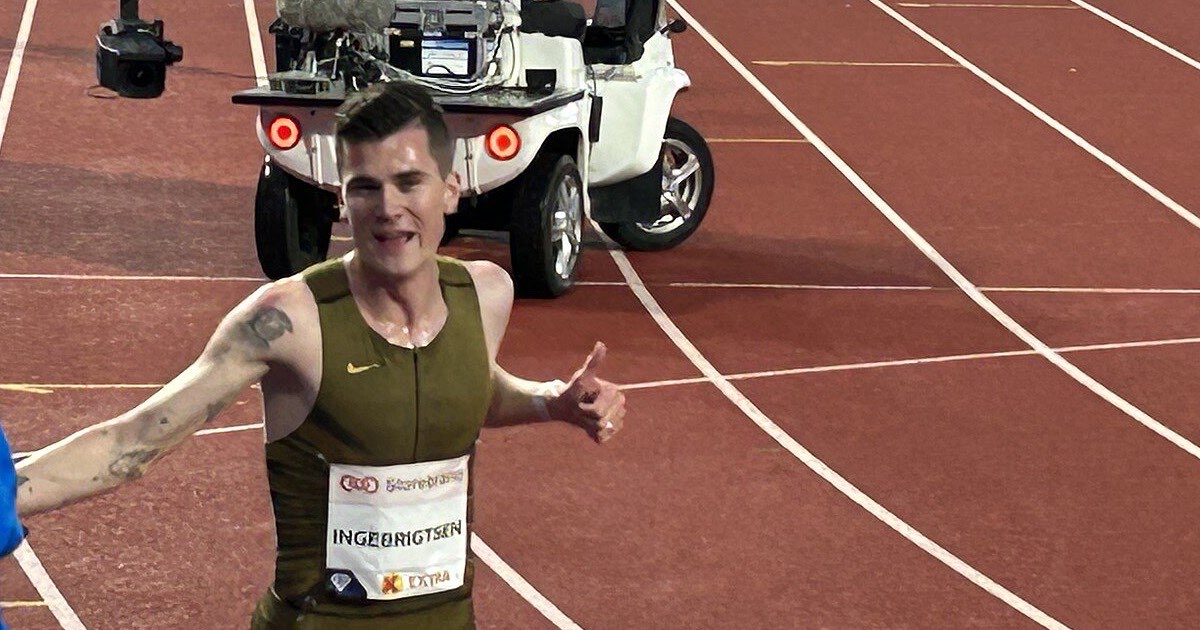
How Jakob Ingebrigtsen Trains (and What the Achilles Injury Exposed)
Ingebrigtsen's week: two double-threshold days, every rep capped by a lactate meter. The injury blind spot it missed, and the post-surgery comeback.

Jakob Ingebrigtsen's training is hard to copy because it is too disciplined. The Olympic 1500m and 5000m champion built his career on a week that reads like arithmetic, where the defining skill is refusing to run faster than the plan says. In 2025 and 2026 that week ran into something a lactate meter cannot measure.
The mechanics of the system are in the Norwegian method explained. This is about the athlete: what his week contains, why it works, and what it missed.
The week: two days that do the heavy lifting
The spine is two double-threshold days, typically Tuesday and Thursday. Each is two threshold sessions, morning and evening, both capped.
As widely reported, a Tuesday looks like this:
- Morning: longer reps, something like 5 x 6 minutes, at a blood lactate under about 2 mmol/L. Close to marathon pace or slower for him.
- Evening: shorter reps, 10 to 12 x 1000m or 25 x 400m off short recovery, with lactate under roughly 3 to 3.5 mmol/L.
Everything else is easy running, and there is a lot of it. The weekly total sits past 150km. On top sits a small amount of fast work, the racing speed that turns the engine into a last-lap kick.
The trick is that it isn't threshold
The Norwegian method is famous as "threshold training," but the sessions are run below the threshold proper. The target band sits under LT2, where lactate production and clearance stop balancing. That is why he can do a second session six hours after the first, and repeat it on Thursday.
Run those reps at true threshold and the day costs three days of recovery. Run them a fraction slower and it costs almost nothing while delivering most of the aerobic stimulus. The difference is invisible without a meter and large enough to decide whether the system works. Start with the LT1 and LT2 distinction if that is fuzzy.
Your hard sessions are probably too hard to be repeatable, and repeatability is where the adaptation lives.
The meter is a governor
Ingebrigtsen pricks a finger mid-session and adjusts. He also uses a treadmill for some of this work, because on a treadmill the pace cannot drift when you feel good.
You do not need a lactate meter. You need an external governor other than your sense of effort, because your sense of effort lies. The cheapest one is pace from a recent race result:
VDOT
49.8
Daniels 러닝 피트니스 점수
| 존 | 범위 | 무엇을 단련하는가 |
|---|---|---|
| E | 쉬움 / 롱런 4:54–5:53 /km | 유산소 기초, 모세혈관, 지방 대사; 주간 볼륨의 대부분. RPE 3–4, 대화 가능. |
| M | 마라톤 4:26–4:51 /km | 마라톤 특화 지구력과 경제성. RPE 5–6, 꾸준함. |
| T | 역치 4:16–4:28 /km | 젖산 역치; 편안하게 힘든 템포와 크루즈 인터벌. RPE 7, 약 1시간 레이스 강도. |
| I | 인터벌 3:51–4:01 /km | VO₂max; 3–5분 강한 반복. RPE 9, 힘듦. |
| R | 리피티션 3:19–3:42 /km | 스피드, 경제성, 러닝 파워; 충분한 회복과 함께하는 짧고 빠른 반복. RPE 9–10, 빠르고 통제됨. |
E · 쉬움 / 롱런. 유산소 기초, 모세혈관, 지방 대사; 주간 볼륨의 대부분. RPE 3–4, 대화 가능.
M · 마라톤. 마라톤 특화 지구력과 경제성. RPE 5–6, 꾸준함.
T · 역치. 젖산 역치; 편안하게 힘든 템포와 크루즈 인터벌. RPE 7, 약 1시간 레이스 강도.
I · 인터벌. VO₂max; 3–5분 강한 반복. RPE 9, 힘듦.
R · 리피티션. 스피드, 경제성, 러닝 파워; 충분한 회복과 함께하는 짧고 빠른 반복. RPE 9–10, 빠르고 통제됨.
- 당신의 VDOT 49.8은 현재 러닝 체력을 담아낸 단일 수치입니다(러닝 경제성을 반영해 조정한 'VO₂max'). 모든 훈련 페이스가 여기서 도출됩니다.
- VDOT는 최근의 강도 높은 레이스나 타임 트라이얼 하나에서 나옵니다. 전력을 다해 레이스한 결과를 사용하세요. 이상적으로는 5 km 이상이며, 하프 마라톤이나 10 km가 가장 안정적인 추정치를 줍니다.
- 단위 토글을 전환하면 마일당 페이스로 볼 수 있습니다. 체력이 향상되면 다시 레이스하세요. VDOT와 모든 페이스가 갱신됩니다.
- 이것은 다니얼스의 개별 훈련 페이스(E, M, T, I, R)이며 연속된 존이 아닙니다. 각 페이스를 특정 목적에 맞춰 달립니다. 더 힘든 페이스(T, I, R) 사이의 간격은 오류가 아니라 의도된 것입니다.
당신의 개인 맞춤 결과가 담긴 PDF와, 언제든 다시 열 수 있는 QR 코드.
Treat the threshold pace it gives you as a ceiling. Or anchor the same sessions to your threshold heart rate, and see how to find your lactate threshold without a lab.
Self-coached, because the system travels
Since 2022 Ingebrigtsen has been effectively self-coached, leaning on his brothers Henrik and Filip rather than the family setup he grew up in. He kept winning. The method is a set of rules, not a coach's intuition: "hold this lactate value, twice a day, twice a week, and keep everything else easy" survives changing hands. That is why it spread to triathlon, the roads and amateur training logs.
What the Achilles exposed
Ingebrigtsen strained his Achilles in May 2025 and, by his own account, made it worse by racing while injured. It flared again in January 2026, and in February he had surgery to clear scar tissue around the paratenon. He went nearly a year without racing.
There is no good evidence the Norwegian method causes injuries. The narrower lesson: a lactate meter controls metabolic stress, and metabolic stress is only one of the two things that break runners. Lactate says nothing about what 150km a week does to a tendon. The method instruments one load, not both.
So the most precisely governed athlete in the sport lost two seasons to a mechanical injury, then compounded it by racing through pain. Whatever you use to control intensity, you need a separate habit for controlling load. Ramp volume slowly and treat new pain as data. The calculator that sets your paces has no idea what your Achilles is doing.
The comeback that proved the point
On 10 August 2026, in Birmingham, he came back. It was his first race since the previous September's World Championships in Tokyo, off a single month-long block in St. Moritz and Chiavenna. He won the European 5000m title, his fourth in a row, in 13:15.29, from third place with 100 metres to go, kicking past Germany's Florian Bremm in the final 50 metres on a 54.8-second last lap and a 12.7-second last 100.
The aerobic engine the system builds does not evaporate when you stop racing, and it was never what failed. The tendon was. Fix the mechanical problem, keep the base, and the kick is still there after eleven months away.
What you can steal from it
- Run your quality work slower than feels right. If you could not do a second session tonight, it was too hard for this method.
- Use an external governor. Pace from a recent race or a threshold heart rate band, held as a ceiling.
- Frequency over ferocity. Two controlled threshold days a week beat one heroic session.
- Scale the volume, not the principle. A Norwegian week works at 50km. Splitting one threshold session into a morning and an evening half is a legitimate amateur version.
- Instrument your mechanical load too. Intensity control and load control are different problems.
The principle is almost boring. Do slightly less than you can, more often than you would, and keep the rest easy.
For the same idea over 42km, read Eliud Kipchoge. On the track, Cole Hocker, whose indoor mile sits just behind Ingebrigtsen's, and Josh Kerr, his rival and the man who broke the mile world record in 2026. For three sports at once, Kristian Blummenfelt. For cycling, Tadej Pogačar, Jonas Vingegaard, Demi Vollering and Marianne Vos. In the mountains, Kilian Jornet and Courtney Dauwalter. On the water, elite rowers. The full system is in the Norwegian method explained.
Sources
Cover photo by Premeditated, CC BY-SA 4.0, via Wikimedia Commons.
.jpg)