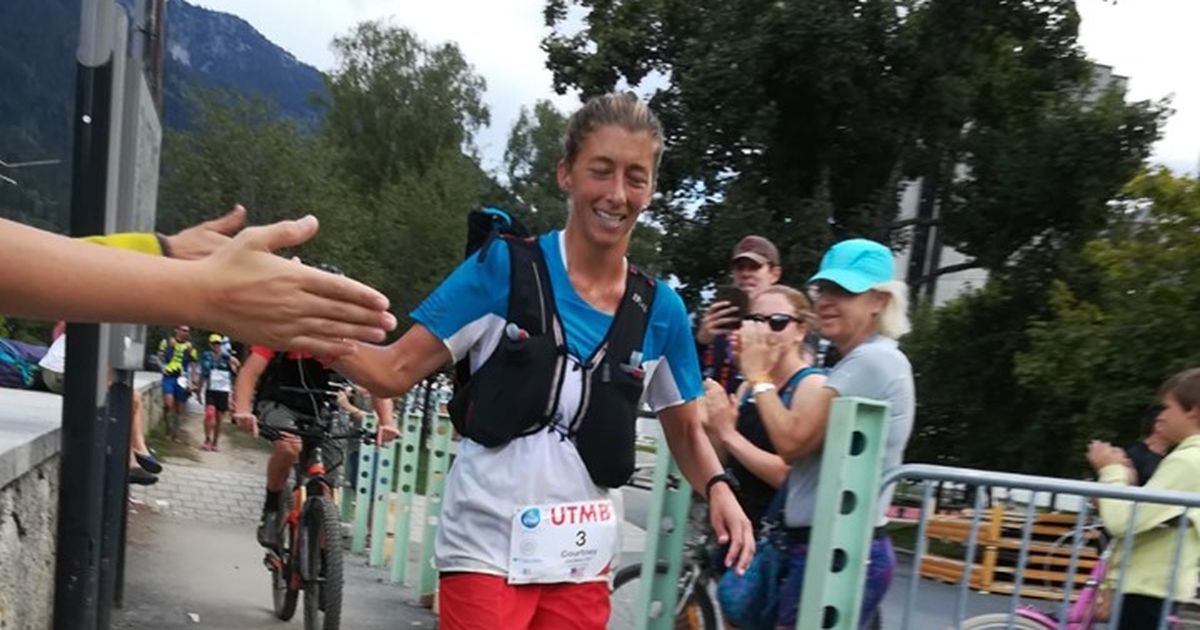
How Courtney Dauwalter Trains (No Coach, No Plan, No Heart-Rate Monitor)
The best ultrarunner alive trains by feel: no coach, no plan, no heart-rate data. Why it works for her, and what a heart-rate cap gives the rest of us.

Courtney Dauwalter trains with no coach, no written plan and no heart-rate monitor. She decides each day's run after her morning coffee based on how her body and brain feel. She is the only person to win Western States, Hardrock and UTMB in a single year, and in July 2026 she won Hardrock for a fourth time. Can you copy any of it?
By feel, and she means it
No periodised plan, no prescribed paces, no intensity distribution written down. She runs on effort, does not track heart-rate zones, and keeps no public training log. Her husband gives occasional informal input.
Volume is high and self-modulated: around 100 to 115 miles a week, with her own sense that 115 is the sweet spot and 130 tips into overworked. Long runs are three to four hours, with outliers like a reported eight-hour run "just playing" before Hardrock in 2022.
By feel does not mean no hard running. She does speed work, improvised rather than periodised, often as simple as finding a hill she likes and running it hard.
Why it works for her (and might not for you)
Twenty-plus years of running have given Dauwalter a calibrated sense of effort. Her easy is easy and her hard is hard. Most amateurs do not have that yet. Run "by feel" uncalibrated and your easy runs drift too fast, your hard runs are not hard enough, and you live in the unproductive middle.
A heart-rate cap like the MAF 180 formula is training wheels for the same skill. It forces the discipline Dauwalter has internalised.
MAF aerobt tak
145bpm
180 − 35 + 0
| Sone | Område | Hva den trener |
|---|---|---|
| MAF | Aerobt treningsområde 135–145 bpm | Maksimal aerob funksjon, bygger fettforbrenning, mitokondrier og en sterk aerob grunnform med minimal belastning. Lett og bærekraftig, RPE 3–4. Nesepust-fart; du bør kunne holde en samtale. |
MAF · Aerobt treningsområde. Maksimal aerob funksjon, bygger fettforbrenning, mitokondrier og en sterk aerob grunnform med minimal belastning. Lett og bærekraftig, RPE 3–4. Nesepust-fart; du bør kunne holde en samtale.
- Maffetones metode holder nesten all trening på eller under 145 bpm for å bygge en dyp aerob grunnform. Kjerneområdet er 135–145 bpm.
- Fremgang spores med en MAF-test: ved en fast MAF-hjertefrekvens skal farten din bli raskere over uker. En platåfase eller tilbakegang signaliserer overtrening, dårlig ernæring eller stress.
- Den er bevisst konservativ. Mange utøvere synes den er veldig treig i starten, det er forventet; de aerobe tilpasningene kommer med tålmodighet.
En PDF med resultatene dine, pluss en QR-kode for å åpne dem igjen senere.
Enter your age, get a maximum aerobic heart rate, and cap your easy runs there. It feels slow at first. Hold it for a few months and your aerobic engine grows while your sense of "easy" recalibrates. Full logic in the aerobic base training guide.
The pain cave is a separate skill
Dauwalter's "pain cave" is a racing mindset, not a training prescription. She describes going toward the suffering-and-doubt phase of a long race rather than avoiding it. You can train with a heart-rate cap and still practise being comfortable with discomfort on race day.
Fuel like a normal person
Race fuel is mostly liquid calories plus a lot of candy, and in very long races a cheeseburger. Everyday eating she describes as a normal person's diet. She practises fuelling broadly and eats what she can stomach on the day.
What she has done lately
Dauwalter is 41 and based in Leadville, Colorado. Her triple came in 2023, not 2024 as often misremembered. In 2026 she took second at the Cocodona 250 in May, after a rare DNF there the year before, then won Hardrock in July with the fastest women's clockwise time in the race's history. She faded to tenth at UTMB in 2025 in brutal weather after leading early.
What you can steal from it
- Build a calibrated sense of effort, don't assume you have one. Dauwalter earned hers over two decades. Use a heart-rate cap to build yours.
- Keep easy easy. Whether a monitor or a lifetime of feel enforces it.
- Do hard efforts, just don't over-plan them.
- Fuel broadly, then eat what works. Practise nutrition in training so race day has options.
- Treat the pain cave as a separate, trainable mindset, not a reason to skip the aerobic base.
Her "no data" approach and your heart-rate calculator aim at the same target: easy running kept easy, for years.
More in this series: Eliud Kipchoge, Kilian Jornet, Jakob Ingebrigtsen, Cole Hocker, Marianne Vos and Mark Allen, who built a career on the same heart-rate cap.
Sources
Cover photo by Heike Maria Seitz, CC BY-SA 4.0, via Wikimedia Commons.
.jpg)