Sub-Elite 5k Training Plan: 8 Weeks for 15 to 17 Minutes
An 8-week sub-elite 5k plan for 15 to 17 minute runners: six runs a week, peak 78 km, 6 × 1000 m at interval pace, 12 × 200 m reps, 90 % easy. Free.

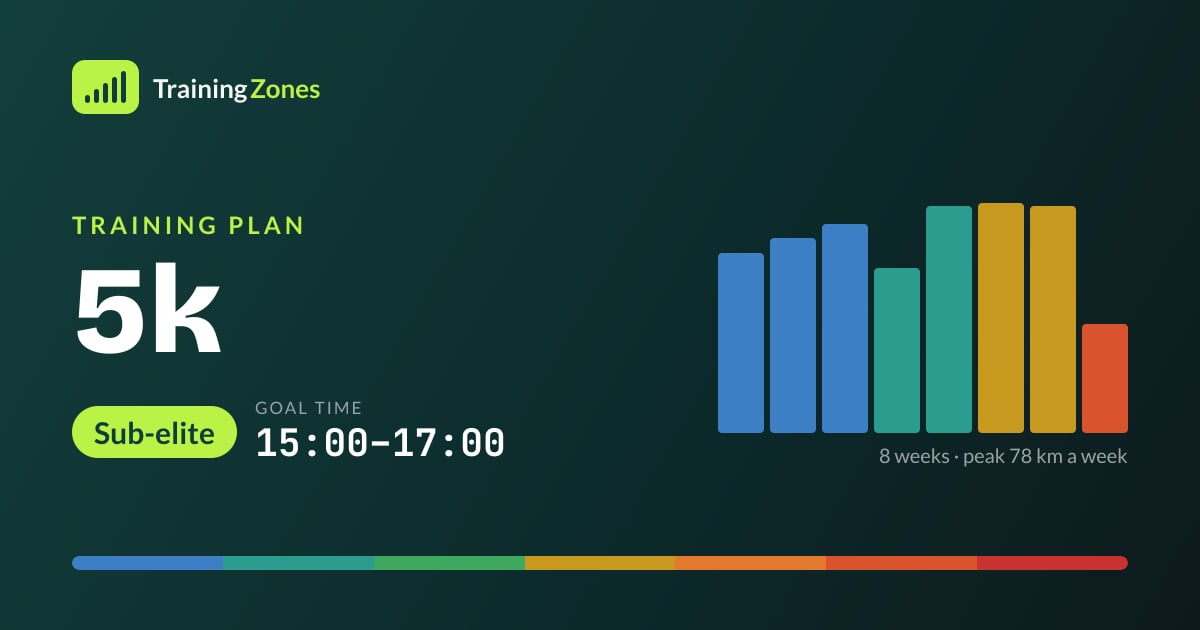
A sub-elite 5k plan runs 8 weeks at six runs a week, peaks at about 78 km, and builds to 6 × 1000 m at interval pace with 90 % of the running easy. It fits runners whose 5k sits between 15 and 17 minutes, roughly a 31 to 35 minute 10k. Sub-16 sits in the middle, sub-15 at the fast edge.
The 8 weeks
Sample plan · Sub-elite 5k
8 weeks, 6 runs a week, peak 78 km, longest run 15 km. Built for a recent 5k of 16:00 (VDOT 64.6). 90 % of the running is easy.
| Week | Km | Key sessions | Long run |
|---|---|---|---|
| 1 Base | 61 | Easy running only | 14 km long run |
| 2 Base | 66 | Easy running only | 15 km long run + strides |
| 3 Base | 71 | Tempo run: 20 min T | 14 km long run |
| 4 Build, recovery | 56 | Cruise intervals: 4 × 1.6 km T (1 min jog); Long intervals: 4 × 3 min I (3 min jog) | 14 km long run |
| 5 Build | 77 | Tempo run: 25 min T; 30/30 intervals: 2 × (15 × 30 s I / 30 s jog), 3 min between sets | 15 km long run + strides |
| 6 Peak | 78 | Long intervals: 5 × 4 min I (4 min jog); 200 m reps: 12 × 200 m R (200 m jog) | 15 km long run + strides |
| 7 Peak | 77 | 1000 m repeats: 6 × 1000 m I (400 m jog); 300 m reps: 10 × 300 m R (300 m jog) | 14 km long run |
| 8 Taper | 37 + race | Sharpener: 6 × 200 m R (200 m jog); race day | None, race week |
- Base, weeks 1 to 3. 61 to 71 km, long runs of 14 to 15 km. A 20-minute tempo in week 3.
- Build, weeks 4 and 5. Week 4 is lighter: 4 × 1.6 km cruise intervals and 4 × 3 minutes at interval pace. Week 5: a 25-minute tempo and two sets of 15 × 30/30.
- Peak, weeks 6 and 7. 5 × 4 minutes and 6 × 1000 m at interval pace, 12 × 200 m and 10 × 300 m at repetition pace.
- Taper, week 8. 37 km of training before the race, with six 200 m reps early in the week.
Who counts as sub-elite
Sub-elite is the level just below professional: fast club and championship runners. Here it means a 5k faster than 17:00, roughly VDOT 60 and up in Jack Daniels' system. A 17-minute 5k is VDOT 60.2, a 16-minute 5k VDOT 64.6, a 15-minute 5k VDOT 69.6. The sample runner has a 16:00 5k.
| 5k finish | Race pace | Easy | Marathon | Threshold | Interval |
|---|---|---|---|---|---|
| 15:00 | 3:00 | 3:45–4:30 | 3:25 | 3:15 | 2:59 |
| 16:00 | 3:12 | 3:59–4:47 | 3:38 | 3:27 | 3:10 |
| 17:00 | 3:24 | 4:13–5:03 | 3:52 | 3:40 | 3:21 |
Eight weeks is a sharpening block
At this level the aerobic base is already there. The plan starts at 61 km in week 1, a volume a beginner never reaches. Eight weeks is not enough to build that base. It is enough to put speed on top of it.
So the plan moves quickly from threshold to the paces the race uses:
- Threshold in weeks 3 to 5. A 20- and a 25-minute tempo, 4 × 1.6 km cruise intervals.
- VO2max from week 4. 4 × 3 minutes, 30/30 sets, then 5 × 4 minutes and 6 × 1000 m in the peak. At VDOT 65, 6 × 1000 m is about 19 minutes at interval pace, close to the length of the race itself.
- Repetition pace in the peak. 200 m and 300 m reps at 15 to 18 seconds per km faster than 5k pace, with equal-distance jogs. Paavolainen (1999) found explosive-type training improved 5k time through running economy and muscle power, with no change in VO2max.
Everything else is easy. Haugen (2022) found world-class distance runners keep at least 80 % of their running at low intensity through the whole year. This plan sits at 90 %.
Where this plan stops
The generator plans six runs a week with no doubles, and caps the 5k long run at 14 km. Haugen reports world-class track runners at 130 to 190 km a week over 11 to 14 sessions. If you already run doubles, keep the plan's two quality days and the long run as the skeleton and add easy running around them. The paces stay correct, because they come from your race time.
Your own plan
The 5k training plan generator builds all 8 weeks from your 5k or parkrun time, your weeks until race day, your running days and your long-run day. Add a goal like 15:59 and it shows the gap to your prediction. Longer builds of up to 24 weeks add base weeks in front. Free, no account, PDF included.
FAQ
What pace do I need for a sub-16 5k? 3:12 per km, VDOT 64.6. A 10k of 33:13 predicts it.
How many kilometres a week for a sub-16 5k? This plan peaks at 80 km on six days. If you train higher, the plan's quality sessions still fit with easy volume added around them.
Can a 5k plan this short work for a sub-15 goal? Only on top of a long base. Sub-15 is VDOT 69.6, at the top of this band. The plan starts at 61 km in week 1, so if you run much less today, choose a longer plan and let the base weeks come first.
Should I race during the plan? A tune-up race can replace the week-5 tempo. The plan never puts two hard days in a row, and a race counts as one.
Only need your training paces? Enter a recent race:
VDOT
49.8
índice de condición física de carrera de Daniels
| Zona | Rango | Qué entrena |
|---|---|---|
| E | Fácil / Larga 4:54–5:53 /km | Base aeróbica, capilares, metabolismo de las grasas; la mayor parte del volumen semanal. RPE 3–4, conversacional. |
| M | Maratón 4:26–4:51 /km | Resistencia y economía específicas de maratón. RPE 5–6, constante. |
| T | Umbral 4:16–4:28 /km | Umbral de lactato; tempo cómodamente duro e intervalos de crucero. RPE 7, esfuerzo de competición de ~1 h. |
| I | Intervalo 3:51–4:01 /km | VO₂max; repeticiones duras de 3–5 min. RPE 9, duro. |
| R | Repetición 3:19–3:42 /km | Velocidad, economía y potencia de carrera; repeticiones cortas y rápidas con recuperación completa. RPE 9–10, rápido y controlado. |
E · Fácil / Larga. Base aeróbica, capilares, metabolismo de las grasas; la mayor parte del volumen semanal. RPE 3–4, conversacional.
M · Maratón. Resistencia y economía específicas de maratón. RPE 5–6, constante.
T · Umbral. Umbral de lactato; tempo cómodamente duro e intervalos de crucero. RPE 7, esfuerzo de competición de ~1 h.
I · Intervalo. VO₂max; repeticiones duras de 3–5 min. RPE 9, duro.
R · Repetición. Velocidad, economía y potencia de carrera; repeticiones cortas y rápidas con recuperación completa. RPE 9–10, rápido y controlado.
- Tu VDOT de 49.8 es un único número que captura tu condición física de carrera actual (un 'VO₂max' ajustado por la economía de carrera). Cada ritmo de entrenamiento se deriva de él.
- El VDOT proviene de una carrera o contrarreloj reciente y dura. Usa un resultado que hayas competido a tope, idealmente de 5 km o más; una media maratón o 10 km dan la estimación más estable.
- Cambia el selector de unidades para ver los ritmos por milla. A medida que mejores tu forma, vuelve a competir; tu VDOT y todos los ritmos se actualizarán.
- Estos son los ritmos de entrenamiento concretos de Daniels (E, M, T, I, R), no zonas continuas: corres a cada ritmo con un propósito específico. Los huecos entre los ritmos más duros (T, I y R) son intencionados, no un fallo.
Un PDF con tus resultados personalizados, más un código QR para volver a abrirlos cuando quieras.
More in this series: the beginner, intermediate and advanced 5k plans and the sub-elite 10k plan.
Sources
- Haugen et al. 2022, training of world-class distance runners
- Paavolainen et al. 1999, explosive-strength training and 5k performance
Cover image: TrainingZones.