Advanced Half Marathon Training Plan: 12 Weeks for 1:20 to 1:30
A 12-week advanced half marathon plan for 1:20 to 1:30 runners: six runs a week, peak 67 km, 22 km long runs with marathon-pace finishes. Free.

An advanced half marathon plan runs 12 weeks at six runs a week, peaks at about 67 km, and holds 22 km long runs through the second half. It fits runners whose fitness predicts a 1:20 to 1:30 half: roughly a 17:30 to 19:40 5k, or a 10k between about 36 and 41 minutes. Sub-1:25 sits in the middle, sub-1:20 at the fast edge.
The 12 weeks
Sample plan · Advanced half marathon
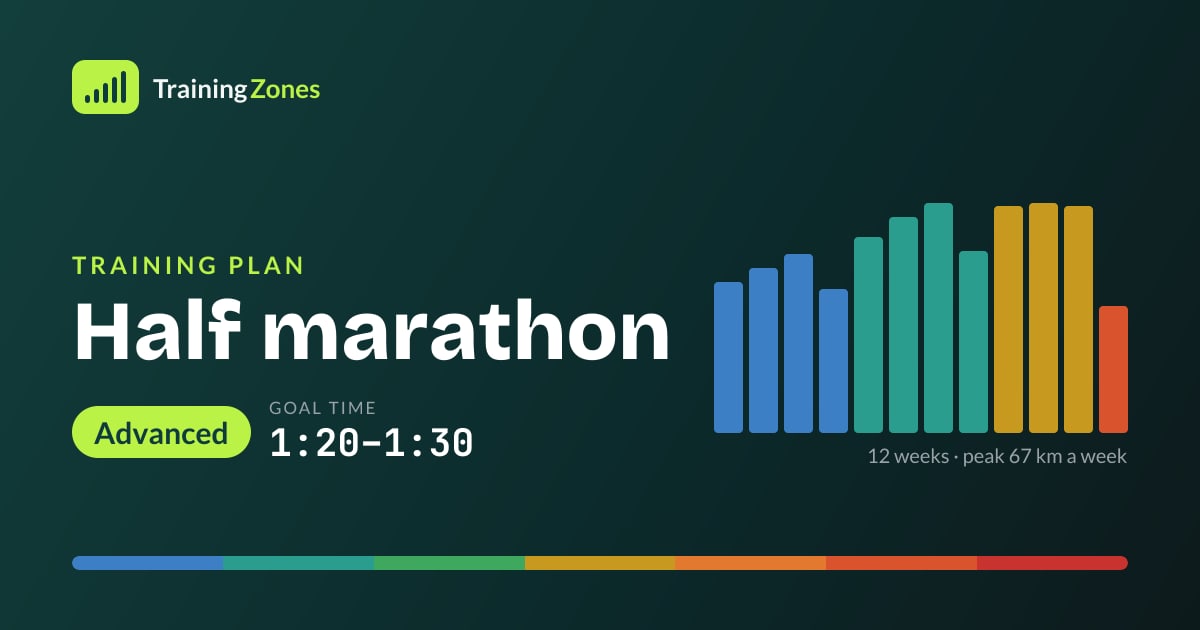
12 weeks, 6 runs a week, peak 67 km, longest run 22 km. Built for a recent 5k of 18:00 (VDOT 56.3). 82 % of the running is easy.
| Week | Km | Key sessions | Long run |
|---|---|---|---|
| 1 Base | 44 | Easy running only | 15 km long run |
| 2 Base | 48 | Easy running only | 17 km long run + strides |
| 3 Base | 52 | Tempo run: 15 min T | 18 km long run |
| 4 Base, recovery | 42 | Progression run: 13 min M · 13 min T | 14 km long run |
| 5 Build | 57 | Cruise intervals: 4 × 1.6 km T (1 min jog); Long intervals: 4 × 4 min I (4 min jog) | 20 km long run |
| 6 Build | 63 | Tempo run: 25 min T; 30/15 sets: 2 × (13 × 30 s I / 15 s jog), 3 min between sets | 22 km progressive long run |
| 7 Build | 67 | Broken tempo: 2 × 13 min T (2 min jog); 5k time trial | 22 km long run |
| 8 Build, recovery | 53 | Progression run: 20 min M · 20 min T; 1000 m repeats: 4 × 1000 m I (400 m jog) | 19 km long run |
| 9 Peak | 66 | Half-marathon pace reps: 2 × 3 km race pace (2 min jog); Long intervals: 4 × 3 min I (3 min jog) | 22 km long run with marathon-pace finish |
| 10 Peak | 67 | Race-pace run: 7 km race pace; 30/15 sets: 2 × (13 × 30 s I / 15 s jog), 3 min between sets | 22 km progressive long run |
| 11 Peak | 66 | Half-marathon pace reps: 2 × 3 km race pace (2 min jog); Hill repeats: 10 × 75 s I (2 min jog) | 22 km long run with marathon-pace finish |
| 12 Taper | 37 + race | Sharpener: 4 × 2 min race pace (2 min jog); race day | None, race week |
- Base, weeks 1 to 4. From 44 to 52 km, long runs of 15 to 18 km. Threshold from week 3: a 15-minute tempo, then a 13-minute marathon-pace plus 13-minute threshold progression.
- Build, weeks 5 to 8. Up to 67 km. Two quality days: threshold (4 × 1.6 km cruise intervals, a 25-minute tempo, 2 × 13 minutes broken tempo) plus VO2max work such as 4 × 4 minutes. Long runs reach 22 km, one of them progressive. A 5k time trial in week 7.
- Peak, weeks 9 to 11. Half-marathon pace: 2 × 3 km, a continuous 7 km, 2 × 3 km. Long runs of 22 km that finish with 4, 7, then 10 km at marathon pace.
- Taper, week 12. Volume near 55 % of peak, four 2-minute pickups at race pace, then the race.
Who counts as advanced
Levels come from Jack Daniels' VDOT, one number from a recent race that sets every training pace. Advanced means a predicted half of 1:20 to 1:30, roughly VDOT 51 to 58. A 1:25 half is VDOT 54.5, a 1:20 half VDOT 58.4. The sample runner has an 18:00 5k, VDOT 56.3, which predicts 1:22:33.
| Half marathon finish | Race pace | Easy | Marathon | Threshold | Interval |
|---|---|---|---|---|---|
| 1:20 | 3:48 | 4:19–5:11 | 3:58 | 3:45 | 3:26 |
| 1:25 | 4:02 | 4:34–5:29 | 4:12 | 3:58 | 3:38 |
| 1:30 | 4:16 | 4:49–5:47 | 4:27 | 4:11 | 3:50 |
Long runs longer than the race
At this level the long run is 22 km, longer than the half marathon itself. That is deliberate. Running past the race distance means the last kilometres of the race are never new territory, and the aerobic volume of a 100-minute run keeps building the base that threshold work sits on.
The peak-phase long runs add a second job. The last 10 km of the week-11 long run is at marathon pace, about 10 seconds per km slower than half-marathon pace for an advanced runner. It is sustained, controlled work on tired legs, which is what the last 5 km of a half asks for. Maunder (2021) and Jones (2024) describe that ability as durability, a performance factor separate from VO2max and threshold.
The rest of the plan holds the structure together:
- 82 % easy running, in line with the 80 % or more Haugen (2022) found in world-class distance runners.
- Threshold every week, because an 80 to 90 minute race is run just below the pace you could hold for an hour.
- Recovery weeks 4 and 8, at about 75 % volume, so the 67 km weeks land on a recovered body.
Your own plan
The sample is one runner. The half marathon training plan generator builds yours from your recent race, your weeks until race day, your running days and your long-run day. Add a goal like 1:24:59 and it shows the gap to your prediction. Free, no account, PDF included.
FAQ
What 10k time predicts a sub-1:25 half marathon? About 38:25, VDOT 54.5. A 5k of 18:32 predicts the same.
How many kilometres a week for a sub-1:20 half marathon? This plan peaks at 70 km on six days. A 1:20 half is VDOT 58.4, the fast edge of this band. Below 1:20 the sub-elite plan goes to 100 km.
Why are the long runs at marathon pace and not half-marathon pace? Marathon pace is controlled enough to hold for 10 km inside a long run and still leave room for the mid-week sessions. Half-marathon pace lives in those sessions instead.
Can I run the plan on five days? Yes. On five days the peak still reaches 70 km, because each run can be up to 14 km plus a 22 km long run.
Only need your training paces? Enter a recent race:
VDOT
49.8
score de forme à la course de Daniels
| Zone | Plage | Ce que cela développe |
|---|---|---|
| E | Facile / Long 4:54–5:53 /km | Base aérobie, capillaires, métabolisme des graisses ; l'essentiel du volume hebdomadaire. RPE 3–4, conversationnel. |
| M | Marathon 4:26–4:51 /km | Endurance et économie spécifiques au marathon. RPE 5–6, régulier. |
| T | Seuil 4:16–4:28 /km | Seuil lactique ; tempo et intervalles « cruise » confortablement difficiles. RPE 7, effort de course ~1 h. |
| I | Intervalle 3:51–4:01 /km | VO₂max ; répétitions intenses de 3–5 min. RPE 9, difficile. |
| R | Répétition 3:19–3:42 /km | Vitesse, économie et puissance de course ; répétitions courtes et rapides avec récupération complète. RPE 9–10, rapide et contrôlé. |
E · Facile / Long. Base aérobie, capillaires, métabolisme des graisses ; l'essentiel du volume hebdomadaire. RPE 3–4, conversationnel.
M · Marathon. Endurance et économie spécifiques au marathon. RPE 5–6, régulier.
T · Seuil. Seuil lactique ; tempo et intervalles « cruise » confortablement difficiles. RPE 7, effort de course ~1 h.
I · Intervalle. VO₂max ; répétitions intenses de 3–5 min. RPE 9, difficile.
R · Répétition. Vitesse, économie et puissance de course ; répétitions courtes et rapides avec récupération complète. RPE 9–10, rapide et contrôlé.
- Votre VDOT de 49.8 est un nombre unique qui résume votre forme actuelle à la course (une « VO₂max » ajustée pour l'économie de course). Toutes vos allures d'entraînement en découlent.
- Le VDOT provient d'une course ou d'un contre-la-montre récent et intense. Utilisez un résultat couru à fond, idéalement sur 5 km ou plus ; un semi-marathon ou un 10 km donne l'estimation la plus stable.
- Basculez le sélecteur d'unités pour lire les allures au mile. À mesure que vous progressez, recourez ; votre VDOT et toutes les allures se mettront à jour.
- Ce sont les allures d’entraînement distinctes de Daniels (E, M, T, I, R), pas des zones continues : on court à chaque allure dans un but précis. Les écarts entre les allures les plus dures (T, I et R) sont intentionnels, pas un bug.
Un PDF de vos résultats, avec un QR code pour les rouvrir à tout moment.
More in this series: the beginner, intermediate and sub-elite half marathon plans, the advanced 10k plan and the advanced marathon plan.
Sources
- Haugen et al. 2022, training of world-class distance runners
- Maunder et al. 2021, durability in endurance athletes
- Jones 2024, physiological resilience
Cover image: TrainingZones.