How Mark Allen Trained (and Why He Ran Slower to Get Faster)
Six-time Ironman World Champion Mark Allen capped his heart rate with Maffetone's 180-formula and watched his pace at that heart rate transform. A formula you can run now.

Mark Allen won the Ironman World Championship six times. The useful part of his story is the period when he made himself slower. Working with Dr. Phil Maffetone, Allen capped his training heart rate and ran well under it, even at a pace that felt embarrassingly easy. Over the following years, the pace he could hold at that capped heart rate got dramatically faster. The formula behind it ships as a calculator on this site.
The runner who got faster by slowing down
When Allen started training by heart rate under Maffetone, he had to slow down a lot. In his words, "the first time Phil Maffetone took me to the track and had me put on a heart rate monitor, we timed a couple of miles, my pace was 8:45 min/mile." The method demands exactly that: stay under the cap, and walk the hills if that is what it takes.
The payoff: "at the end of the season I was able to run 5:30 to 5:45 pace at 155 beats per minute. Some years I would get faster to almost a 5:20 min/mile aerobic pace." The same heart rate that once produced an 8:45 mile eventually produced close to a 5:20 mile. The exact starting figures vary between his retellings, so treat them as self-reported, but the direction and scale are consistent across the accounts.
The formula: 180 minus your age
The cap comes from Maffetone's 180-formula, which estimates your maximum aerobic heart rate, the ceiling for building aerobic base without tipping into stress that costs more than it gives. Allen's roughly 155-beat cap was about 180 minus his age at the time.
Plafond aérobie MAF
145bpm
180 − 35 + 0
| Zone | Plage | Ce que cela développe |
|---|---|---|
| MAF | Plage d'entraînement aérobie 135–145 bpm | Fonction aérobie maximale, développe la combustion des graisses, les mitochondries et une solide base aérobie avec un stress minimal. Facile et tenable, RPE 3–4. Allure de respiration nasale ; vous devriez pouvoir tenir une conversation. |
MAF · Plage d'entraînement aérobie. Fonction aérobie maximale, développe la combustion des graisses, les mitochondries et une solide base aérobie avec un stress minimal. Facile et tenable, RPE 3–4. Allure de respiration nasale ; vous devriez pouvoir tenir une conversation.
- La méthode de Maffetone maintient presque tout l'entraînement à 145 bpm ou en dessous pour bâtir une base aérobie profonde. La plage centrale est 135–145 bpm.
- Les progrès se suivent avec un test MAF : à une fréquence cardiaque MAF fixe, votre allure devrait s'accélérer au fil des semaines. Un plateau ou une régression signale un surentraînement, une mauvaise alimentation ou du stress.
- Elle est délibérément prudente. Beaucoup d'athlètes la trouvent très lente au début, c'est attendu ; les adaptations aérobies viennent avec la patience.
Un PDF de vos résultats, avec un QR code pour les rouvrir à tout moment.
Start with 180 minus your age, then apply one modifier: subtract 10 if you are recovering from a major illness or on regular medication, subtract 5 if you are injured, out of form, or get sick more than twice a year, keep it if you have trained consistently for a couple of years without those problems, and add 5 only if you have trained for more than two years, kept improving, and stayed healthy. Keep the large majority of your training under that number. Courtney Dauwalter uses the same cap as a guardrail for by-feel ultrarunning.
The MAF test: proof you can repeat every month
Maffetone's system comes with its own progress check. Warm up, run a fixed distance (one to five miles, on a flat track or the same route each time) at your maximum aerobic heart rate, and record the pace. Repeat about once a month, all year. If the aerobic base is growing, pace at that heart rate trends faster, as Allen's did. If it stalls or reverses across a couple of tests, you are overtrained, run down or sick, and it is time to back off.
Does it work?
With a caveat. The core principle, that most training should be easy so you build aerobic capacity without accumulating stress and injury, is well supported. The specific 180-minus-age number is a population average that can be off by several beats for any individual, and dedicated research on the MAF protocol is thin. Use the formula as a starting ceiling and let your MAF-test trend refine it.
What you can steal from it
- Cap your easy training by heart rate. Compute your maximum aerobic heart rate and keep the bulk of your training under it.
- Let easy be easy. Allen ran 8:45 miles to stay under his cap.
- Test monthly. Run the same MAF test each month and watch pace at that heart rate improve.
- Treat the number as a start, not scripture. Refine your ceiling with test results and how you feel.
- Be patient. Allen's transformation took months to years.
Allen retired in 1996 as a six-time world champion, undefeated in ten trips to the Nice International Triathlon, and winner of the 1989 "Iron War" duel with Dave Scott. The version worth copying is the earlier one who was willing to look slow in training for a season.
More in this series: Courtney Dauwalter, Kristian Blummenfelt, Lucy Charles-Barclay, the 2026 Kona champions Vincent Luis and Taylor Knibb, and the fast age-grouper on eight hours a week.
Sources
- Wikipedia profile
- Triathlete
- Interview with Extramilest
- The 180 formula
- The MAF test
- Want Speed? Slow Down!
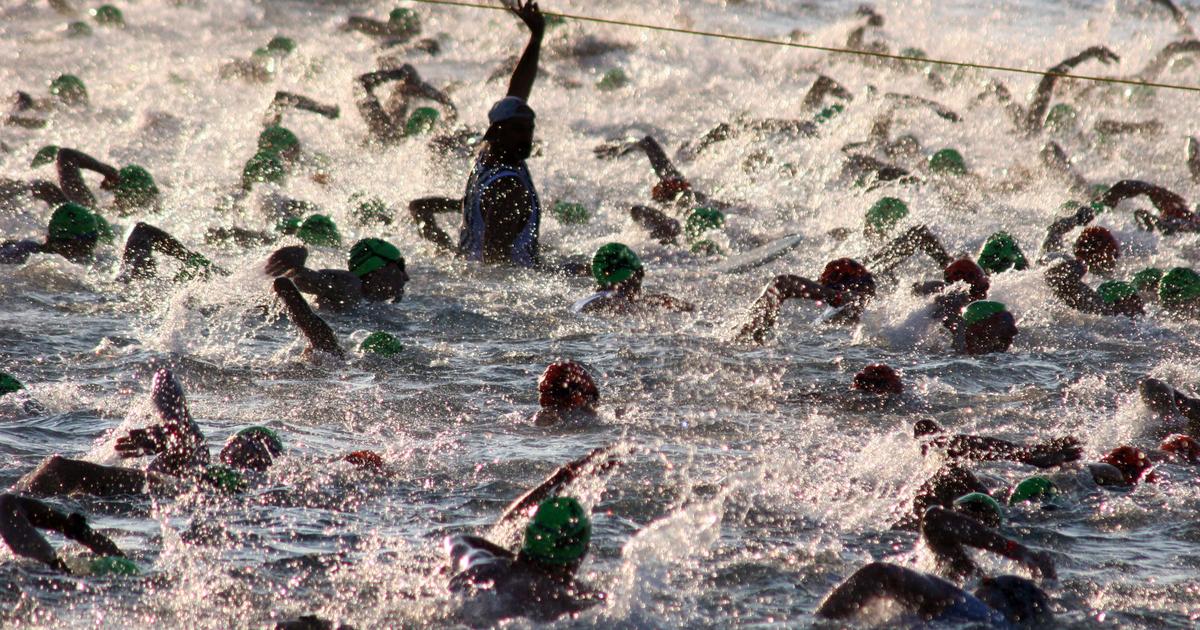
Cover photo: the mass swim start of the Ironman World Championship in Kailua-Kona, Hawaii, the race Mark Allen won six times (no freely licensed photograph of Allen himself is available on Wikimedia Commons). U.S. Navy photo by Chief Journalist Deborah Carson, public domain, via Wikimedia Commons.
