How Lucy Charles-Barclay Trains for the Heat (and the Hydration Mistake That Cost Her Kona)
The 2023 Ironman World Champion prepares for Kona with a six-week heat block, then lost a Kona lead to a sodium overdose. What long-course athletes get wrong about sweat and salt.

Lucy Charles-Barclay leads almost every race out of the water, but the instructive part of her story is heat. She won the 2023 Ironman World Championship in Kona, one of the hottest, most humid endurance races on earth, and two years later lost a commanding lead in the same race to a hydration mistake. Her career is a lesson in the variable most amateurs never measure: how much they sweat, and what to put back.
The swimmer who became a triathlete
Charles-Barclay swam competitively from childhood, was a national champion as a teenager, and narrowly missed selection for London 2012 before turning to triathlon. She turned professional in 2016 after winning her age group at the Ironman World Championship, and has since won Kona (2023), two Ironman 70.3 world titles (2021 and 2025), and finished runner-up at Kona four times. She is coached by her husband, Reece Barclay.
Racing from the front in long-course means more time alone in the full heat of the day than an athlete in a pack. Heat management is a core part of her event.
Training for the heat, not just the distance
Ahead of a Kona campaign, Charles-Barclay and coach Dan Lorang ran a six-week heat-acclimation block from home in the UK. She trained indoors at around 34 degrees Celsius and high humidity, often in a sauna-style suit, on top of her normal swim volume. Treadmill belts got so soaked that she had to keep switching machines, once finishing a session's final run outdoors because there was no dry treadmill left. She called it one of the hardest blocks she had ever done.
Heat acclimation, repeated training in the heat over one to two weeks or more, expands plasma volume, lowers the core temperature at which you start sweating, and makes sweat more dilute so you hold onto more sodium. It is one of the most reliable interventions in hot-weather endurance sport, and any amateur with a turbo trainer in a warm room can do it.
Sweat rate is the number
Fluid loss in the heat is large and highly individual. Sports scientists measure endurance athletes losing roughly half a litre to two litres an hour, with an average around 1.3. Reported numbers put Charles-Barclay's sweat rate at around 1.2 litres an hour, and that is the figure she sizes her race-day drinking around.
Laju keringat
2L/h
Cairan yang hilang per jam
Total kehilangan keringat
2L
Selama sesi 60 menit Anda
Asupan cairan yang disarankan pada sesi panjang
| Minum per jamDirekomendasikanGanti sekitar 100% hingga 150% dari kehilangan keringat | 1,5 to 2,3 L/h |
- Timbang sebelum dan sesudah dengan pakaian kering minimal untuk pembacaan yang akurat, dan kosongkan kandung kemih Anda sebelum penimbangan pertama.
- Laju keringat berubah dengan panas, kelembapan, intensitas, dan ketinggian. Uji dalam kondisi seperti acara target Anda dan uji ulang saat iklim berubah.
- Jangan minum berlebihan. Mengonsumsi jauh lebih banyak dari yang Anda kehilangan dapat mengencerkan sodium darah dan menyebabkan hiponatremia. Jika Anda selesai lebih berat dari saat memulai, Anda minum terlalu banyak.
PDF berisi hasil personalmu, plus kode QR untuk membukanya kembali kapan saja.
Weigh yourself before a hard session and again straight after, track what you drank, and the calculator turns the change into litres per hour. Do it once in cool conditions and once in the heat, because the two numbers can differ dramatically. Performance and safety suffer once you have lost roughly two percent of body weight in fluid, so your rate tells you how much to drink to stay ahead of that line.
When even the professionals get it wrong
Measuring sweat is only half of it. Sodium matters too, and it is easy to overcorrect. At the 2025 Kona race Charles-Barclay was leading the marathon before withdrawing about nine miles from the finish with hypernatraemia, too much sodium relative to fluid. She was "extremely thirsty" and drank heavily but nothing touched it. Afterwards: "It was my own fault in Kona. I overdosed on the salts and then needed excess fluid to try and claw it back, and that wouldn't work." For her comeback win at Ironman Lanzarote in 2026 she halved her electrolyte dosing, half a tablet an hour instead of a whole one.
Build a fluid and sodium plan from your measured sweat rate, rehearse it in the heat, and do not improvise new numbers on race day. More salt is not automatically safer.
What you can steal from it
- Measure your sweat rate. A before-and-after weigh-in turns fluid loss into litres per hour.
- Measure it hot. Your cool-weather rate understates summer racing losses.
- Acclimate before a hot race. Even a world champion runs a multi-week heat block. A warm indoor trainer session counts.
- Match sodium to fluid, and rehearse it. Charles-Barclay lost Kona to too much salt.
- Front-runners cook. Less shade, less draft, smaller hydration margin.
Most athletes never weigh themselves around a workout. She built a world title on taking it seriously, and lost a Kona the day she got the sodium half wrong.
More in this series: the 2026 Kona podium, Taylor Knibb, Laura Philipp and Julie Derron, plus Kristian Blummenfelt, Alex Yee, Mark Allen and the fast age-grouper on eight hours a week.
Sources
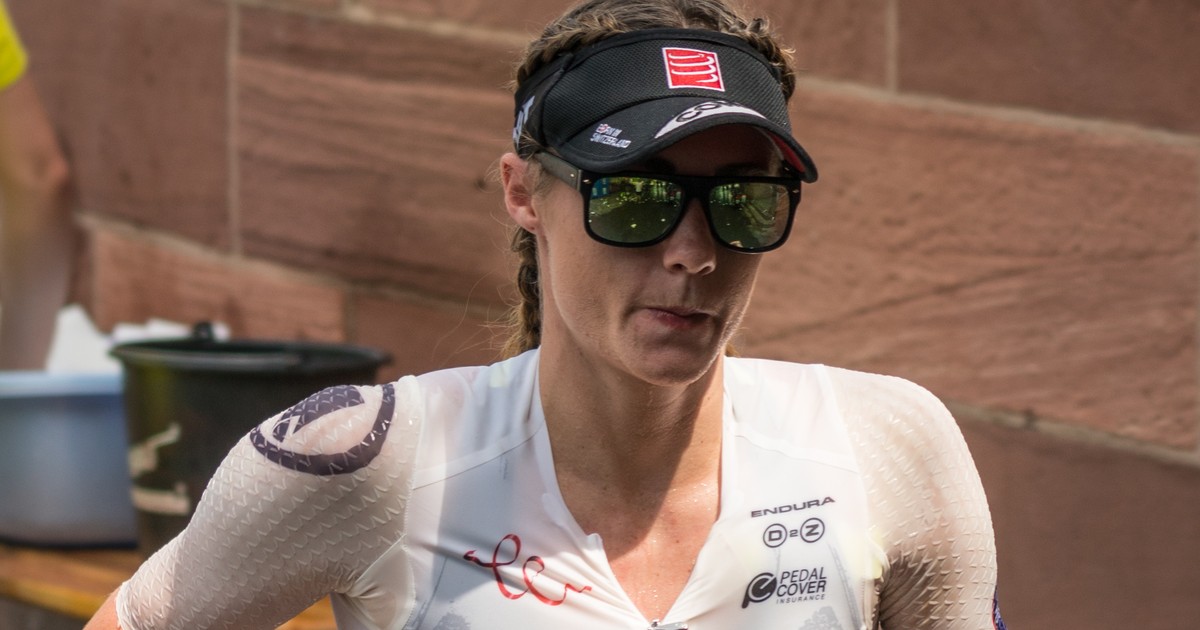
Cover photo by Jürgen Matern, CC BY-SA 4.0, via Wikimedia Commons.
