Advanced 5k Training Plan: 8 Weeks for 17 to 20 Minutes
An 8-week advanced 5k plan for 17 to 20 minute runners: six runs a week, peak 59 km, 5 × 1000 m at interval pace, 11 × 200 m reps. Built for sub-18. Free.

An advanced 5k plan runs 8 weeks at six runs a week, peaks at about 59 km, and builds to 5 × 1000 m at interval pace and 11 × 200 m at repetition pace. It fits runners whose 5k sits between 17 and 20 minutes, roughly a 35 to 41 minute 10k. Sub-19 and sub-18 are both inside this band.
The 8 weeks
Sample plan · Advanced 5k
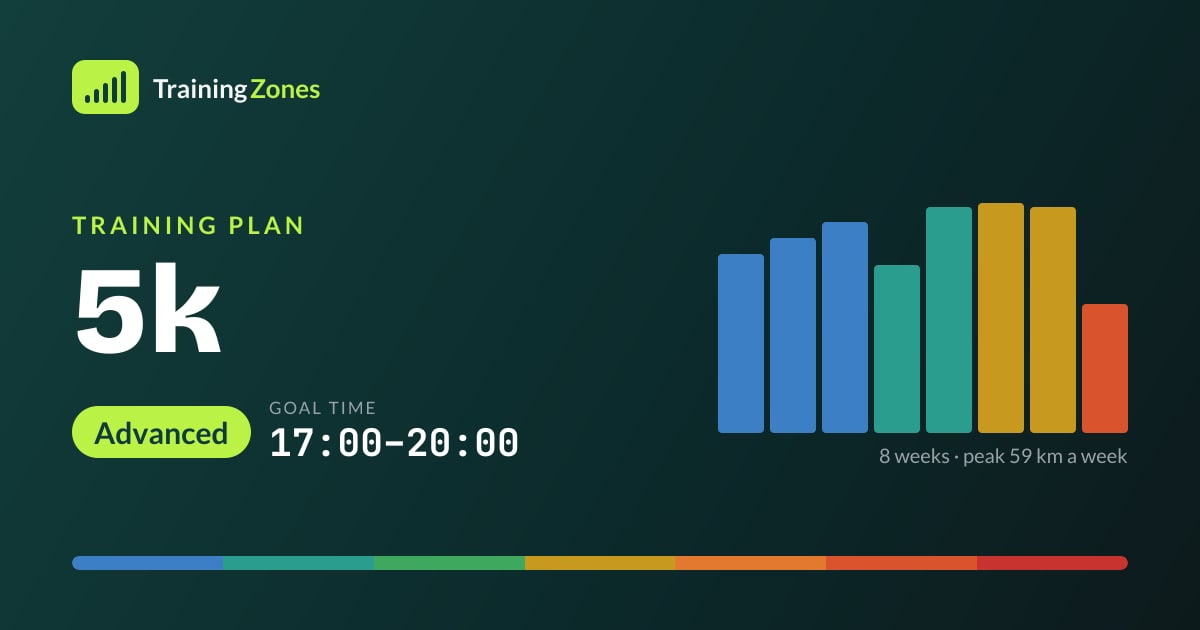
8 weeks, 6 runs a week, peak 59 km, longest run 15 km. Built for a recent 5k of 18:00 (VDOT 56.3). 89 % of the running is easy.
| Week | Km | Key sessions | Long run |
|---|---|---|---|
| 1 Base | 46 | Easy running only | 13 km long run |
| 2 Base | 50 | Easy running only | 15 km long run + strides |
| 3 Base | 54 | Tempo run: 15 min T | 14 km long run |
| 4 Build, recovery | 43 | Cruise intervals: 3 × 1.6 km T (1 min jog); Long intervals: 4 × 3 min I (3 min jog) | 12 km long run |
| 5 Build | 58 | Tempo run: 20 min T; 30/30 intervals: 2 × (15 × 30 s I / 30 s jog), 3 min between sets | 15 km long run + strides |
| 6 Peak | 59 | Long intervals: 4 × 4 min I (4 min jog); 200 m reps: 11 × 200 m R (200 m jog) | 15 km long run + strides |
| 7 Peak | 58 | 1000 m repeats: 5 × 1000 m I (400 m jog); 300 m reps: 8 × 300 m R (300 m jog) | 14 km long run |
| 8 Taper | 33 + race | Sharpener: 6 × 200 m R (200 m jog); race day | None, race week |
- Base, weeks 1 to 3. 46 to 54 km, long runs of 13 to 15 km. A 15-minute tempo in week 3.
- Build, weeks 4 and 5. Week 4 is lighter: 3 × 1.6 km cruise intervals and 4 × 3 minutes at interval pace. Week 5: a 20-minute tempo and two sets of 15 × 30/30.
- Peak, weeks 6 and 7. 4 × 4 minutes and 5 × 1000 m at interval pace, 11 × 200 m and 8 × 300 m at repetition pace. Long runs of 14 to 15 km.
- Taper, week 8. Six 200 m reps, easy running, race day.
Who counts as advanced
The level comes from Jack Daniels' VDOT, one number from a recent race that sets every training pace. Advanced means a 5k of 17 to 20 minutes, roughly VDOT 50 to 60. A 19-minute 5k is VDOT 52.9, an 18-minute 5k VDOT 56.3. Sub-17 is where the sub-elite band starts. The sample runner has an 18:00 5k.
| 5k finish | Race pace | Easy | Marathon | Threshold | Interval |
|---|---|---|---|---|---|
| 17:00 | 3:24 | 4:13–5:03 | 3:52 | 3:40 | 3:21 |
| 18:30 | 3:42 | 4:34–5:28 | 4:12 | 3:58 | 3:38 |
| 20:00 | 4:00 | 4:54–5:53 | 4:32 | 4:16 | 3:55 |
Same sessions, bigger doses
The advanced plan uses the same session types as the intermediate one. What changes is the dose. Side by side in the peak weeks:
- Long intervals: 4 × 4 minutes instead of 4 × 3.
- 1000 m repeats: five instead of three.
- 200 m reps: eleven instead of eight.
- 300 m reps: eight instead of six.
The generator sets each dose as minutes at intensity. It starts from a value per level and grows about 10 % per loading week. Daniels' limits then cap it against your weekly distance: interval work at about 8 % of the week, repetition work at about 5 %, rounded to whole reps. A runner on 59 km a week can hold about twice the repetition volume of a beginner on 30, so the reps grow with the week around them.
The frame around those sessions:
- Two hard days that never touch, and a rest day after the long run.
- 89 % easy running. Haugen (2022) found world-class distance runners keep at least 80 % of their volume at low intensity.
- Strides and hill sprints on easy days. Short, fast, fully recovered efforts that train speed without adding fatigue. Paavolainen (1999) found explosive-type strength training improved 5k time through running economy and muscle power, with no change in VO2max. Hill sprints are the running version of that stimulus.
Your own plan
The 5k training plan generator builds all 8 weeks from your 5k or parkrun time, your weeks until race day, your running days and your long-run day. Add a goal like 17:59 and it shows the gap to your prediction. Free, no account, PDF included.
FAQ
What pace do I need for a sub-18 5k? 3:36 per km, VDOT 56.3. A 10k of 37:20 predicts it.
How many kilometres a week for a sub-18 5k? This plan peaks at 60 km on six days. On five days the target is the same, with longer mid-week runs.
Why is the long run only 15 km for a 5k? The 5k long run is capped at 28 % of the week and 14 km of running, plus strides. It builds aerobic volume without cutting into the two quality days.
Should I race parkruns during the plan? Only in place of a quality session. The plan never puts two hard days in a row, and a hard parkrun counts as one.
Only need your training paces? Enter a recent race:
VDOT
49.8
Danielsのランニングフィットネススコア
| ゾーン | 範囲 | 鍛えられるもの |
|---|---|---|
| E | イージー/ロング 4:54–5:53 /km | 有酸素的土台、毛細血管、脂質代謝。週間ボリュームの大半。 RPE 3〜4、会話可能。 |
| M | マラソン 4:26–4:51 /km | マラソン特化の持久力とエコノミー。 RPE 5〜6、定常。 |
| T | スレッショルド 4:16–4:28 /km | 乳酸性作業閾値。快適にきついテンポとクルーズインターバル。 RPE 7、約1時間のレース強度。 |
| I | インターバル 3:51–4:01 /km | VO₂max。3〜5分のきついレップ。 RPE 9、きつい。 |
| R | レペティション 3:19–3:42 /km | スピード、エコノミー、ランニングパワー。完全休息を伴う短く速いレップ。 RPE 9〜10、速くコントロールされている。 |
E · イージー/ロング. 有酸素的土台、毛細血管、脂質代謝。週間ボリュームの大半。 RPE 3〜4、会話可能。
M · マラソン. マラソン特化の持久力とエコノミー。 RPE 5〜6、定常。
T · スレッショルド. 乳酸性作業閾値。快適にきついテンポとクルーズインターバル。 RPE 7、約1時間のレース強度。
I · インターバル. VO₂max。3〜5分のきついレップ。 RPE 9、きつい。
R · レペティション. スピード、エコノミー、ランニングパワー。完全休息を伴う短く速いレップ。 RPE 9〜10、速くコントロールされている。
- あなたのVDOT 49.8 は、現在のランニングフィットネスを捉える単一の数値です(ランニングエコノミーで調整した「VO₂max」)。すべてのトレーニングペースがこれから導かれます。
- VDOTは最近のきついレースまたはタイムトライアル1本から得られます。全力で走った結果、理想的には5 km以上を使ってください。ハーフマラソンや10 kmが最も安定した推定値を与えます。
- 単位の切り替えを使うとマイルあたりのペースで読めます。フィットネスが上がったら再びレースしてください。VDOTとすべてのペースが更新されます。
- これらはダニエルズの個別のトレーニングペース(E, M, T, I, R)であり、連続したゾーンではありません。それぞれのペースを特定の目的のために走ります。きついペース(T・I・R)の間の空白は意図的なもので、不具合ではありません。
パーソナライズされた結果のPDFと、いつでも再表示できるQRコード付き。
More in this series: the beginner, intermediate and sub-elite 5k plans and the advanced 10k plan.
Sources
- Haugen et al. 2022, training of world-class distance runners
- Paavolainen et al. 1999, explosive-strength training and 5k performance
Cover image: TrainingZones.