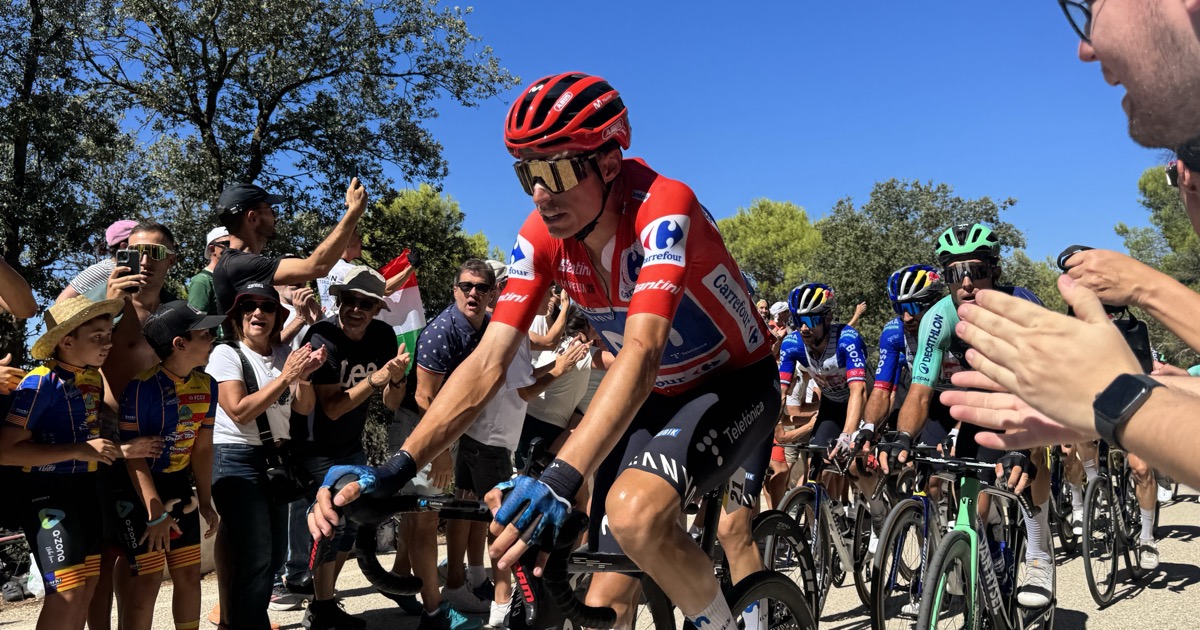
How Enric Mas Trains (Won the Vuelta a Year After Surgery)
Mas lost half of 2025 to a blood clot and was 32nd at the Giro in May. On 13 September he won the Vuelta. How the comeback was built, block by block.
Enric Mas won the 2026 Vuelta a España on 13 September, 2:15 clear of Primož Roglič. His first Grand Tour win, after four Vuelta podiums. In May he finished 32nd at the Giro d'Italia and lost the general classification on the first mountain day. In October 2025 he had surgery on a blood clot in his leg. His physiology did not change in the months between. The training block did.
A year that started with a blood clot
Mas crashed on the Mur-de-Bretagne stage of the 2025 Tour de France. Tests found thrombophlebitis in his left leg, a clot in an inflamed vein. He abandoned in the Alps and missed the Vuelta for the first time since 2019. He told AS he had no idea when he would ride again.
His first race back was a team time trial at Challenge Mallorca in February, seven months after the crash. "It has been a long process and I am still in it, little by little." Training followed the recovery, not the calendar. He then skipped the Tour de France: "I want to take a break from France for a few years or a few months, let's put it that way."
The Giro was a block
He went to the Giro saying a podium was realistic. On paper, the end of a career. As training, three weeks of the hardest aerobic load available, absorbed by a rider eight months post-surgery. Then he did not race for two months.
His own account: "After a very difficult start to the season, this summer I had a training camp at altitude, went to San Sebastian and then the Vuelta a Burgos and I've started having lots of good moments."
Copyable at any level:
- A big aerobic load (the Giro), taken as stimulus.
- A long absorption block at altitude, where adaptation happens.
- One hard single-day race (17th at Clásica San Sebastián) to reopen the top end.
- One short stage race (5th at the Vuelta a Burgos) to confirm the form repeats day on day.
- The target.
Most amateurs compress steps 1 and 5 and skip 2. Load without absorption is fatigue. Mas went into the Vuelta saying "we've come from altitude and we don't know exactly how we will respond." Altitude blocks pay off weeks later. You find out in the race.
What he does well
Mas is 1.77m and 61kg. His career rests on one repeatable skill: very high steady power on a 20 to 40 minute climb, day after day, for three weeks. He wins by still being there.
Stage 9 to the Alto de Aitana: 187.4km, 4,952m of climbing, six categorised climbs, 32 degrees. He sat in the group all day, went with 3.2km to go, and outsprinted Oscar Onley for his first win since 2022, Roglič third at 12 seconds. Three days later on Calar Alto he attacked again and took another half minute from Roglič. Both moves came late and both were sized to what he could hold.
The number that governs him is threshold power against body weight.
FTP
250W
Sweet Spot
220–235W
88–94 % FTP
| Zone | Bereich | Was es trainiert |
|---|---|---|
| Z1 | Aktive Regeneration ≤ 138 W | Erholung; kurbelt die Beine ohne zusätzliche Last. RPE 1–2, sehr leicht. |
| Z2 | Grundlagenausdauer 139–188 W | Aerobe Basis, Fettstoffwechsel, Dauertempo. RPE 3–4, Gesprächstempo. |
| Z3 | Tempo 189–225 W | Aerobe Ausdauer und muskuläre Effizienz. RPE 5–6, angenehm hart. |
| Z4 | Schwelle 226–263 W | Laktatschwelle, FTP-Arbeit – die nachhaltige Obergrenze. RPE 7–8, 10–30 min Wiederholungen. |
| Z5 | VO₂max 264–300 W | Maximale aerobe Leistung; 3–8 min Intervalle. RPE 9, sehr hart. |
| Z6 | Anaerobe Kapazität 301–375 W | Anaerobe Kapazität; 30 s–3 min Belastungen. RPE 9–10, nahezu maximal. |
| Z7 | Neuromuskuläre Leistung ≥ 376 W | Sprint- und neuromuskuläre Leistung. RPE 10, All-out-Sprints. |
Z1 · Aktive Regeneration. Erholung; kurbelt die Beine ohne zusätzliche Last. RPE 1–2, sehr leicht.
Z2 · Grundlagenausdauer. Aerobe Basis, Fettstoffwechsel, Dauertempo. RPE 3–4, Gesprächstempo.
Z3 · Tempo. Aerobe Ausdauer und muskuläre Effizienz. RPE 5–6, angenehm hart.
Z4 · Schwelle. Laktatschwelle, FTP-Arbeit – die nachhaltige Obergrenze. RPE 7–8, 10–30 min Wiederholungen.
Z5 · VO₂max. Maximale aerobe Leistung; 3–8 min Intervalle. RPE 9, sehr hart.
Z6 · Anaerobe Kapazität. Anaerobe Kapazität; 30 s–3 min Belastungen. RPE 9–10, nahezu maximal.
Z7 · Neuromuskuläre Leistung. Sprint- und neuromuskuläre Leistung. RPE 10, All-out-Sprints.
- Andrew Coggans Sieben-Zonen-Modell drückt jede Zone als Prozentsatz der Functional Threshold Power aus. Der Sweet Spot (220–235 W, 88–94 % FTP) liegt zwischen Tempo und Schwelle und liefert einen hohen Trainingsreiz bei mäßiger Ermüdung.
- FTP ist die Leistung, die du theoretisch etwa eine Stunde halten könntest. Teste alle 4–6 Wochen neu; eine veraltete FTP macht jede Zone falsch.
Ein PDF mit deinen personalisierten Ergebnissen, plus QR-Code, um sie jederzeit wieder zu öffnen.
Enter a recent 20-minute or ramp effort for an FTP estimate and the zones that follow, then divide by mass on the watts per kilogram page. On an 8.3km climb at 9.8%, W/kg is nearly everything. From two maximal efforts instead, use critical power.
The rest of his week looks like Vingegaard's and Pogačar's: mostly low-intensity riding, a little very hard work, altitude blocks, years of it. The principle is in how to train zone 2 and polarized training.
The limiter he never fixed, and won anyway
Four Vuelta podiums and no wins: second in 2018, 2021 and 2022, third in 2024. In the 2021 Vuelta's 33.8km time trial, Roglič won in 44:02 and Mas was ninth, 1:24 down. In 2020 he called his Vuelta time trial "a disaster."
Stage 18 was a flat 32.1km time trial into Jerez, Mas leading by 1:45, Roglič behind him the Olympic time trial champion. On history that stage erased the lead. Mas said so beforehand: "We have to be aware that Primož Roglič is an Olympic champion and has an impressive time."
Stefan Küng won it in 35:22.82. Mas rode the best Grand Tour time trial of his career for 12th, gave up 33 seconds to Roglič in fourth, and ended the day 1:37 ahead.
He never became a time triallist. He built a climber's lead his worst discipline could not spend, then went back to the mountains. On the queen stage to Collado del Alguacil, 8.3km at 9.8% with ramps touching 22%, Felix Gall attacked 1.2km out and Mas went with him, taking more time from Roglič. Mikel Landa won the stage from the break.
What you can steal from it
- Judge a comeback in blocks, not races. 32nd in May and the winner in September is the same rider.
- Load, then absorb. The Giro was the stimulus; the altitude camp turned it into fitness.
- Test the form before you need it. One hard one-day race, one short stage race, then the target.
- Pace to a number you know. Set yours with FTP and W/kg.
- Build a lead your limiter cannot spend. Mas never fixed his time trial, so he made it cost 33 seconds instead of the race.
More in this series: Primož Roglič, Jonas Vingegaard, Tadej Pogačar, Remco Evenepoel and Demi Vollering.
Sources
- Wikipedia
- 2026 Vuelta a España
- Cyclingnews on the thrombophlebitis
- Cyclingnews on his return to racing
- Domestique on his 2026 changes
- Cyclingnews stage 9 report
- CyclingUpToDate GC after stage 13
- IDL Procycling on the time trial maths
- Vuelta 2026 route
- Vuelta 2026 results
- CyclingUpToDate stage 18 report
- CyclingUpToDate stage 20 report
Cover photo by Yannick Arts, CC BY-SA 4.0, via Wikimedia Commons.
