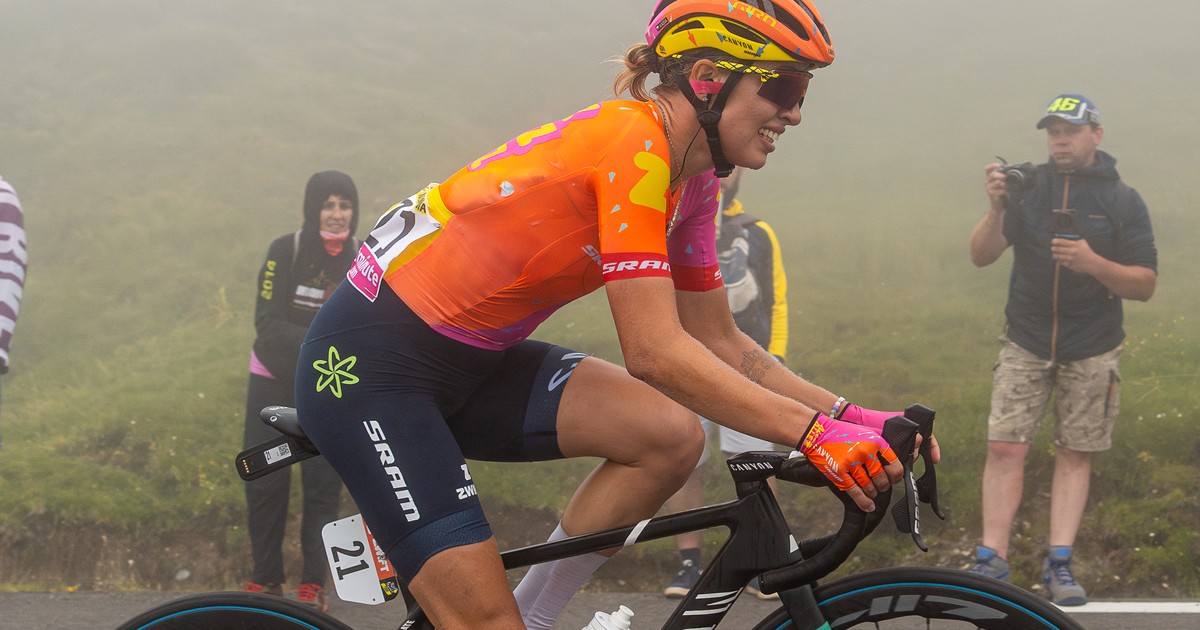
How Kasia Niewiadoma Trains (and How She Won on Mont Ventoux)
Kasia Niewiadoma soloed Mont Ventoux to take yellow at the 2026 Tour de France Femmes. The recon, the pacing and the watts per kilogram behind it.

On 7 August 2026, Kasia Niewiadoma attacked Mont Ventoux with 9.5 kilometres to climb, dropped Demi Vollering and Marlen Reusser, and crossed the summit 1 minute 16 seconds clear to take the stage and the yellow jersey at the Tour de France Femmes. The lesson for a normal cyclist is not the raw power. She had already ridden this climb, pictured this win for two months, and knew exactly where to make her move.
A climb she had already ridden in her head
Niewiadoma reconnoitred Ventoux months earlier. "I came here to recon it with my friends and my husband, and we had so much fun together," she said afterwards, her husband being the former professional Taylor Phinney. "I've been trying to picture this for the last two months, so I definitely had this in my head," and, "When I stood on top of Ventoux after the recon, I knew I wanted to win here." Before the Tour she told reporters, "I'm ready to break the KOM on Mont Ventoux."
Course knowledge costs nothing but time on the road. Knowing where a climb ramps, where it eases and where the wind hits is available to any amateur with a target hill-climb or sportive, and almost nobody does it seriously.
Knowing where to spend the effort
The attack was course-reading. "I knew I had to go away before 6ks to go because then it was kind of not flat, but less steep. And I knew that if I had a gap there, then in the back they would gamble because we had a headwind." Once clear: "So I knew with the wind and the lesser gradients, I had to be small and just maintain the gap." Hardest effort on the steepest section, then defend aerodynamically where the mountain eases.
A climb like Ventoux is well over an hour of sustained effort at the front of the race, so it is a test of the power you can hold at threshold. Start with your own number:
FTP
250W
Sweet Spot
220–235W
88–94 % FTP
| Zone | Bereich | Was es trainiert |
|---|---|---|
| Z1 | Aktive Regeneration ≤ 138 W | Erholung; kurbelt die Beine ohne zusätzliche Last. RPE 1–2, sehr leicht. |
| Z2 | Grundlagenausdauer 139–188 W | Aerobe Basis, Fettstoffwechsel, Dauertempo. RPE 3–4, Gesprächstempo. |
| Z3 | Tempo 189–225 W | Aerobe Ausdauer und muskuläre Effizienz. RPE 5–6, angenehm hart. |
| Z4 | Schwelle 226–263 W | Laktatschwelle, FTP-Arbeit – die nachhaltige Obergrenze. RPE 7–8, 10–30 min Wiederholungen. |
| Z5 | VO₂max 264–300 W | Maximale aerobe Leistung; 3–8 min Intervalle. RPE 9, sehr hart. |
| Z6 | Anaerobe Kapazität 301–375 W | Anaerobe Kapazität; 30 s–3 min Belastungen. RPE 9–10, nahezu maximal. |
| Z7 | Neuromuskuläre Leistung ≥ 376 W | Sprint- und neuromuskuläre Leistung. RPE 10, All-out-Sprints. |
Z1 · Aktive Regeneration. Erholung; kurbelt die Beine ohne zusätzliche Last. RPE 1–2, sehr leicht.
Z2 · Grundlagenausdauer. Aerobe Basis, Fettstoffwechsel, Dauertempo. RPE 3–4, Gesprächstempo.
Z3 · Tempo. Aerobe Ausdauer und muskuläre Effizienz. RPE 5–6, angenehm hart.
Z4 · Schwelle. Laktatschwelle, FTP-Arbeit – die nachhaltige Obergrenze. RPE 7–8, 10–30 min Wiederholungen.
Z5 · VO₂max. Maximale aerobe Leistung; 3–8 min Intervalle. RPE 9, sehr hart.
Z6 · Anaerobe Kapazität. Anaerobe Kapazität; 30 s–3 min Belastungen. RPE 9–10, nahezu maximal.
Z7 · Neuromuskuläre Leistung. Sprint- und neuromuskuläre Leistung. RPE 10, All-out-Sprints.
- Andrew Coggans Sieben-Zonen-Modell drückt jede Zone als Prozentsatz der Functional Threshold Power aus. Der Sweet Spot (220–235 W, 88–94 % FTP) liegt zwischen Tempo und Schwelle und liefert einen hohen Trainingsreiz bei mäßiger Ermüdung.
- FTP ist die Leistung, die du theoretisch etwa eine Stunde halten könntest. Teste alle 4–6 Wochen neu; eine veraltete FTP macht jede Zone falsch.
Ein PDF mit deinen personalisierten Ergebnissen, plus QR-Code, um sie jederzeit wieder zu öffnen.
Your FTP is roughly the power you can sustain for an hour, which is the demand of a long mountain finish. Hold near it on sustained grades. Going above it, as Niewiadoma did on the steep pitch, is a match you can only burn a few times.
Why climbers are ruled by watts per kilogram
On the flat, raw watts win. On a mountain you lift yourself against gravity for over an hour, so power relative to body weight decides it. FTP divided by weight in kilograms is the number that predicts how fast you go uphill.
The watts-per-kg guide does the maths and shows where your figure sits. Because a climb is a long steady effort, critical power is the companion concept for how long you can hold a given intensity. It is the same power-to-weight story as the Vingegaard and Pogačar posts, and the terrain where Niewiadoma dropped Vollering, whose own critical-power-driven approach she beat on the biggest mountain of the race.
Payback, and the long game
Niewiadoma won the 2024 Tour de France Femmes by four seconds over Vollering, the closest overall finish in the race's history, after three final podiums without the win in 2022, 2023 and 2025. She has a Flèche Wallonne, an Amstel Gold Race and a gravel world title, and races on instinct and emotion as much as on numbers. On Ventoux she said, "this is payback for all the second and third places I've had in my life."
She could not hold yellow to the finish. Demi Vollering clawed the lead back in the final days and rode away on the Col d'Èze above Nice to win the 2026 Tour de France Femmes overall, with Niewiadoma second.
What you can steal from it
- Recon your key climb. Learn where it ramps, eases and turns into the wind. Course knowledge is free speed.
- Know your FTP. A long climb is an hour-plus threshold effort. Estimate your FTP and let it anchor your zones and pacing.
- Train power-to-weight, not just power. Uphill, watts per kilogram wins mountains.
- Attack the steep, defend the shallow. Spend your matches where they buy the most time.
- Visualise the specific win. Two months of picturing one real course beats vague ambition.
More in this series: Demi Vollering, her rival on the climb, plus Jonas Vingegaard, Tadej Pogačar, Mathieu van der Poel and the fast age-grouper on eight hours a week.
Sources
Cover photo by Hugo LUC, CC BY-SA 4.0, via Wikimedia Commons.
