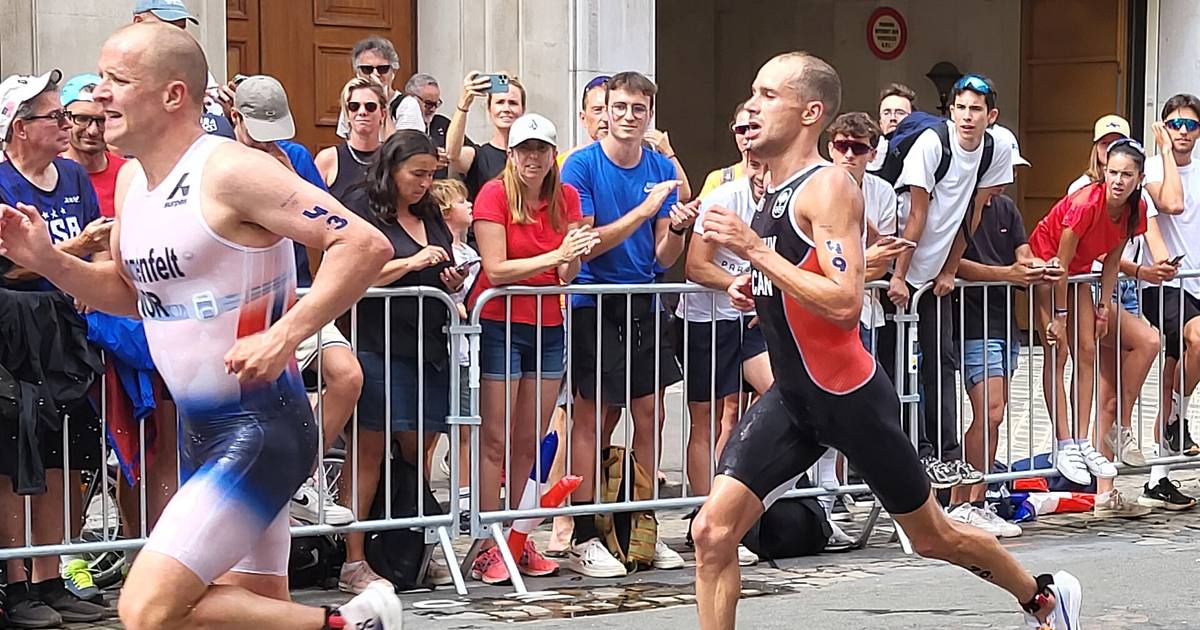
How Kristian Blummenfelt Trains (and What He Eats While Doing It)
Kristian Blummenfelt runs the Norwegian method in three sports: lactate-guided thresholds, obsessive measurement, and a carb intake that rewrote the rules.
The Norwegian method reached running through Jakob Ingebrigtsen and triathlon through a small group in Bergen. Kristian Blummenfelt is its most visible member: Olympic champion in Tokyo, then a fixture at the front of long-course racing. Same principle, controlled work at and just below threshold, governed by measurement. What differs is the scale of the measuring and the fuelling.
Three sports, one lactate framework
Blummenfelt uses the Ingebrigtsen skeleton: sessions clustered around lactate threshold, held to a target window of roughly 2 to 4 mmol/L rather than run to exhaustion, often twice a day, on a large easy base. A handful of threshold sessions per week.
He does it in three disciplines, each with its own threshold and recovery cost, and the lactate meter is the common currency. Reported volume is around 30 to 35 hours a week over six or seven days, from secondary reporting rather than a published log.
One difference from the running version: Ingebrigtsen pairs double-threshold days with fast VO2max work. Long-course triathlon leans further aerobic, because the event lasts eight hours, not three and a half minutes.
The measuring is the method
The Bergen signature is instrumentation: finger-prick lactate in the field, lab testing, portable metabolic analysers, core-temperature sensors, heat blocks, sauna protocols and altitude camps. Coach Olav Aleksander Bu:
The strength of data comes exactly from what you say. You need to measure regularly all the time there, and it has to be done in a way that the athlete doesn't feel it as intrusive.
Measurement that interrupts training stops happening within a fortnight. Bu has also suggested they could remove much of the technology and land in roughly the same place. The data reduces uncertainty. It does not replace the training.
The VO2max number, and why to be sceptical
In January 2026 a VO2max of 101.1 ml/kg/min was published for Blummenfelt on social media as the highest ever recorded. It has not appeared in peer-reviewed form. Several exercise scientists pointed to a respiratory exchange ratio of 0.93, well below the value expected at a true maximum, which suggests a test that ended early or a calibration problem. The number is a claim, not a result, as with Kilian Jornet's widely quoted VO2max.
The fuelling is the novel part
The accepted ceiling for carbohydrate absorption during exercise was long around 60g per hour, later 90g using glucose and fructose together. The Norwegians treated absorption as trainable and went far past it.
Journalists' reconstructions from the 2025 Ironman World Championship in Nice put Blummenfelt at roughly 177g per hour on the bike and around 130g per hour on the run. Those are counts from bottles and gels on one day, not lab measurements. Even heavily discounted, they are extraordinary.
Your gut adapts to what you repeatedly ask of it. Most age-groupers under-fuel long sessions, then blame their legs. Start from a sensible target and build up in training:
Target na carb
60g/h
Kada oras ng ehersisyo
Kabuuang carb
120g
Sa buong 2-oras na session
Inirerekomendang carbohydrate ayon sa haba ng session
| Wala pang 1 orasKadalasang sapat na ang tubig | 0 g/h |
| 1 hanggang 2.5 orasInirerekomendaIisang transportable na carb (glucose) | 60 g/h |
| 2.5 oras o mahaba paGlucose at fructose, malapit sa 2:1 na timpla | 90 g/h |
- Isabay ang carbohydrate sa likido at sodium. Ang konsentradong fuel na walang sapat na tubig ay nananatili sa bituka at nagdudulot ng pagkadismaya.
- Ang pagtitiis sa mataas na bilis ng carbohydrate ay kakayahang matututunan. Sanayin ang iyong race fuelling sa mahahabang session at itaas nang unti-unti, huwag kailanman subukan ang bagong mataas na intake sa araw ng karera.
- Sa itaas ng 60 g kada oras, gumamit ng glucose-to-fructose na timpla na malapit sa 2:1. Ang glucose lamang ay napupuno ang gut transporter sa mga 60 g kada oras.
- Ang mahihirap na pagsisikap ay mas mabilis na sumusunog ng carbohydrate, kaya umupo malapit sa tuktok ng bawat saklaw.
PDF ng iyong personalized na resulta, may QR code para buksan muli kahit kailan.
It gives a grams-per-hour target and a session total to practise with. For fluid, use the sweat rate calculator.
2026
He won 70.3 Geelong in March, 70.3 Oceanside a week later with a course record, defended his Ironman Texas title in April, and in July finished second on his Challenge Roth debut in 7:26:24 behind Sam Laidlow, whose 7:21:04 is the fastest full-distance time ever recorded. Reporting points his focus toward the Ironman World Championship.
His 2026 coaching arrangement is unclear. Some accounts have the Bergen athletes managing more of their own training while Bu consults, so this post describes the method, not who writes the plan.
What you can steal from it
- Control intensity, don't just survive it. Hold work at a repeatable level near threshold, capped by pace, power or the talk test.
- Train your gut on purpose. Build hourly carbohydrate intake gradually in training. One of the few large, cheap gains left.
- Heat adapts you too. A sauna or hot bath after training is the low-tech heat block.
- Measure something, consistently. A cheap number tracked for months beats an expensive number measured once.
- Discount the headline figures. The principle usually survives. The number often does not.
More in this series: Jakob Ingebrigtsen, Eliud Kipchoge, Kilian Jornet, Marianne Vos, Demi Vollering, Tadej Pogačar and Jonas Vingegaard. The system: the Norwegian method. Fellow long-course triathletes: Gustav Iden, his Bergen training partner, plus Vincent Luis, Lucy Charles-Barclay and Mark Allen.
Sources
- TrainingPeaks
- The Peter Attia Drive
- Science for Sport
- Sweat Science
- 220 Triathlon
- Race Smart
- Triathlete
- TRI247
Cover photo by Rz98, CC BY-SA 4.0, via Wikimedia Commons.
