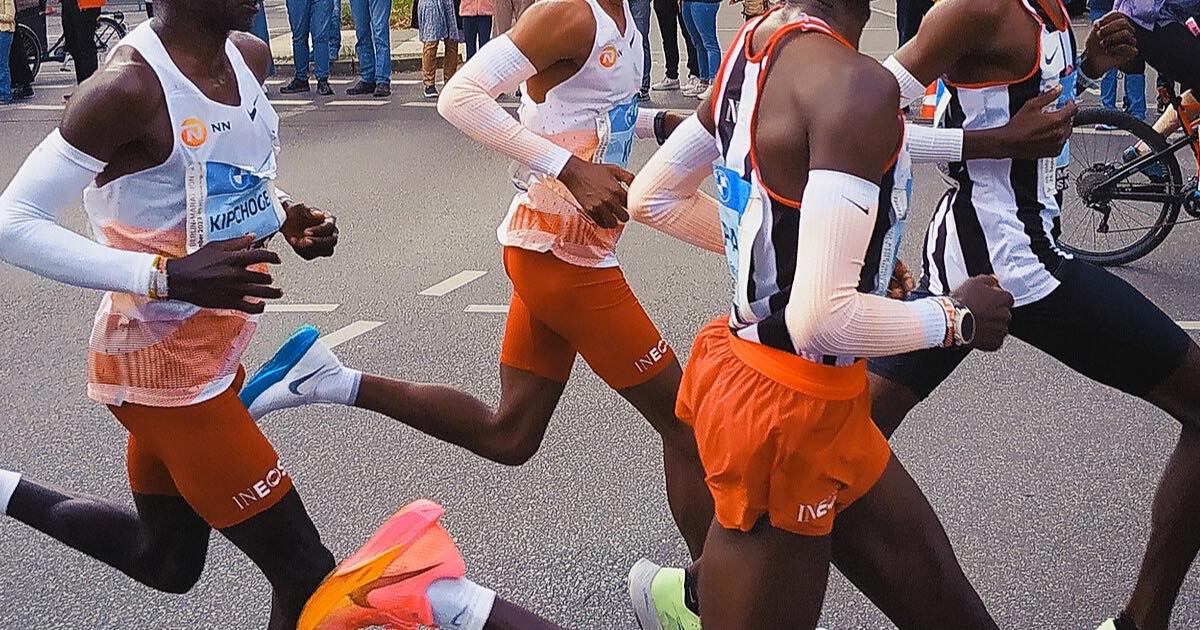
How Eliud Kipchoge Trains (and Why He's Still Out There at 41)
Kipchoge never runs a session flat out. The 80/50 week behind the greatest marathon career ever, and why it has him racing seven continents at 41.
On 12 July 2026, Eliud Kipchoge finished twelfth at the Porto Alegre marathon in 2:18:39, almost ten minutes behind the winner. Two Olympic titles, a world record of 2:01:09, the first human under two hours in any conditions, and now a 41-year-old through halfway on 2:09 pace and fading. The philosophy that made him the best marathoner in history is the one that keeps him on start lines after the winning has stopped.
He never trains flat out
The most quoted thing Kipchoge has said about his training is also the most useful:
I try not to run 100 percent. I perform 80 percent on Tuesday, Thursday, and Saturday and then at 50 percent Monday, Wednesday, Friday, and Sunday.
His hard days are 80 percent. His easy days are half effort. Nothing in a normal week is run to the bottom of the tank.
Adaptation comes from doing the work repeatedly, not from surviving any single session. A session at 80 percent leaves you able to train tomorrow. A session at 100 percent buys a slightly better workout and costs the next three days. Over a year, the athlete who never empties the tank does far more quality work.
The amateur mistake: easy runs a bit too fast, hard sessions run as races, a weekly total that looks impressive and produces nothing. Our guide to aerobic base training covers why that fails. Zone 2 is the intensity most people never hit because they run easy days at 70 percent instead of 50.
Enormous volume, almost all of it slow
Kipchoge trains at Kaptagat in the Kenyan highlands at roughly 2,400m, in a camp run by his long-time coach Patrick Sang. Weekly volume sits between 200 and 220km, split across a morning and an afternoon run most days.
The structure is a couple of quality sessions a week (a fartlek or a track session), a long run of 30 to 40km every second week, and easy running filling everything else. World Athletics reported one Kaptagat long run at a pace equivalent to about half an hour slower than the group's marathon bests. The best marathon runners alive do their signature long run far off race pace, on purpose.
If your long runs are quietly becoming time trials, that is the habit to break first.
Effort, not a prescribed pace
Sang does not hand out paces for the long run. He asks his athletes to set an honest pace, run on feel, and pick it up towards the end if they can. World Athletics summarised it as trusting your effort over your watch.
That only works if your sense of effort is calibrated. Start from evidence of your current fitness, not the shape you were in two years ago:
あなたの10K
45:00
4:30 /km
予測される相当タイム
| 5K4:19 /km | 21:35 |
| 10K推奨4:30 /km | 45:00 |
| ハーフマラソン4:42 /km | 1:39:17 |
| マラソン4:54 /km | 3:27:01 |
- Riegelの指数1.06は、距離をまたいで同等のトレーニングをしていることを前提とします。距離の差が非常に大きい場合、予測の精度は下がります。
- 5Kから予測したマラソンは、長い距離が要求する持久力の土台を築いていない限り、楽観的になりがちです。
- Riegel PS (1981)「Athletic Records and Human Endurance」American Scientist 69(3):285-290 に基づく。
パーソナライズされた結果のPDFと、いつでも再表示できるQRコード付き。
Take a recent race, see what it says about your marathon, and let that set your expectations. From the same result you can derive training paces with VDOT or work from heart rate zones. Use them the way Sang does: as a ceiling that keeps easy days honest, not a target to chase every session.
The camp is part of the method
Kaptagat is plain. The athletes live there from Monday evening until Saturday, away from home, and share the chores: cleaning, dishes, no special treatment for the most famous distance runner on the planet. Then everyone goes home for the weekend.
The correct behaviour is the default there. Recovery is uninterrupted and no willpower is spent deciding whether to run. Most amateurs have an environment problem, not a discipline problem.
2026: the World Tour
Kipchoge has started what he calls his World Tour: a marathon on each of the seven continents over two years, hoping to finish in Antarctica. It began in Cape Town on 24 May, where he came sixteenth, and continued in Brazil on 12 July. Melbourne follows on 11 October. He is running these at 41 among fields that beat him, having said he wants to compete for the people rather than only for the podium.
A career built on never emptying the tank does not end in a single blowup. Longevity is what Sang has called the newest lesson from coaching him. You are not going to run 2:01. You might want to still be running at 60.
What you can steal from it
- Cap your hard days at 80 percent. If you can't train well tomorrow, yesterday's session was too hard.
- Make easy days easy. Half effort. Slower than feels dignified.
- Run the long run slow. It is an aerobic session, not a race rehearsal.
- Calibrate to reality. Use a recent race result to set paces, then trust effort on the day.
- Fix the environment, not the willpower. Regular time, regular route, regular people.
More in this series: Faith Kipyegon, who trains in the same Kaptagat camp, plus Sifan Hassan, Josh Kerr, Courtney Dauwalter, Cole Hocker, Jakob Ingebrigtsen, Kilian Jornet, Alex Yee and elite rowers. For the amateur translation, see how a fast age-grouper trains on eight hours a week, or a full 16-week marathon plan for your level.
Sources
Cover photo by IgorCalzone1, CC BY-SA 4.0, via Wikimedia Commons.
